风鹏大电芯587Ah

Search documents
独家 | 15家储能企业,给出2026年关键预判
行家说储能· 2026-03-03 04:40
Core Viewpoint - The article discusses the significant changes and trends in the energy storage industry as it approaches 2026, highlighting seven major changes and three core constants that will shape the future of the sector [3][7]. Group 1: Seven Major Changes in the Energy Storage Industry - The role of energy storage has evolved from being a passive supporting facility for renewable energy installations to an active necessity for grid operation, becoming a key node in the energy ecosystem [3][4]. - The driving factors for energy storage have shifted from a reliance on policy-driven fixed income to market-driven operational revenue, marking a transition from a focus on scale to system construction [3][4]. - The business model has transformed into a "storage+" approach, enhancing value through system collaboration, moving from short-term profit-taking to long-term and diversified revenue streams [3][4]. - Market focus has expanded into deeper niche areas, with new hotspots emerging in integrated solar-storage-charging systems, commercial and industrial applications, and innovative storage devices for distribution management [4]. - Technological pathways are diversifying, with a shift from lithium batteries to sodium-ion and flow batteries for long-duration storage applications in specific scenarios [4]. - Customer demand has evolved from a singular focus on price to a comprehensive evaluation of lifecycle value, emphasizing return on investment and operational efficiency [4]. - Competitive dynamics are shifting from scale to value, necessitating companies to possess a comprehensive understanding of technology, market, and trading [4]. Group 2: Three Core Constants in the Energy Storage Industry - The value of energy storage remains unchanged as a critical adjustment resource in the new power system, supporting renewable energy consumption and ensuring grid safety [7]. - The core market demand for energy storage, focusing on safety, stability, and sustainable value, has not altered despite changes in policy and market mechanisms [8]. - The long-term trend towards green and low-carbon energy remains a constant driving force in the industry, particularly as the dual carbon strategy progresses [8]. Group 3: Insights for 2026 - Key variables for 2026 include the full integration of the electricity spot market and the operationalization of virtual power plants, enhancing the role of energy storage in grid interaction [11][12]. - The focus on zero-carbon industrial parks and the retrofitting of existing power stations are expected to be significant growth areas, driven by the need for compliance with safety regulations and efficiency improvements [12][13]. - The industry is transitioning from a focus on large-scale construction to high-quality development, with an emphasis on integrated energy solutions and the optimization of lifecycle value [13][16]. Group 4: Commercial and Industrial Storage Innovations - The commercial energy storage sector is poised for breakthroughs in application scenarios, with new technologies such as cross-system scheduling control and large-capacity battery products being developed to meet market demands [20][22]. - The integration of energy storage with virtual power plants and trading operations is expected to deepen, creating new revenue opportunities and enhancing operational efficiency [31][32]. - Companies are focusing on long-duration discharge capabilities and multi-dimensional revenue models to adapt to the evolving market landscape [26][29].


爆单满产!业绩暴涨!鹏辉能源排产已至2026上半年
起点锂电· 2025-12-24 10:14
Group 1 - The core viewpoint of the article highlights the significant growth potential in the global energy storage market, with a forecasted shipment volume of 510 GWh by 2025 and 6,650 GWh by 2035, indicating a concentrated demand explosion across various storage scenarios [3] - Chinese companies, as major players in the global energy storage capacity, are experiencing a new wave of development opportunities, with many firms reporting strong production and sales growth [4] - The energy storage cell industry is expected to see a high concentration rate of 74% for the top 10 companies by 2025, with Penghui Energy solidifying its position among the global top ten and anticipating a shipment growth rate of nearly 150% [6] Group 2 - Penghui Energy has strategically focused on strengthening its energy storage capabilities, offering a diverse product matrix that includes various battery forms to meet full-scenario storage demands [8] - The company has introduced the Fengpeng 587Ah large cell, utilizing advanced safety technologies and achieving industry-leading cycle life, with plans for further product development in the large cell series [8] - Penghui Energy is expanding its production capacity with new facilities in Quzhou, Zhumadian, and Qingdao, with the 587Ah cell moving towards industrialization and international export [9] Group 3 - Penghui Energy's financial performance is recovering, with a significant increase in revenue and profit in Q3 2025, achieving a revenue of 7.581 billion yuan, a year-on-year growth of 34.23%, and a net profit turnaround of 115 million yuan, reflecting a growth of 89.33% [12] - The company is pursuing a secondary listing in Hong Kong to enhance its global strategy and improve its financial structure, amidst a trend of other lithium battery companies also seeking listings [13] - The growth in Q3 is seen as just the beginning, with expectations for continued expansion driven by technological advancements and capital support [14]


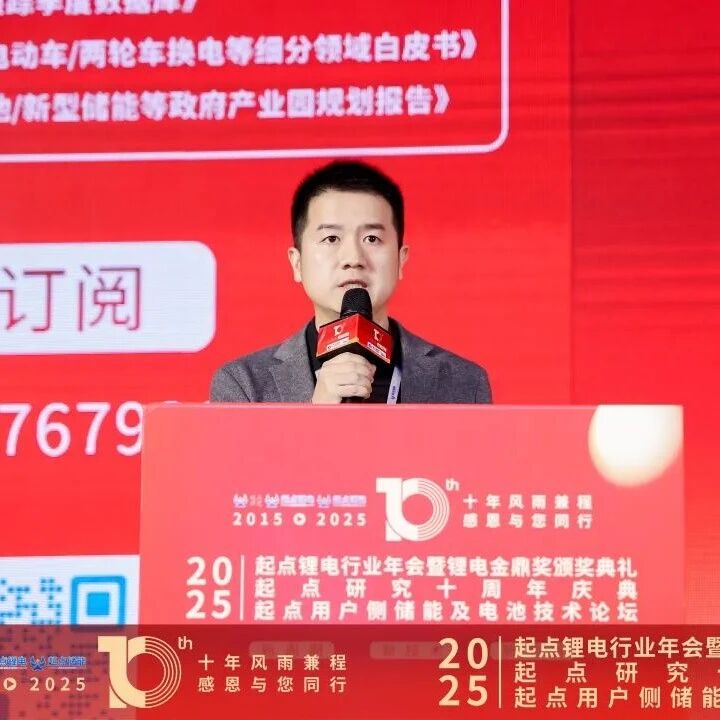
鹏辉能源 研发总监 周琰俊:大电芯 大时代:TWh时代大容量储能电芯的技术底色
起点锂电· 2025-12-19 12:17
Core Viewpoint - The energy storage industry is experiencing rapid growth, with a significant increase in lithium battery installations globally, driven by technological advancements and a shift towards high-value, reliable solutions [6][7][10]. Industry Trends - The global installed capacity of lithium batteries reached 170 GWh by the third quarter of 2025, representing a year-on-year growth of 68%, with domestic growth at 61% and overseas growth at 74% [6]. - Chinese companies have expanded their overseas orders to 163 GWh in the first half of the year, marking a staggering increase of 246% year-on-year, covering over 50 countries [6]. - The industry is transitioning from low-cost competition to a focus on the entire lifecycle value, technological innovation, and reliability [6][7]. Evolution of the Energy Storage Industry - The industry has progressed through three stages: 1. Policy-driven and pilot verification (1.0 era) 2. Initial commercialization and pursuit of economic viability (2.0 era) 3. Scalable development focusing on high-value and reliable solutions (3.0 era) [7]. - The core value proposition has shifted from initial investment costs to a comprehensive pursuit of safety, longevity, efficiency, and simplified operations [8]. Technological Innovations - The next generation of battery cells is essential for overcoming the bottlenecks of large-scale development, aiming to create a safer, smarter, and more durable energy storage system [8][9]. - The focus is on developing larger capacity cells, with advancements from 280 Ah to 314 Ah, and future expectations for even larger capacities, enhancing system capacity from 3.44 MWh to over 6 MWh [8]. - The introduction of large cells aims to reduce complexity and potential failure points associated with smaller cells, thereby improving overall system reliability [8][9]. Safety and Reliability Concerns - Thermal runaway risks remain a significant concern as project scales increase, with potential impacts and economic losses growing exponentially [9]. - The market demands high cycle life and efficiency across various extreme environments, necessitating differentiated performance and reliability from traditional battery solutions [10]. Company Innovations - Penghui Energy has developed the "Fengpeng" large cell technology, emphasizing reliability and efficiency as key attributes [11][12]. - The company employs a three-tiered protection strategy for safety, including: 1. Nano-shield technology to prevent thermal runaway [13]. 2. Gel flame-retardant electrolyte technology [14]. 3. Honeycomb carbon cooling technology for efficient heat management [14]. - The Fengpeng 587 Ah battery has been tested for safety and achieved a cycle life of 10,000 cycles at room temperature, setting a new standard for the next generation of energy storage systems [18].