
龙纹盘

Search documents
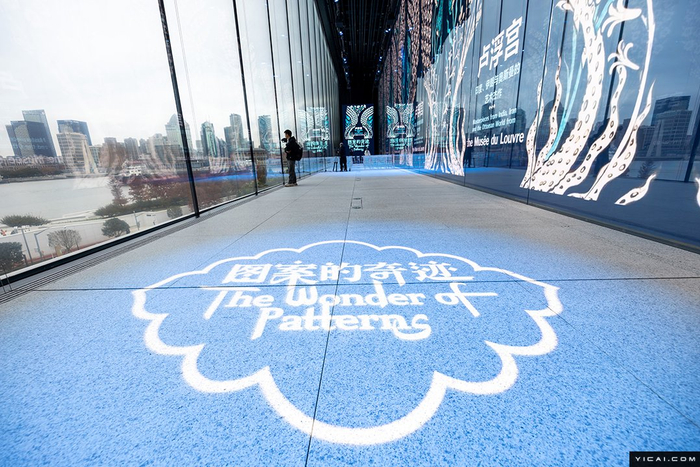
“图案的奇迹”卢浮宫大展开幕 汇聚约300件来自16至19世纪珍品
Di Yi Cai Jing· 2025-12-14 13:19
Core Insights - The exhibition "The Miracles of Patterns: Masterpieces of Indian, Iranian, and Ottoman Art from the Louvre" opened on December 13, 2025, at the Pudong Art Museum, marking the Louvre's debut in Shanghai. It features approximately 300 artifacts from the 16th to 19th centuries, showcasing a variety of mediums including ceramics, jewelry, jade, metalwork, carpets, calligraphy, painting, and sculpture, offering an immersive experience that highlights the cultural convergence of Asia, Africa, and Europe [2] Group 1 - The exhibition design emphasizes luxury and intricacy, with the Indian section characterized by soft reddish tones reminiscent of local sandstone, featuring items like a brass and silver armillary sphere that illustrate the Indian style from the 16th to 19th centuries [6] - The Iranian section transitions from warm red to deep blue-purple tones, showcasing the Safavid dynasty's influence, where increased trade and mass production significantly boosted artistic creation [12] - The Ottoman section is presented in deep navy blue, featuring artifacts such as a Turkish hanging lamp from around 1510, reflecting the empire's aesthetic trends [15] Group 2 - The exhibition includes a segment titled "From Damascus to Cairo," which features traditional wooden lattice windows and geometric patterned wooden doors, showcasing local traditions while also reflecting new aesthetic trends in the Ottoman Empire [19][20]

龙纹盘配色:飞龙在天,异彩纷呈
Jing Ji Guan Cha Bao· 2025-11-27 07:07
Core Viewpoint - The article discusses the historical evolution and artistic significance of dragon-patterned plates in Chinese ceramics, highlighting their diverse styles and color schemes across different dynasties. Group 1: Historical Development - The dragon pattern has been a widely used decorative motif in Chinese ceramics since at least the Northern and Southern Dynasties, becoming more common during the Tang Dynasty [1] - The Song Dynasty marked a significant development period for dragon-patterned ceramics, with notable kilns such as Guan, Ge, Ru, Ding, and Jun producing distinct styles characterized by fresh and elegant glazes [1] - The Yuan Dynasty primarily featured blue-and-white dragon patterns, while the Ming Dynasty saw the creation of various colorful styles, including Doucai and Wucai [1] - The Qing Dynasty achieved major breakthroughs in color porcelain techniques, with the late Kangxi period introducing Famille Rose and the Yongzheng period seeing the maturation of this style [1] Group 2: Color Schemes - Single Color Systems: - Green: Longquan kiln is famous for its green porcelain, described as "green as jade" [2] - Red: The creation of red glaze can be traced back to the Yuan Dynasty, with the Ming Yongle period achieving a peak in the production of pure red glaze [3] Group 3: Color Combinations - Two-Color Combinations: - White + Blue: The beauty of blue-and-white porcelain is noted for its serene elegance [4] - White + Green: The combination of white glaze with green decorations creates an elegant and tranquil effect [5] - White + Red: The contrast of red patterns on a white base is striking and eye-catching [6] Group 4: Multi-Color Techniques - Doucai: This technique combines underglaze blue with overglaze colors, resulting in vibrant and intricate designs [10] - Wucai: Emerging during the Ming Dynasty, this style features a combination of red, yellow, green, purple, and blue, characterized by strong color contrasts and clear lines [11] - Famille Rose: Developed in the late Kangxi period, this technique uses a variety of colors to create rich and detailed patterns [12]