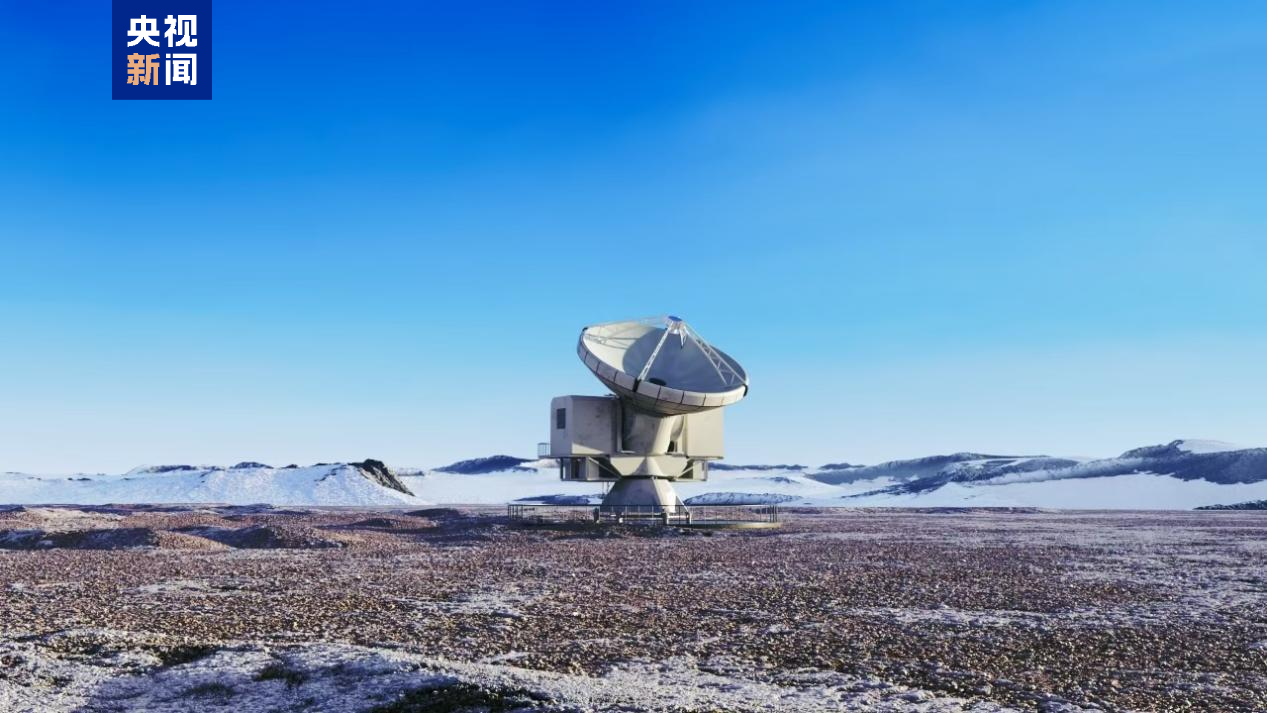
15米口径亚毫米波望远镜(XSMT)

Search documents
中国首台15米口径亚毫米波望远镜启动建设
Zhong Guo Xin Wen Wang· 2025-09-21 00:50
Core Viewpoint - The construction of China's first self-developed 15-meter diameter submillimeter wave telescope (XSMT) has officially commenced in Delingha, Qinghai Province, aiming for completion by 2027, which will position China at the forefront of submillimeter astronomy with an internationally advanced telescope [1] Group 1: Project Overview - The XSMT is led by the Purple Mountain Observatory of the Chinese Academy of Sciences and features a high-precision antenna panel capable of supporting high-frequency submillimeter wave observations [1] - The telescope is equipped with advanced scientific instruments, including a large-field multi-color camera, a three-band superheterodyne receiver, and a 460GHz multi-beam receiver, enabling wideband, wide-field, and high-sensitivity observations [1] Group 2: Scientific Significance - The submillimeter wave range, defined as electromagnetic waves with wavelengths between 0.1 to 1 millimeter, reveals phenomena not visible in the optical and near-infrared spectrum, such as the movement of interstellar dust, distribution of molecular gas, and the birth and growth of stars [1] - The development of this telescope addresses a significant gap in China's astronomical capabilities, particularly in the submillimeter wave domain [1]
我国首台15米口径亚毫米波望远镜启动建设
Yang Shi Xin Wen· 2025-09-20 03:09
Core Viewpoint - The construction of China's first self-developed 15-meter diameter submillimeter wave telescope (XSMT) has officially commenced, aimed at enhancing the country's capabilities in astronomical observation and research [1][5]. Group 1: Telescope Specifications and Features - The XSMT features a 15-meter diameter high-precision antenna panel, supporting high-frequency submillimeter wave observations [1]. - It is equipped with advanced scientific instruments, including a large field multi-color camera, a three-band superheterodyne receiver, and a 460GHz multi-beam receiver, enabling wideband, broad field, and high-sensitivity observations [1]. Group 2: Importance of Submillimeter Wave Observations - Submillimeter waves, with wavelengths between 0.1 to 1 millimeter, reveal cosmic secrets that are invisible to visible light and near-infrared observations, such as the movement of interstellar dust, distribution of molecular gas, and the birth and growth of stars [2]. - Traditional visible light telescopes struggle to penetrate cosmic dust, while submillimeter wave observations can uncover the laws of galaxy formation and evolution, as well as trace the origins of life-related molecules, playing a crucial role in studying the formation of stars and planets [2]. Group 3: Strategic Significance and Future Impact - The establishment of the XSMT addresses the historical weakness in China's submillimeter wave astronomical observation capabilities, filling a significant gap in the country's observational facilities [5]. - Once operational, the telescope is expected to drive breakthroughs in fields such as galaxy formation and evolution, galactic structure, interstellar chemistry, and time-domain astronomy, and will serve as a platform for interdisciplinary applications in atmospheric science and large-capacity space-ground communication [7].