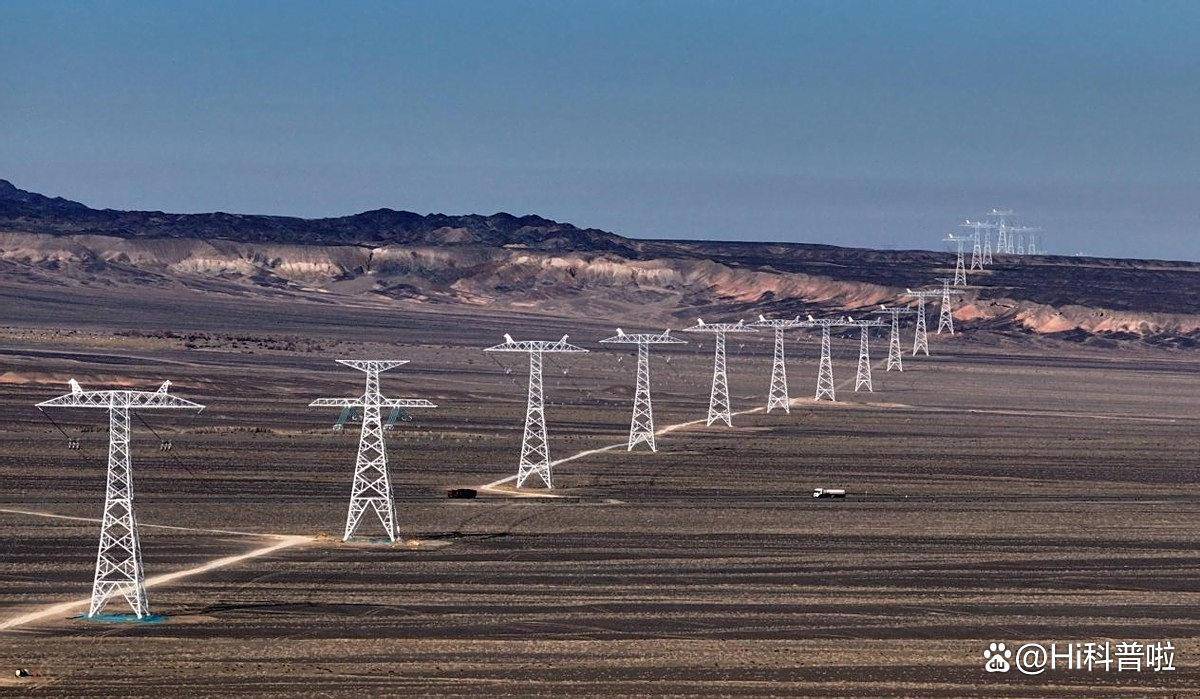
750千伏超高压环网工程

Search documents
中国最大750千伏超高压环网工程投运
Zhong Guo Xin Wen Wang· 2025-10-30 20:46
Core Viewpoint - The completion and operation of the Hetian-Minfu-Qiemu-Ruoqiang 750 kV power transmission and transformation project marks the establishment of China's largest 750 kV ultra-high voltage ring network, significantly enhancing the power supply and renewable energy transmission capabilities in Xinjiang [1] Investment and Construction Details - The project involved a dynamic investment of 4.736 billion RMB, including the construction of two new 750 kV substations in Minfu and Qiemu, and the expansion of two existing substations in Hetian and Ruoqiang [1] - A total of 900 kilometers of 750 kV lines were built, making it the largest ultra-high voltage transmission project constructed in a single phase during Xinjiang's 14th Five-Year Plan [1] Engineering Challenges and Achievements - The project is part of the Xinjiang Tarim Basin 750 kV power transmission and transformation project, which consists of nine 750 kV projects completed in phases over a 15-year period, with a total ring length of 4,197 kilometers [1] - The construction faced various challenges, including working in desert, Gobi, mountainous, and river environments [1] Impact on Power Supply and Renewable Energy - The operation of the project ends the long-chain power supply pattern in southern Xinjiang, creating a hub-type backbone network that connects the north to the south and the west to the east [1] - The maximum power supply capacity is increased from 800,000 kW to 1,000,000 kW, and the renewable energy absorption capacity is enhanced by an additional 8 million kW [1] - This project not only improves the internal power supply but also strengthens the external transmission channels, significantly boosting Xinjiang's capacity to export green energy and facilitating the conversion of energy advantages into economic benefits [1]
欧洲电力危机,新疆特高压0.01秒连通中国,15年布局展现战略眼光
Sou Hu Cai Jing· 2025-08-14 22:21
Core Insights - The article highlights China's successful energy strategy, exemplified by the completion of the 750 kV ultra-high voltage ring network project, which ensures 24-hour electricity supply across the nation, contrasting sharply with the massive power outages experienced in parts of Europe [1][17]. Group 1: Project Overview - The 750 kV ring network spans 4,197 kilometers and represents an investment of over 100 billion yuan, marking a significant milestone in China's energy infrastructure [1][4]. - The construction faced extreme challenges, particularly in the desert region, where innovative techniques such as spiral anchor foundations and rapid construction methods were developed to overcome environmental obstacles [4][5]. Group 2: Economic Impact - The project is expected to generate substantial economic benefits, with local areas like Qemant County projected to receive 200-300 million yuan annually from electricity exports alone [7]. - The region's industrial electricity prices are significantly lower than many inland areas, providing a competitive advantage for businesses and potentially saving them over 100 million yuan in costs each year [7]. Group 3: Resource Development - The Taklamakan Desert is rich in natural resources, including over 5,600 billion cubic meters of shale gas and various minerals, which were previously untapped due to lack of electricity [9]. - The completion of the power grid is anticipated to unlock these resources, transforming them into economic assets [9]. Group 4: Strategic Importance - Xinjiang's geographical position as a transportation hub enhances its potential as a key player in connecting Asia and Europe, supported by the robust energy infrastructure [11]. - The ±1100 kV ultra-high voltage direct current project, known as the "Electricity Everest," further strengthens this connectivity, allowing rapid electricity transmission across vast distances [13][15]. Group 5: Technological Advancements - The ±1100 kV project showcases China's technological prowess, being the only one of its kind globally, and is entirely developed with domestic technology, positioning China as a leader in energy technology [15][17]. - The project is capable of transmitting 2.55 billion kilowatt-hours daily, significantly contributing to carbon emission reductions [13]. Group 6: Energy Security - The contrasting energy strategies between Europe and China highlight the effectiveness of China's diversified energy supply system, which enhances national energy security and resilience against external shocks [17][20]. - The successful implementation of these projects demonstrates China's commitment to energy independence and its potential to serve as a model for global energy transformation [20].