AI皮肤科影像系统

Search documents
行业聚焦:全球AI 皮肤科影像系统市场规模及主要企业排名情况
QYResearch· 2026-03-09 01:57
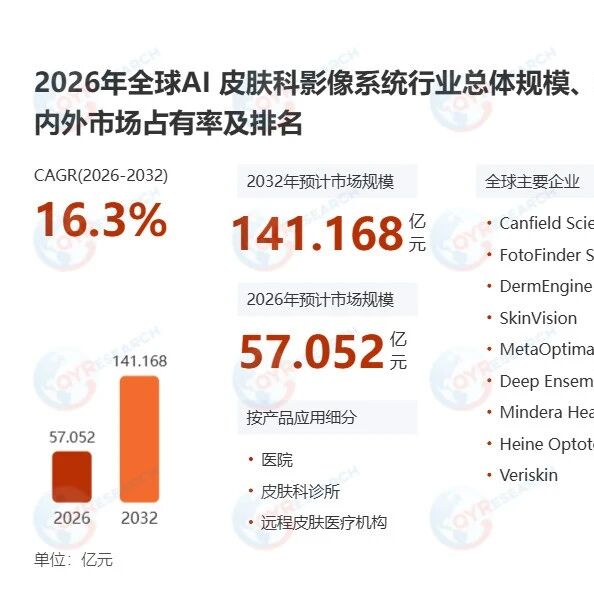
Core Viewpoint - The article discusses the development and market potential of AI dermatology imaging systems, highlighting their role in enhancing skin disease diagnosis and management through advanced imaging and AI algorithms [2][12]. Group 1: Industry Chain Analysis - The upstream of AI dermatology imaging systems includes high-resolution camera modules, dermatoscopes, light source systems, and data annotation resources, which are essential for image quality and algorithm accuracy [2][3]. - The midstream focuses on integrating imaging devices with AI algorithms to create clinically applicable systems, which require compliance with medical device regulations [4][5]. - The downstream applications encompass hospitals, primary healthcare institutions, health check centers, aesthetic medical institutions, and telemedicine platforms, addressing the need for early skin cancer screening and risk assessment [6][8][9]. Group 2: Global Market Size and Structure - According to QYResearch, the global market for AI dermatology imaging systems is projected to reach 4.873 billion yuan by 2025 and 14.12 billion yuan by 2032, with a compound annual growth rate (CAGR) of 16.3% from 2026 to 2032 [12][27]. Group 3: Development Trends, Opportunities, and Challenges - The technology is evolving towards higher precision and multi-modal integration, enhancing predictive accuracy through the combination of various data types [14][15]. - The increasing incidence of skin cancer and the demand for early screening present stable market opportunities, alongside the digitalization of primary healthcare and telemedicine support [16][17]. - The industry faces challenges such as stringent regulatory requirements, the need for extensive clinical validation, and the necessity for continuous data updates and model optimization [18][19][20]. Group 4: Downstream Analysis - In hospital systems, AI dermatology imaging systems serve as auxiliary diagnostic tools to improve screening efficiency, while primary healthcare institutions prioritize ease of use and affordability [21]. - Aesthetic medical institutions focus on image comparison and visual presentation to enhance client communication, and telemedicine platforms expand accessibility for initial skin screenings [22]. Group 5: Industry Entry Barriers - Entry barriers in the AI dermatology imaging system industry stem from the accumulation of data resources, algorithm capabilities, and compliance with medical regulations, with high costs associated with obtaining quality annotated data [23][24]. - Continuous optimization of algorithm performance and lengthy regulatory approval processes contribute to high entry costs, while brand trust and clinical reputation are critical for market expansion [25][26].