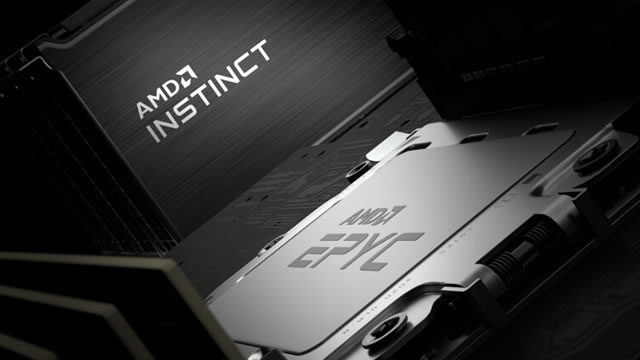
AMD MI350 series

Search documents
How AMD Stock Can Crash
Forbes· 2025-10-29 15:35
Core Insights - Advanced Micro Devices (AMD) has a history of significant stock volatility, with declines exceeding 30% occurring 14 times over multiple years, resulting in billions lost in market value [1] - The company faces intense competition, particularly from NVIDIA, which is projected to hold 80-90% of the AI compute chip market share through 2025 [6] Financial Performance - AMD's stock has experienced severe downturns in past market crises, including an 83% drop during the Dot-Com crash and a nearly 92% decline during the Global Financial Crisis [5] - The company reported a revenue growth of 27.2% over the last twelve months (LTM) and an average growth of 11.7% over the past three years [6] - AMD's free cash flow margin stands at nearly 13.7%, with an operating margin of 8.3% LTM [6] - The stock is currently valued at a P/E ratio of 147.8, indicating a higher valuation compared to the S&P [6] Market Dynamics - ARM-based servers are expected to capture 21.1% of global shipments by 2025, with Qualcomm's Snapdragon X chips already holding 10% of the high-end Windows PC market [6] - Intel maintains a strong position in client CPUs with approximately 75.7% market share overall and 79.7% in mobile CPUs, despite AMD's desktop share increasing to 32.2% by Q2 2025 [6] Risk Factors - Market volatility can lead to stock declines even in favorable conditions, influenced by earnings announcements and business updates [7] - Historical data indicates that major market selloffs have had a dramatic impact on AMD's stock performance, despite positive growth factors [5]


AMD's AI Moment May Be Coming. Will It Seize It?
Forbes· 2025-06-26 11:35
Group 1: AMD's Market Position and Stock Performance - AMD's stock rose nearly 7% during recent trading and approximately 15% year-to-date, driven by growing investor confidence in its role in the AI chip market [2] - The AI semiconductor industry is expanding rapidly, with Nvidia dominating the market and more than doubling its revenue over the last two years, while AMD focuses on increasing GPU sales rather than surpassing Nvidia [2][3] Group 2: AI Market Dynamics - The AI market has seen significant investments from major tech companies, focusing on performance and training speed for large language models, which has favored Nvidia due to its leading chips and established ecosystem [3] - There is a potential plateau in the rapid enhancements of frontier AI models, leading to a shift towards inference workloads where efficiency and cost become more critical [3] Group 3: Opportunities for AMD - AMD may benefit as not all organizations can afford Nvidia's premium GPUs, leading some to opt for older Nvidia models or AMD's more budget-friendly MI series, which are suitable for inference tasks [4] - The introduction of open-source models like Llama from Meta could enable companies to run AI workloads on-site, reducing reliance on expensive cloud computing, which may also favor AMD [4] Group 4: AMD's Product Developments - At its AI Day event, AMD announced the MI350 series, launching in the second half of 2025, which promises four times the AI compute capacity of its predecessor, along with previews of the MI400 and MI450 chips [5] - AMD is enhancing its AI software and systems stack through acquisitions, positioning itself as a comprehensive AI provider, contrasting with Nvidia's proprietary environment [5] Group 5: Strategic Partnerships - AMD's partnership with Oracle aims to make its MI355X GPUs available through Oracle Cloud Infrastructure, offering over two times the price-performance advantage for large-scale AI tasks [6] Group 6: Competitive Landscape - Cloud providers like Google and Amazon are developing their own custom AI chips, which may limit long-term demand for third-party hardware solutions, while Nvidia may focus on more efficient mid-tier chips as the market shifts [6][7]