
After Effects

Search documents
两周内你能学会任何东西
虎嗅APP· 2026-03-05 11:09
Core Viewpoint - The article emphasizes that individuals can learn any skill or knowledge necessary to achieve specific goals within a short time frame, rather than spending excessive hours on traditional learning methods that yield little practical application [2][3]. Group 1: Learning Efficiency - Most time spent on learning is wasted due to traditional educational methods that do not focus on practical application [3]. - Learning should be approached by identifying specific skills and techniques rather than attempting to master an entire skill at once [7][10]. - Skills are composed of techniques, and by focusing on these individual components, one can achieve mastery more efficiently [5][12]. Group 2: Practical Application - The process of learning should start with a clear goal, such as playing a specific song on the guitar, and then identifying the necessary techniques to achieve that goal [9][10]. - For creative tasks like using Photoshop, the focus should be on completing a specific project rather than learning every tool available [11][12]. - The accumulation of techniques leads to a more effective learning process, allowing for the creation of desired outcomes without unnecessary knowledge [12]. Group 3: Mental Framework - Skills are formed through repeated practice, creating neural pathways that facilitate learning [14]. - The ability to earn money is viewed as a skill that can be learned, requiring a focus on actionable steps rather than abstract concepts [15][16]. - The concept of "progressive overload" is introduced, suggesting that gradual increases in challenge lead to skill improvement [17]. Group 4: Focus and Pressure - Pure focus is essential for rapid learning, where distractions are eliminated, allowing for complete immersion in the task [20]. - "Tactical pressure" is a method to create a high-stakes environment that compels individuals to learn quickly and effectively [21]. - By placing oneself in challenging situations, individuals can accelerate their learning process and achieve significant goals [21].


Adobe Stock: Is ADBE Underperforming the Technology Sector?
Yahoo Finance· 2026-02-25 14:30
Core Viewpoint - Adobe Inc. is facing significant challenges in the market, particularly due to competition and concerns over AI disruption, leading to underperformance compared to its sector [2][5][6]. Company Overview - Adobe Inc. is a leading software company specializing in digital media, creative tools, and marketing solutions, with a market capitalization of $101.26 billion [1]. Stock Performance - The stock reached a 52-week low of $244.28 on February 24 and has since increased by 4.5%, but is down 19.9% over the past three months, underperforming the broader technology sector [2][5]. - Over the past 52 weeks, Adobe's stock has dropped 42.6%, and it is down 27.1% year-to-date (YTD), while the Technology Select Sector ETF has gained 21.2% over the same period [5][8]. Competitive Landscape - Adobe's stock dropped 4.6% intraday on February 23 following competitor Canva's acquisition of two startups, indicating increased competition in the market [6]. - Despite fears of AI disruption, Adobe continues to invest in key areas, suggesting potential for a comeback [6]. Financial Performance - In the fourth quarter of fiscal 2025, Adobe's revenue grew by 10.5% year-over-year to a record $6.19 billion, exceeding analysts' expectations [7]. - Analysts expect Adobe's profit for the first quarter of fiscal 2026 to grow by 13.3% year-over-year to $4.85 per diluted share [7]. Comparative Analysis - Compared to Autodesk, which has declined 22.6% over the past 52 weeks and 25.4% YTD, Adobe has been the clear underperformer [8].

As Wall Street punishes software stocks over AI concerns, Canva gets more acquisitive
CNBC· 2026-02-24 03:01
Core Insights - Software stocks, including design software, have faced significant declines due to concerns over artificial intelligence impacts, with Adobe's stock down 30% this year [1] - Canva is actively acquiring startups to enhance its competitive position against Adobe, purchasing Cavalry and MangoAI to bolster its animation and video capabilities [2] Company Developments - Canva has acquired Cavalry, which specializes in two-dimensional animation software, and MangoAI, which focuses on short video creation for advertising [2] - The terms of the acquisitions were not disclosed, but both startups are expected to help Canva compete more effectively with Adobe [2] Product Integration - Canva plans to integrate Cavalry's animation technology into its core product and the Affinity application, which was made free after its acquisition in 2024 [4] - MangoAI will be incorporated into the Canva Grow advertisement generator, which is available at $250 per person per year, enhancing video performance tracking and recommendations [5] Market Position and Financials - Canva reported over $4 billion in annualized revenue for 2025, a 36% increase from the previous year, while Adobe's revenue for the November quarter was $6.2 billion, up 10% [7] - Canva's market valuation was noted at $42 billion in August, prior to the recent downturn in software stock prices [7] AI and User Experience - Canva's co-founder emphasized the importance of human input in content creation, stating that while AI can assist, the final touches that ensure brand representation are crucial [8] - The company has not experienced a slowdown in revenue or user growth, attributing improvements in product quality to the integration of AI [9]

Adobe 连夜认怂!前几天官宣关停 Animate 遭大量吐槽
程序员的那些事· 2026-02-05 10:29
Core Viewpoint - Adobe announced the discontinuation of its 25-year-old Animate animation tool, which was met with significant backlash from users, leading to a rapid reversal of the decision and highlighting the company's aggressive pivot towards AI products while neglecting user needs [1]. Group 1: Announcement and User Reaction - On February 2, Adobe declared it would shut down Animate, ceasing sales on March 1, with support for regular users until 2027 and enterprise users until 2029, without a direct replacement [1] - The decision sparked outrage among users who feared losing years of work and experience, criticizing Adobe for prioritizing AI over user needs and calling for the software to be open-sourced [1]. Group 2: Reversal of Decision - Following the user protests, Adobe quickly retracted its shutdown plan on February 4, confirming that Animate would continue to serve both new and existing users, providing technical support and security updates, but would not develop new features [1]. - This incident underscores the importance of user feedback in corporate decision-making, as Adobe's initial plan was ultimately abandoned due to the strong collective response from its user base [1].

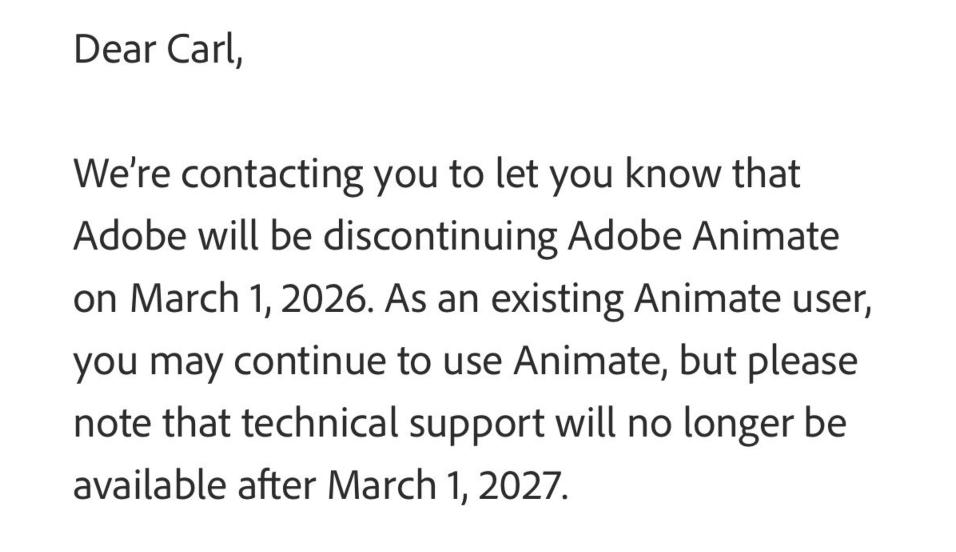
猝不及防,Adobe关停2D动画软件Animate拥抱AI,最惨学生:一学期的课白上了
3 6 Ke· 2026-02-03 10:02
Core Viewpoint - Adobe has announced the discontinuation of Adobe Animate, a 2D animation software that has been in use for over 25 years, primarily due to a shift in focus towards AI technologies [8][19]. Group 1: Announcement and User Reactions - Adobe officially notified users that sales of Adobe Animate will cease on March 1, 2026, leading to widespread disbelief and anger among users, particularly those who have recently invested time in learning the software [3][8]. - Long-time users expressed frustration over Adobe's lack of communication and support for Animate, feeling betrayed by the sudden decision [5][17]. - The decision has significant implications for various professionals, including web animators, game developers, and independent creators who rely on Animate for their work [10][12]. Group 2: Reasons for Discontinuation - The primary reason cited for the discontinuation is Adobe's strategic pivot towards AI, with the company focusing on developing AI-driven tools across its product suite [19]. - Despite the software's historical significance and continued use, Adobe has not developed a suitable replacement that matches the capabilities of Animate, particularly in terms of frame-by-frame animation control [19][20]. Group 3: User Concerns and Alternatives - Users are concerned about the lack of a viable alternative, as transitioning to other software like Toon Boom involves high migration costs and a steep learning curve [11][12]. - Adobe's proposed solutions for users include using other Adobe applications to replicate some of Animate's functionalities, which many users find inadequate [14][19]. - The abrupt nature of the announcement and the absence of a clear transition plan have left users feeling unsupported and frustrated [17][19]. Group 4: Historical Context and Legacy - Adobe Animate, originally launched as FutureSplash Animator in 1996, played a crucial role in transforming the internet by enabling rich multimedia content [20][25]. - The software's legacy includes significant contributions to independent animation and web gaming, despite its decline in recent years [29].
猝不及防,Adobe关停2D动画软件Animate拥抱AI!最惨学生:一学期的课白上了
量子位· 2026-02-03 07:45
Core Viewpoint - Adobe has announced the discontinuation of Adobe Animate, a 2D animation software that has been in use for over 25 years, primarily due to a shift in focus towards AI technologies [10][38]. Group 1: Announcement and User Reactions - Adobe officially notified users that sales of Adobe Animate will cease on March 1, 2026, with varying support timelines for enterprise and individual users [10][19]. - The announcement has led to widespread disbelief and frustration among users, particularly those who have invested time in learning the software [3][5]. - Many users feel abandoned, citing a lack of communication and a suitable alternative from Adobe [28][29]. Group 2: Impact on Users and Industry - Despite its decline, Adobe Animate remains essential for many web animators, game developers, and content creators, with some users stating it is irreplaceable [11][13]. - The transition to alternative software, such as Toon Boom, is complicated by high migration costs and the need to relearn workflows [16][17]. - Users express concerns that Adobe's decision will negatively impact their work quality and existing projects [12][46]. Group 3: Adobe's Strategic Shift - Adobe's rationale for discontinuing Animate centers around the advancement of technology and a strategic pivot towards AI-driven tools [37][38]. - The company has been focusing on integrating AI features across its applications, which has led to the neglect of Animate [39][41]. - Critics argue that the decision to shut down Animate reflects a broader trend of prioritizing new technologies over established products, even when those products still have a dedicated user base [44][46]. Group 4: Historical Context and Legacy - Adobe Animate, originally launched as FutureSplash Animator in 1996, played a significant role in transforming the internet by enabling rich multimedia content [48][50]. - At its peak, Flash Player was installed on over 98% of computers, making it a cornerstone of web animation and independent game development [52][54]. - Despite its historical significance, Animate has struggled to adapt to modern demands, leading to its eventual phase-out [62][67].

静谧高效,适合工作室环境的5款i5创作主机
Xin Lang Cai Jing· 2026-01-07 01:46
Core Insights - The article emphasizes the importance of powerful desktop computers for creative professionals, highlighting the growing preference for systems equipped with Intel's 13th and 14th generation Core i5 processors due to their excellent multi-core performance and platform compatibility [1][5][9] Group 1: Product Highlights - Dell's Vostro 3030S 2024 model, priced at 3699 yuan, features an i5-14400 processor with 10 cores and 16 threads, reaching a maximum turbo frequency of 4.7GHz, making it a cost-effective choice for entry-level creators [6][7] - Lenovo's GeekPro with an i5-14400F processor, priced at 6899 yuan, is designed for graphic-intensive tasks, equipped with an RTX 3050 GPU, enhancing rendering and video export capabilities [2][7] - HP's Pro Tower 288 G9 E, priced at 6299 yuan, is marketed for business use but offers superior performance with an i7-14700 processor and RTX 4060 GPU, suitable for high-load tasks [2][8] - Lenovo's Yangtian M4000q, priced at 4399 yuan, features an i5-10400 processor and is suitable for basic design tasks, offering practical value despite being based on an older platform [4][8] - Dell's Pro Tower QCT1250, priced at 3500 yuan, supports DDR5 memory and offers significant upgrade potential, making it ideal for compact workspaces [4][9] Group 2: Market Positioning - The five featured Core i5 desktop models range from 3500 to 7000 yuan, catering to various needs from budget-conscious users to those requiring enhanced graphics performance [5][9] - All highlighted models share common traits of strong stability, comprehensive connectivity, and support for long-term use, effectively serving the creative process [5][9]
Adobe财报前瞻:目前“最佳”的机会
美股研究社· 2025-12-09 10:53
Core Viewpoint - Both Adobe and Salesforce have lost favor on Wall Street, yet their fundamentals continue to strengthen, presenting a dilemma: they could either be the most attractive stocks in the software sector or companies in decline whose downturn has not yet reflected in financial data [1]. Adobe Financial Performance - Adobe is set to release its Q4 FY2025 earnings report on December 10, which will provide insights into its performance for the fiscal year and expectations for the next fiscal year [3]. - The company's success over the past decade is attributed to its transition to a subscription-based business model, with nearly 97% of revenue coming from subscriptions. The revenue breakdown includes approximately 74% from digital media, 25% from digital experience, and 1% from publishing and advertising [4]. - For FY2024, Adobe's revenue target is set at no less than $23.65 billion, with expectations of quarterly revenue surpassing $6 billion for the first time [4][7]. - The projected net profit margin for the current fiscal year is expected to exceed 30%, with earnings per share (EPS) estimated between $16.53 and $16.58, leading to a trailing P/E ratio of approximately 20.5 [4][7]. Revenue Guidance and Growth - Adobe's revenue guidance has been consistently raised throughout the year, with the latest targets exceeding earlier projections made in March [8]. - Over the past decade, Adobe's core financial metrics have shown steady improvement, with no signs of adverse impacts from AI on its business. The average annual revenue growth rate for its products from 2021 to 2024 is projected to be no less than 12%, with Document Cloud experiencing a compound annual growth rate of 23% [8]. AI Integration and Market Perception - Concerns about AI disrupting Adobe's business model may be overstated, as the management has emphasized that AI presents significant growth opportunities [10]. - Adobe's professional user base requires high-quality tools, and while AI can enhance content production efficiency, it also increases the demand for post-processing, which could drive growth for Adobe [10][11]. - The integration of AI into Adobe's core products, such as Photoshop and Illustrator, is being executed through Adobe Firefly, which uses authorized datasets to mitigate legal risks [11]. - The adoption of AI features has led to a 70% penetration rate among eligible customers using Adobe Experience Platform's AI assistant, indicating that AI is becoming a growth driver rather than a threat [13][14]. Valuation and Stock Buyback - Adobe's current P/E ratio stands at 20, with a forward PEG ratio of 1.16, suggesting it is undervalued compared to typical tech valuations. The forward EV/EBITDA ratio is 12.4, and the forward P/FCF ratio is 15.34 [14]. - If Adobe maintains a 12% net profit growth rate, its forward P/E could drop to 14.9 by 2026, indicating a valuation more typical of industrial companies despite its tech-level profitability [15]. - The company has been actively repurchasing shares, with a total buyback of nearly $12 billion over the past four quarters, reflecting confidence in its undervalued stock [15][16]. Investment Outlook - Analysts view Adobe as an attractive investment opportunity, likely to yield substantial returns in the coming years, as the divergence between market narratives and the company's fundamentals becomes more pronounced [18]. - A comparison is drawn to Google's previous undervaluation, suggesting a similar turnaround could occur for Adobe by 2026 [19].

Down 27%, Should You Buy Adobe Stock Before Dec. 10?
The Motley Fool· 2025-12-07 16:15
Core Viewpoint - Adobe's stock is experiencing significant downward pressure, with a year-to-date decline of approximately 27%, raising concerns about its future in the AI landscape despite strong earnings and cash flow [2][8]. Company Overview - Adobe has transitioned from traditional software licensing to a software as a service (SaaS) model, becoming a pioneer in this space [4]. - The company has successfully bundled its applications into a subscription package known as Creative Cloud, which has become a standard in various sectors [5]. Financial Performance - Adobe has achieved all-time-high earnings and free cash flow (FCF), yet its stock price has decreased over the last five years [8]. - The stock is currently trading at 20.4 times earnings and 14 times forward earnings, making it the cheapest it has been in over a decade, significantly below the S&P 500's forward price-to-earnings ratio of 23.6 [14]. Market Sentiment - Investor sentiment is currently negative, focusing on concerns about Adobe's leadership in AI and the potential erosion of its competitive advantages due to generative AI tools [9][10]. - The stock's decline mirrors past sell-offs of companies like Apple and Alphabet, which later rebounded after proving their critics wrong [11][12]. Future Outlook - If Adobe can effectively implement and monetize AI tools, it could lead to a recovery in its stock price, despite potential subscriber losses [13]. - The company has been actively buying back shares, reducing its share count by 12.4% over the last five years, which supports its stock price [15]. - Adobe's balance sheet remains strong, with only $260 million in long-term debt net of cash and equivalents [16]. Earnings Report Expectations - Adobe is set to report earnings on December 10, and investors are advised to look for concrete evidence of how the company is monetizing AI rather than just optimistic statements from management [20].

Adobe(ADBE) - 2025 Q3 - Earnings Call Transcript
2025-09-11 22:02
Financial Data and Key Metrics Changes - Adobe achieved record revenue of $5.99 billion in Q3 FY25, representing a 10% year-over-year growth [4][29] - GAAP earnings per share for the quarter was $4.18, and non-GAAP earnings per share was $5.31, reflecting 11% and 14% year-over-year growth respectively [29] - Cash flows from operations reached a record $2.20 billion for Q3 [30] - Remaining performance obligations were $20.44 billion, growing 13% year-over-year [30] Business Line Data and Key Metrics Changes - Digital Media revenue was $4.46 billion, growing 11% year-over-year, with ending ARR of $18.59 billion, up 11.7% year-over-year [11][30] - Digital Experience revenue was $1.48 billion, with subscription revenue of $1.37 billion, representing 11% year-over-year growth [22][33] - AI-influenced ARR surpassed $5 billion, with significant contributions from Firefly, Acrobat AI Assistant, and Gen Studio for Performance Marketing [10][29] Market Data and Key Metrics Changes - The adoption of Adobe Experience Platform AI Assistant reached 70% among eligible customers [8][27] - Monthly active users of Acrobat and Express grew approximately 25% year-over-year [31] - Over 14,000 organizations added Express in Q3, a 4x increase compared to the previous year [15] Company Strategy and Development Direction - Adobe's strategy focuses on integrating AI across its applications to enhance value and deliver innovative products [4][10] - The company aims to be the operating system for creative work, combining creativity and marketing solutions [7][10] - Adobe is positioned to help businesses orchestrate personalized customer experiences through its integrated platform [23][24] Management's Comments on Operating Environment and Future Outlook - Management expressed confidence in Adobe's ability to deliver durable and profitable growth in an AI-first world [38][39] - The company raised its FY25 revenue and EPS targets based on strong momentum and customer adoption of AI-first products [38][39] - The shift in consumer behavior towards LLMs is seen as an opportunity for Adobe to enhance brand visibility and customer engagement [22][24] Other Important Information - Adobe's effective tax rate in Q3 was 19.0% on a GAAP basis and 18.5% on a non-GAAP basis [36] - The company entered into a share repurchase agreement totaling $2.50 billion, with $8.40 billion remaining of its $25 billion authorization [37] Q&A Session Summary Question: Insights on Adobe's video manipulation technology and competitive risks from advertising platforms - Management highlighted the integration of third-party models like Nano Banana into Adobe's applications, emphasizing the unique workflow and control Adobe provides [44][45] - Concerns about competition from advertising platforms were addressed, noting that larger enterprises prefer Adobe for multi-channel campaign management [48][49] Question: Drivers of success in AI-first products - Management noted strong adoption across various AI-first products, including Firefly and Acrobat AI Assistant, contributing to exceeding the $250 million ARR target [52][54] Question: Mix of AI credit usage and internal impact of LLM Optimizer - The majority of AI generation continues to come from Firefly, with increasing usage of third-party models for ideation [58][59] - The LLM Optimizer was tested internally, leading to increased visibility for Adobe's products through LLMs [60][61] Question: Pricing strategy and performance expectations - Management reported strong adoption of Creative Cloud Pro and Firefly, indicating healthy migration and overall strength across the creative business [64][66] Question: Future growth prospects and adaptation to LLMs - Management expressed confidence in the growth of digital media ARR, driven by strong adoption of AI-first products and integrated solutions [68][70]