Alita

Search documents
最新自进化综述!从静态模型到终身进化...
自动驾驶之心· 2025-10-17 00:03
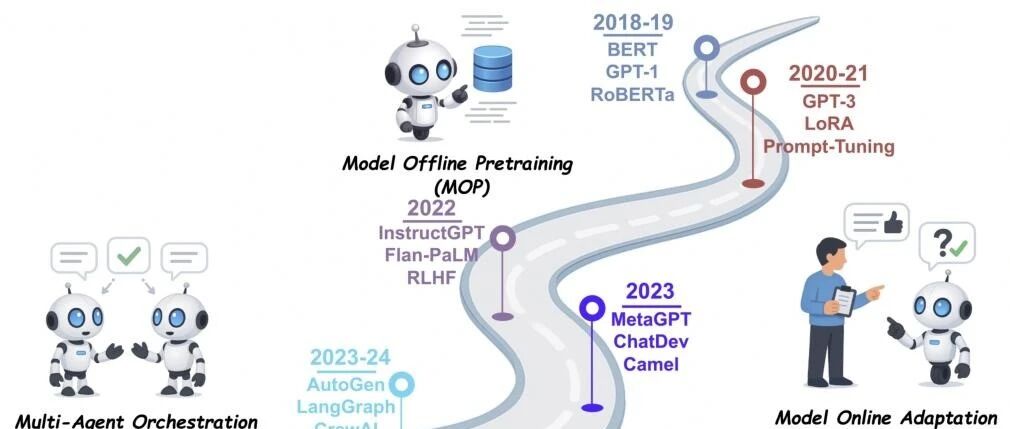
Core Viewpoint - The article discusses the limitations of current AI agents, which rely heavily on static configurations and struggle to adapt to dynamic environments. It introduces the concept of "self-evolving AI agents" as a solution to these challenges, providing a systematic framework for their development and implementation [1][5][6]. Summary by Sections Need for Self-Evolving AI Agents - The rapid development of large language models (LLMs) has shown the potential of AI agents in various fields, but they are fundamentally limited by their dependence on manually designed static configurations [5][6]. Definition and Goals - Self-evolving AI agents are defined as autonomous systems that continuously and systematically optimize their internal components through interaction with their environment, adapting to changes in tasks, context, and resources while ensuring safety and performance [6][12]. Three Laws and Evolution Stages - The article outlines three laws for self-evolving AI agents, inspired by Asimov's laws, which serve as constraints during the design process [8][12]. It also describes a four-stage evolution process for LLM-driven agents, transitioning from static models to self-evolving systems [9]. Four-Component Feedback Loop - A unified technical framework is proposed, consisting of four components: system inputs, agent systems, environments, and optimizers, which work together in a feedback loop to facilitate the evolution of AI agents [10][11]. Technical Framework and Optimization - The article categorizes the optimization of self-evolving AI into three main directions: single-agent optimization, multi-agent optimization, and domain-specific optimization, detailing various techniques and methodologies for each [20][21][30]. Domain-Specific Applications - The paper highlights the application of self-evolving AI in specific fields such as biomedicine, programming, finance, and law, emphasizing the need for tailored approaches to meet the unique challenges of each domain [30][31][33]. Evaluation and Safety - The article discusses the importance of establishing evaluation methods to measure the effectiveness of self-evolving AI and addresses safety concerns associated with their evolution, proposing continuous monitoring and auditing mechanisms [34][40]. Future Challenges and Directions - The article identifies key challenges in the development of self-evolving AI, including balancing safety with evolution efficiency, improving evaluation systems, and enabling cross-domain adaptability [41][42]. Conclusion - The ultimate goal of self-evolving AI agents is to create systems that can collaborate with humans as partners rather than merely executing commands, marking a significant shift in the understanding and application of AI technology [42].

开启 AI 自主进化时代,普林斯顿Alita颠覆传统通用智能体,GAIA榜单引来终章
机器之心· 2025-06-04 09:22
Core Insights - Alita, developed by Princeton University's AI Lab, embodies the philosophy of "simplicity is the ultimate sophistication," focusing on minimal predefined tools and maximizing self-evolution capabilities [1][11]. Performance Metrics - Alita achieved a remarkable 75.15% pass@1 and 87.27% pass@3 in the GAIA validation benchmark, surpassing notable AI systems like OpenAI Deep Research [3][22]. - In specific tests, Alita scored 74.00% in Mathvista and 52.00% in PathVQA, demonstrating superior performance compared to systems with complex tool libraries [22]. Design Philosophy - The core design principle of Alita is to allow the agent to autonomously create MCP tools without relying on predefined settings, addressing limitations of existing systems that depend heavily on predefined tools [5][6]. - Alita's architecture consists of only essential components, including a Manager Agent and a Web Agent, which facilitate dynamic tool creation and self-evolution [13][16]. Challenges Addressed - Existing generalist agents face limitations such as narrow coverage, restricted creativity, and compatibility issues with various tools, which Alita aims to overcome through its innovative design [6][11]. - Alita's approach emphasizes the importance of simplicity in enhancing creativity and flexibility, leading to improved scalability and generalization capabilities [11][30]. Self-Evolution Mechanism - Alita's self-evolution is facilitated by its ability to dynamically generate and optimize MCP tools based on task requirements, allowing for continuous improvement and adaptation [19][26]. - The system includes three core modules: MCP Brainstorming for task analysis, Script Generating Tool for real-time tool creation, and Code Running Tool for testing and optimizing generated tools [17][19]. Future Implications - Alita's success indicates that a simplified design can drive performance improvements, suggesting a shift in focus for future AI development towards enhancing creativity and evolutionary potential rather than expanding tool complexity [30]. - The paradigm of integrating simplicity with self-evolution is expected to be crucial for the next generation of general AI assistants, enabling them to solve problems without predefined workflows [30].