Blackwell Platform

Search documents
专用集成电路(ASIC)的崛起:定制芯片渐成关键趋势-The Rise of ASIC_ Custom Chips Becoming a Key Trend
2025-08-27 15:20
Summary of Key Points from the Conference Call Industry Overview - The conference call discusses the rise of Application-Specific Integrated Circuits (ASICs) in the context of the AI chip revolution, highlighting the increasing trend of custom chip development among major tech companies [1][31]. Key Companies Mentioned - **Nvidia**: Positioned as a leader in the AI chip market, introducing a "one product per year" strategy with notable platforms like the Hopper Platform in 2022 and upcoming platforms such as Blackwell (2024) and Rubin (2026) [5][9]. - **Broadcom**: Dominates the ASIC market with key customers including Google, Meta, and OpenAI, utilizing advanced packaging technologies [48][50]. - **Marvell**: Focuses on SerDes and optical interconnects, transitioning from 224G to 448G SerDes technology, and has a strategic partnership with AWS for ASIC development [58][59]. - **AIchip**: A founding member of TSMC's OIP 3DFabric™ Alliance, competing in high-performance computing and AI accelerator markets [64]. - **Fujitsu**: Actively advancing its 2nm process deployment through the establishment of the Rapidus fab in Hokkaido, Japan [53][54]. - **SMIC**: Noted for its Ascend chip, crucial for China's AI chip development efforts [71]. Core Insights and Arguments - **Custom AI Chips**: The development of custom AI chips is essential for enhancing computing efficiency, reducing reliance on third-party suppliers, and optimizing cost structures [27]. - **Market Dynamics**: The shift towards custom AI chips is reshaping the cloud computing and AI hardware landscape, as companies seek greater performance and control over their infrastructure [33]. - **Technological Advancements**: The transition from TSMC's 3nm to 2nm process is highlighted as a critical inflection point, with increased complexity and costs associated with manufacturing [11][41]. - **Competitive Landscape**: The AI ASIC chip race is intensifying, with key players emerging from the US, Taiwan, Japan, and China, each focusing on different aspects of chip technology [75]. Important but Overlooked Content - **EUV Technology**: TSMC's mastery of EUV (Extreme Ultraviolet) lithography is crucial for advancing logic technology, impacting cost, yield, and performance [23]. - **Fujitsu's Ambition**: Japan's efforts to revive its semiconductor industry post-"lost 30 years" are underscored by its focus on AI and advanced manufacturing capabilities [54]. - **Performance Comparisons**: A comprehensive performance comparison of Huawei's Ascend 910 series against mainstream AI chips indicates the competitive landscape's complexity and the impact of export restrictions on China's chip development [76]. Future Outlook - The conference emphasizes the importance of monitoring both technological advancements and geopolitical shifts to understand the future competitive landscape in the AI chip market [72].


AI Chip Market Global Outlook & Forecasts Report 2024-2029 Featuring Prominent Vendors - AMD, Intel, NVIDIA, QUALCOMM, and Taiwan Semiconductor Manufacturing Co
Globenewswire· 2025-02-27 14:12
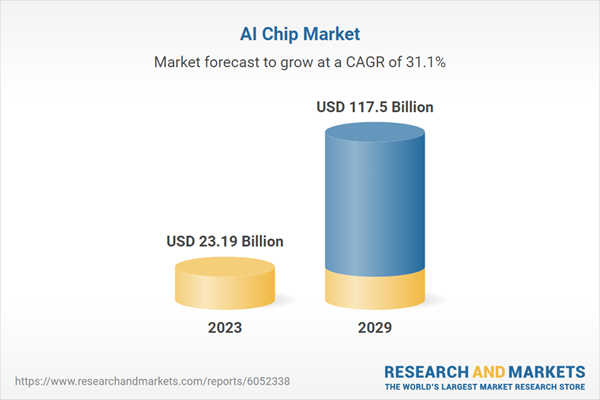
Core Insights - The global AI chip market was valued at USD 23.19 billion in 2023 and is projected to reach USD 117.50 billion by 2029, with a compound annual growth rate (CAGR) of 31.06% [1][20]. Market Overview - The AI chip market is experiencing high competition driven by the demand for high-performance, low-power data processing solutions essential for various sectors [2]. - Leading tech companies such as NVIDIA, AMD, Intel, and Microsoft are heavily investing in R&D to create advanced AI processors to meet the growing demand for efficient AI computations [3]. Regional Insights - North America, particularly the U.S., is a leader in the AI chip market due to strong technological innovation and significant investments in AI R&D [4]. - The APAC region is rapidly growing, with countries like China, Japan, South Korea, and India emerging as technological hubs, particularly China focusing on reducing dependence on foreign chip manufacturers [5]. - Europe is witnessing growth in AI chip adoption, driven by government initiatives, with Germany, the UK, and France being key players [5]. - The Middle East and Africa have smaller AI chip markets but are seeing emerging opportunities due to government initiatives in countries like the UAE and Saudi Arabia [6]. Market Trends and Opportunities - Advanced node development is crucial for AI chip performance, with smaller manufacturing processes leading to increased efficiency [7]. - The U.S. Department of Commerce and Intel announced a preliminary agreement for Intel to receive approximately USD 8.5 billion in funding under the CHIPS and Science Act to enhance semiconductor manufacturing [8]. - Governments worldwide are investing heavily in AI chip technologies for national security and competitiveness, with the U.S. government set to invest up to USD 100 million for sustainable semiconductor materials research [10][11]. Product Launches - AMD launched the Ryzen AI PRO 300 Series Processors in October 2024, featuring advanced capabilities for business productivity [13]. - NVIDIA introduced the Blackwell Platform in March 2024, designed for generative AI and optimized for cost and energy efficiency [14]. - Microsoft unveiled custom-designed chips, the Azure Maia AI Accelerator and Azure Cobalt CPU, aimed at enhancing AI infrastructure [16]. Market Segmentation - The AI chip market is segmented by type, with the ASIC segment expected to grow at the highest CAGR of over 31.70% due to its efficiency in processing data-intensive AI algorithms [17]. - The cloud segment dominates the processing market, driven by its scalability and efficiency in handling large datasets [18]. - The data center segment holds the highest revenue share among end-users, critical for AI applications due to the exponential increase in data generation [19].