
Carbon Black

Search documents
Orion Q4 Earnings Call Highlights
Yahoo Finance· 2026-02-17 18:46
Core Insights - Orion reported better-than-expected fourth-quarter and full-year 2025 results, driven by stronger volumes and improved specialty mix [4][6] - The company anticipates continued challenging conditions in key markets for 2026, with a focus on sustaining positive free cash flow despite a projected decline in EBITDA [4][5] Financial Performance - Adjusted EBITDA for 2025 was $248 million, exceeding expectations, attributed to stronger fourth-quarter volumes, particularly in Specialty and Rubber segments [3][6] - Free cash flow for 2025 was $55 million, with net debt reduced by $40 million to $920 million, resulting in a leverage ratio of 3.7x [6][8] - For 2026, Orion guided adjusted EBITDA between $160 million to $200 million and free cash flow of $25 million to $50 million, with capital expenditures reduced to $90 million [5][12][13] Segment Performance - Specialty segment adjusted EBITDA was $94 million, with a 5% volume decrease due to weaker global demand [1] - Rubber segment adjusted EBITDA was $155 million, with a 4% volume increase driven by higher demand in South America and APAC, but a 3% decrease in net sales due to lower pricing [2] Strategic Actions - Orion is implementing cost-saving measures, including a $20 million productivity initiative and rationalizing 3–5 production lines to preserve cash [5][17] - The company is shifting its customer negotiation strategy from trading volume for pricing to a "hold share" approach to maintain market presence [11] Market Conditions - The carbon black industry faces a "uniquely difficult backdrop," with challenges such as elevated tire imports, inflation pressures, and weak PMI affecting specialty demand [10] - Management noted improving underlying indicators, including a potential rebound in freight activity, which could positively impact future demand [16][18] Project Updates - The La Porte conductive-carbons project has been delayed to 2027, expected to add approximately $10 million in annual depreciation upon startup [5][17] - The company is cautious in its outlook, planning for continued challenging conditions while identifying potential upsides from shifts in trade flows and freight recovery [18]

Orion Engineered Carbons(OEC) - 2025 Q4 - Earnings Call Transcript
2026-02-17 14:32
Financial Data and Key Metrics Changes - The company reported full-year EBITDA of $248 million for 2025, exceeding previous expectations due to better-than-expected Q4 volumes, particularly in the Specialty segment [16][17] - Free cash flow for the year was $55 million, attributed to higher than expected EBITDA in Q4 and working capital initiatives [17][20] - Net debt at the end of the year was $920 million, with a leverage ratio of 3.7x, down from 3.8x at the end of Q3 [21] Business Line Data and Key Metrics Changes - The Rubber segment generated full-year Adjusted EBITDA of $155 million, impacted by lower tire production rates in key Western markets and a 4% increase in volumes mainly from South America and APAC [16][18] - The Specialty segment delivered Adjusted EBITDA of $94 million, reflecting a 5% decrease in volumes due to soft global industrial activity [17][19] Market Data and Key Metrics Changes - The tire industry faced challenges due to elevated imports and soft freight industry conditions, with truck and bus tires accounting for about one-third of carbon black consumption globally [10][15] - Recent trends indicate a potential reversal in consumer behavior, with Tier 2 and Tier 1 tires outselling Tier 3 brands for the first time last year [9][10] Company Strategy and Development Direction - The company is focused on managing costs and has implemented actions expected to drive $20 million in productivity and efficiency savings [11] - A shift towards a "win with our customer" strategy has been adopted to maintain market share amidst challenging conditions [12] - The company has amended its credit agreement to provide flexibility during this cycle, ensuring ample headroom for leverage [21][22] Management's Comments on Operating Environment and Future Outlook - Management expressed cautious optimism about potential recovery in the tire industry, citing improvements in underlying carbon black indicators and a possible rebound in freight activity [15][25] - The company anticipates generating Adjusted EBITDA between $160 million and $200 million for 2026, with free cash flow expected to be between $25 million and $50 million [23][24] Other Important Information - The company achieved a near-record year for employee safety, with only three incidents reported across its global network [6][7] - The company has rationalized 3-5 production lines to improve operational efficiency [11][60] Q&A Session Summary Question: Guidance and Rubber Segment Impact - The company acknowledged a potential $60 million negative impact from contract outcomes, emphasizing that they did not trade off pricing for volume [27][28][30] Question: Free Cash Flow Expectations - Management indicated that the expected free cash flow range for 2026 is $25 million to $50 million, driven by active management of working capital and CapEx [35][36] Question: Accounts Payable Increase - The increase in accounts payable to $197 million is being actively managed, with a focus on terms extensions [47][53] Question: Conductive Carbons Update - The startup of the La Porte plant has been delayed to 2027 to better align with market demand [54][67] Question: Tire Shipments in Europe - Tire imports to Europe were more stable than in the U.S., with no significant surge observed [56] Question: Capacity Under Contract - The company noted a slight decrease in contracted capacity compared to normal years, with some flexibility in contract structures [40][41]
Orion Engineered Carbons(OEC) - 2025 Q4 - Earnings Call Presentation
2026-02-17 13:30
4Q and Full Year 2025 Earnings Conference Call Orion S.A. Forward -Looking Statements This presentation contains and refersto certain forward-looking statements with respect to our financial condition, results of operations and business. These statements constitute forward-looking statements within the meaning of Section 21E of the Securities Exchange Act of 1934, as amended (the "Exchange Act"). Forward-looking statements are statements of future expectations that are based on management's current expectat ...
Cabot (CBT) - 2026 Q1 - Earnings Call Transcript
2026-02-04 14:02
Financial Data and Key Metrics Changes - Adjusted earnings per share (EPS) for the first quarter was $1.53, which is 13% lower than the same quarter last year [19] - Operating cash flow was strong at $126 million, with discretionary free cash flow of $71 million [19] - The company ended the quarter with a cash balance of $230 million and a liquidity position of approximately $1.4 billion [20] - Capital expenditures for the first quarter were $69 million, with expectations for fiscal 2026 to be between $200 million and $230 million [20] - The debt balance was $1.1 billion, with a net debt to EBITDA ratio of 1.2 times [21] Business Segment Data and Key Metrics Changes - EBIT in the Reinforcement Materials segment declined by 22% compared to the first quarter of fiscal 2025, primarily due to lower volumes in the Americas and Asia Pacific [4][19] - EBIT in the Performance Chemicals segment increased by 7% compared to the first quarter of fiscal 2025, driven by a favorable product mix and momentum in battery materials [4][19] - In Reinforcement Materials, volumes decreased by 7% year-over-year, with a 15% decline in the Americas and a 7% decline in Asia Pacific, while Europe saw a 6% increase [21] Market Data and Key Metrics Changes - Tire imports from Asia have increased by approximately 4% year-over-year in the U.S., while Brazil experienced a 4% year-over-year decline in passenger car tire imports due to tariffs [7] - In Europe, tire imports remain elevated, with an 8% increase year-to-date as of November 2025 [8] - The company anticipates that domestic tire production in Western regions will return to growth in 2026 and 2027, influenced by trade measures and pent-up demand [26] Company Strategy and Development Direction - The company is focused on reinforcing its leadership in the market and maintaining strong margins and cash generation through cost-saving measures and strategic investments [10][29] - A multiyear agreement with PowerCo, a subsidiary of Volkswagen Group, is expected to enhance the company's position in the battery materials market [16] - The company plans to rationalize Carbon Black capacity in the Americas and Europe to align with current demand levels [12] Management's Comments on Operating Environment and Future Outlook - The management noted that the global demand environment, particularly in Reinforcement Materials, remains challenging due to depressed tire production levels and inflation affecting the replacement cycle [6][26] - The company expects improving EBIT in the second half of fiscal 2026, driven by new capacity in Indonesia and an acquisition in Mexico [22][25] - Management anticipates continued strong free cash flow generation and a robust balance sheet, allowing for flexibility in cash usage [25][29] Other Important Information - The company delivered $50 million in cost savings in fiscal year 2025 and expects to maintain these benefits in fiscal 2026, with an additional $30 million in cost reduction programs planned [10][11] - The Battery Materials product line saw a revenue growth of 39% compared to the first quarter of fiscal 2025, with EBITDA margins at 22% [14] Q&A Session Summary Question: What are you seeing on tire exports leaving the ports in Asia? - Management indicated that tire imports in the Americas have been decreasing sequentially, with a modest year-over-year decline in South America due to tariffs [32][33] Question: Is the volume weakness in Europe silicas due to the construction silicones market or Dow's silanes closure? - Management clarified that the demand weakness is more related to general market conditions rather than Dow's closure [35] Question: Have you quantified the expected earnings contribution from the PowerCo agreement? - Management did not disclose specific earnings contributions due to confidentiality but emphasized the strategic importance of the agreement [38] Question: How does the new Mexico plant fit into America's manufacturing footprint? - The new plant is seen as strategically important, providing operational synergies and supporting long-term partnerships with customers [45][46] Question: How were volumes realized by region in the annual contracts? - Management noted that overall volumes are expected to be relatively flat globally, with some volume loss in Europe due to contract negotiations [48]

Cabot (CBT) - 2026 Q1 - Earnings Call Transcript
2026-02-04 14:02
Financial Data and Key Metrics Changes - Adjusted earnings per share (EPS) for the first quarter was $1.53, which is 13% lower than the same quarter last year [19] - Operating cash flow was strong at $126 million, with discretionary free cash flow of $71 million [19] - The company ended the quarter with a cash balance of $230 million and a liquidity position of approximately $1.4 billion [20] - Capital expenditures for the first quarter were $69 million, with expectations for fiscal 2026 to be between $200 million and $230 million [20] - The debt balance was $1.1 billion, with a net debt to EBITDA ratio of 1.2 times [21] Business Segment Data and Key Metrics Changes - EBIT in the Reinforcement Materials segment declined by 22% compared to the first quarter of fiscal 2025, primarily due to lower volumes in the Americas and Asia Pacific [4][19] - EBIT in the Performance Chemicals segment increased by 7% compared to the first quarter of fiscal 2025, driven by a favorable product mix and momentum in battery materials [4] - In the Reinforcement Materials segment, volumes decreased by 7% year-over-year, with a 15% decline in the Americas and a 7% decline in Asia Pacific, while Europe saw a 6% increase [21] - In Performance Chemicals, volumes were down 3% year-over-year, mainly due to lower demand in Europe [23] Market Data and Key Metrics Changes - Tire imports from Asia have increased by approximately 4% year-over-year in the U.S., while Brazil saw a 4% decline in passenger car tire imports due to tariffs [7] - In Europe, tire imports remain elevated, with an 8% increase year-to-date as of November 2025 [8] - The competitive environment in the carbon black market has intensified, with pricing declines of 7%-9% compared to 2025 levels [9] Company Strategy and Development Direction - The company is focusing on reinforcing its leadership in the Battery Materials product line, which saw a revenue growth of 39% compared to the first quarter of fiscal 2025 [14] - A multiyear agreement with PowerCo, a subsidiary of Volkswagen Group, is expected to enhance the company's position in the battery materials market [16] - The company plans to rationalize carbon black capacity in the Americas and Europe to improve efficiency and profitability [12] - Cost-saving measures are expected to deliver $30 million in additional savings in fiscal 2026 [11] Management's Comments on Operating Environment and Future Outlook - The management noted that the global demand environment remains challenging, particularly in the Reinforcement Materials segment, due to depressed tire production levels [6] - There are expectations for a recovery in domestic tire production in Western regions in 2026 and 2027, influenced by trade measures and pent-up demand [26] - The company anticipates adjusted EPS guidance for fiscal 2026 to be between $6 and $6.50, reflecting flat volumes in Reinforcement Materials and low single-digit growth in Performance Chemicals [24][25] Other Important Information - The company delivered $50 million in cost savings in fiscal year 2025 and expects to maintain these benefits in fiscal 2026 [10] - The company is reducing capital expenditures to align with the current market environment, with a new CapEx range approximately $60 million lower than 2025 actuals [11] Q&A Session Summary Question: What are you seeing on tire exports leaving the ports in Asia? - The company noted that tire imports in the Americas have been decreasing sequentially, while Brazil has seen a modest year-over-year decline due to tariffs [32][33] Question: Is the volume weakness in Europe silicas due to the construction silicones market or Dow's silanes closure? - The management indicated that the overall demand is not materially impacted by Dow's closure, attributing the weakness to general market conditions in housing and construction [35] Question: Have you quantified the expected earnings contribution from the agreement with PowerCo? - The company has not disclosed specific earnings contributions due to confidentiality but emphasized the strategic importance of the agreement [38] Question: How does the new Mexico plant fit into America's manufacturing footprint? - The Mexico plant is seen as strategically important, providing operational synergies and supporting long-term partnerships with customers like Bridgestone [45][46] Question: How were volumes realized by region for the annual contracts? - The company expects volumes across reinforcement materials to be relatively flat globally, with no significant change in share position in the Americas and a decline in Europe [48]
Carbon Black Market Size to Reach USD 38.54 Billion by 2033 Owing to its Extensive Use in the Automotive Industry | SNS Insider
Globenewswire· 2025-12-06 12:30
Core Insights - The global Carbon Black Market is projected to grow from USD 26.17 Billion in 2025 to USD 38.54 Billion by 2033, with a CAGR of 4.97% from 2026 to 2033 [1][16] - The U.S. carbon black market is estimated at USD 10.22 Billion in 2025, expected to reach USD 14.82 Billion by 2033, growing at a CAGR of 4.77% [2][16] Market Drivers - The automotive industry's demand for carbon black, particularly in tire manufacturing, is a significant growth driver, as carbon black enhances tire performance, durability, and wear resistance [4][10] - The rise in electric vehicle (EV) production indirectly boosts the carbon black market, as EVs require high-performance materials [4] Market Segmentation - By Type: Furnace Black leads the market with a 40.24% share in 2025, while Acetylene Black is the fastest-growing segment with a CAGR of 7.80% [6] - By Grade: Standard Grade dominates with a 60.20% market share in 2025, and Specialty Grade is the fastest-growing segment with a CAGR of 6.85% [7] - By Application: The Tire segment holds a 67.80% share in 2025, with Plastics being the fastest-growing segment at a CAGR of 7.60% [8] - By End-User: The Automotive sector leads with a 64.30% share in 2025, while Electronics is the fastest-growing segment with a CAGR of 7.90% [9] Regional Insights - The Asia Pacific region is the largest market, accounting for over 54.20% of revenue in 2025, driven by high demand from automotive OEMs and tire manufacturing [10] - The Middle East and Africa are projected to grow at the fastest CAGR of 7.00%, fueled by industrialization and increasing automotive production [10] Major Players - Key players in the carbon black market include Cabot Corporation, Birla Carbon, Orion Engineered Carbons S.A., and Tokai Carbon Co., Ltd. [5][12] Recent Developments - Birla Carbon introduced Continua™, a sustainable carbonaceous material derived from post-consumer tires, enhancing sustainability in the industry [13] - Tokai Carbon Co., Ltd. collaborated with Bridgestone to develop eco Carbon Black from end-of-life tires, contributing to a circular economy [13]


Cabot price target lowered to $54 from $75 at JPMorgan
Yahoo Finance· 2025-11-29 12:40
Group 1 - JPMorgan has lowered the price target on Cabot (CBT) to $54 from $75, maintaining an Underweight rating on the shares [1] - Carbon black volumes in the Americas have decreased by 6% for three consecutive years [1] - Margins are being pressured as consumers shift from higher quality tires to lower quality and less expensive options [1] Group 2 - JPMorgan anticipates further downside for Cabot shares due to the weak carbon black price and volume environment [1]
Orion Engineered Carbons(OEC) - 2025 Q3 - Earnings Call Presentation
2025-11-05 13:30
Financial Performance - Q3 2025 - Adjusted EBITDA decreased by 28% year-over-year to approximately $57.7 million, primarily due to soft volumes in key regions, adverse fixed cost absorption variances, and inventory revaluation [5, 24] - Net sales decreased by 2.7% year-over-year to $450.9 million [24] - Gross profit decreased by 20.4% year-over-year to $85.6 million [24] - Adjusted net income decreased by 40.5% year-over-year to $16.3 million [24] Segment Performance - Q3 2025 - Rubber Carbon Black: Adjusted EBITDA decreased by 31.8% year-over-year to $36.1 million, with volume gains in APAC and South America [28, 31] - Specialty Carbon Black: Adjusted EBITDA decreased by 20.6% year-over-year to $21.6 million, with overall volumes modestly higher but predominantly into lower value markets [33, 35] Key Factors and Challenges - Tire imports into the U.S. remain a challenge, with tariffs of 25% on imported replacement tires [6, 15] - Macroeconomic conditions remain difficult, impacting end market recovery [5, 19] - The company is over-indexed to Western markets and premium tire makers, which are most impacted by import levels [6] Outlook and Strategy - Revised full-year 2025 Adjusted EBITDA guidance to $220 million - $235 million and Adjusted EPS to $0.80 - $0.95 per share [40] - The company expects positive free cash flow for 2025, revised to +$25 million - $40 million [38, 40] - The company is intensifying its focus on cash flow generation through cost actions and working capital management [18, 19]
【行业研究】2025年炭黑行业分析
Xin Lang Cai Jing· 2025-08-08 09:31
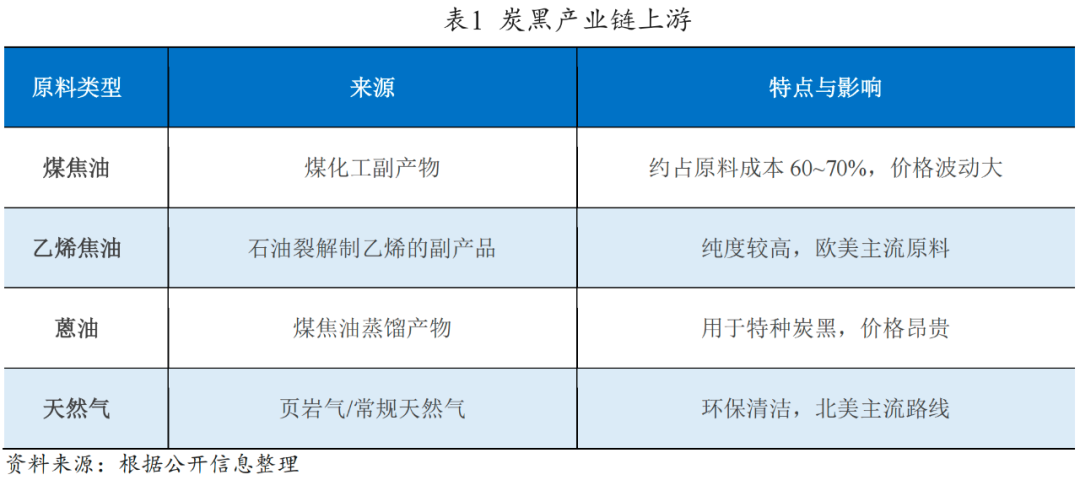
Core Viewpoint - The carbon black industry in China is experiencing structural overcapacity, with low operating rates and production growth, leading to increased operational pressures on companies due to fluctuating raw material prices and environmental regulations [1][8][19]. Industry Overview - Carbon black is a nano-sized carbon material primarily used in tire manufacturing, rubber products, and other applications, with the domestic market mainly focused on rubber-grade carbon black [2][3]. - The upstream materials for carbon black production include coal tar and ethylene tar, which account for 60-80% of total costs, while the downstream applications are dominated by the tire industry, which consumes 70-75% of carbon black [3][7]. Industry Operation - China's carbon black production capacity exceeds 9 million tons, with a utilization rate of around 60%, and production is expected to grow slightly in 2024 [8][19]. - The export of carbon black has increased due to the expansion of Chinese tire manufacturers in Southeast Asia, although the export growth rate is expected to slow due to international trade barriers [9][19]. Raw Material Prices - The price of coal tar, a key raw material, has shown significant volatility, impacting the cost structure of carbon black companies. In 2024, the average price of high-temperature coal tar is projected to be around 4,167 yuan/ton, a decrease of approximately 10% from 2023 [10][19]. Downstream Demand - The tire market's growth directly influences carbon black demand, with a projected 9.2% increase in tire production in 2024. However, rising costs and stricter environmental regulations have led to a decrease in carbon black usage in tires [14][19]. Price Trends - Carbon black prices have been on a downward trend since 2023, influenced by raw material price fluctuations and weak downstream demand. The market is expected to experience price volatility in 2024 [16][19]. Key Industry Players - In 2024, the total carbon black production in China is expected to reach 6.67 million tons, with leading companies like Jiangxi Black Cat and Jineng Technology holding significant market shares. The top five companies account for 46% of total production [19][21]. Industry Policies and Focus - National policies are aimed at eliminating outdated production capacity and increasing industry concentration, with a focus on encouraging advanced production techniques and improving resource utilization [21][22]. - The implementation of stricter environmental regulations is increasing the costs for carbon black companies, necessitating investments in cleaner production technologies [22][23]. Future Industry Outlook - The carbon black market is expected to maintain moderate growth, driven by demand from the tire and automotive sectors, as well as the expansion of high-end carbon black applications [26]. - Key trends include structural adjustments towards high-end products, accelerated industry consolidation, increased focus on technological innovation, and a shift towards green and low-carbon production methods [26].


Orion Engineered Carbons(OEC) - 2025 Q2 - Earnings Call Transcript
2025-08-07 13:30
Financial Data and Key Metrics Changes - The adjusted EBITDA for Q2 was $69 million, aligning with expectations despite demand headwinds, with overall volumes up 3% year over year but down over 4.5% sequentially [6][24] - Gross profit per ton improved sequentially due to better operating performance, although total profitability was down year over year due to adverse geographic and product mix [24][25] Business Line Data and Key Metrics Changes - The Rubber business saw a 7% increase in volumes year over year and a 4% increase in adjusted EBITDA, driven by contract outcomes, though impacted by import-related headwinds [25] - Specialty volumes decreased by 8% year over year and 6% sequentially, primarily due to soft demand and customer hesitancy related to tariff uncertainties [27] Market Data and Key Metrics Changes - The surge in tire imports into the U.S. was attributed to customers trying to beat tariff deadlines, which negatively affected local tire manufacturing rates and demand [7][15] - The company expects improved Rubber segment demand starting late this year or early next year as tariffs normalize tire imports [9][10] Company Strategy and Development Direction - The company is shifting capital allocation priorities towards debt reduction over share repurchases in the near term [14][30] - Self-help initiatives are underway to improve productivity and lower costs, with a focus on driving free cash flow improvement [21][32] Management's Comments on Operating Environment and Future Outlook - Management expressed cautious optimism about demand recovery due to the new tariff paradigm expected to benefit the company in late 2025 or early 2026 [33] - The company is not complacent and is focused on positioning itself for greater earnings power despite the challenging backdrop [32] Other Important Information - The CFO, Jeff Gleich, will retire in the fourth quarter, and a formal search for a successor has begun [5] - The company has committed $7 billion to $8 billion in capital for tire production capacity expansion in North America over the next four years [18] Q&A Session Summary Question: Earnings step up in the second half of the year - Management indicated that volume growth would not significantly increase sequentially, with cost actions expected to benefit in the second half [36][38] Question: Cash balance and levers to hit targets - Management discussed working capital levers, including inventory reduction, with expectations for more opportunities in Q4 [39][40] Question: Tariff impacts and production location expectations - Management does not expect production to revert more to Mexico than the U.S. and noted that the tariff situation remains complex [44][47] Question: Q4 expectations and seasonal trends - Management suggested a possibility of a stronger Q4 due to tariff certainty but emphasized uncertainty [49] Question: Structural versus temporary import impacts - Management acknowledged a price gap between imported and domestic tires, with tariffs helping to close that gap [51][52] Question: Incremental tariff impacts from recent announcements - Management highlighted the significance of the 25% automotive tariff and its implications for imported carbon black from India [55]