Cell Therapies

Search documents
2026年欧洲并购展望——领导者的十大交易主题
奥纬咨询· 2026-01-27 05:55
Investment Rating - The report indicates a positive outlook for European M&A activity, expecting continued momentum into 2026, with a strong case for consolidation across various sectors [3][4][6]. Core Insights - European M&A deal value increased by 12% in 2025, reaching approximately $820 billion, driven by a shift in investor asset allocation towards Europe [3]. - Corporate profitability in Europe has risen by 50% from pre-2008 levels, yet many companies remain sub-scale, indicating a strong need for acquisitions to build capabilities [5]. - A robust pipeline of announced but uncompleted deals, along with favorable capital availability and regulatory conditions, suggests sustained M&A activity in 2026 [6]. Summary by Relevant Sections 1. Banking Sector - European banking M&A has seen a doubling in deal volumes since 2020, driven by restored profitability and regulatory support for consolidation [13]. - Banks are expected to generate over $500 billion in excess capital above regulatory minima over the next three years, which will be increasingly deployed in M&A [15]. 2. Asset Management - The asset and wealth management sector is facing consolidation due to profit margin pressures, with predictions of a 20% reduction in the number of asset managers by 2030 [17]. - M&A activity is expected to intensify, with 100 to 200 transactions anticipated annually in Europe [19]. 3. Telecommunications - The European telecom market is maturing, necessitating M&A for value-accretive deals amid high investment needs for 5G and fiber [20]. - The average EU operator has about 5 million subscribers, compared to 107 million in the US, highlighting the need for consolidation [20]. 4. Defense Sector - Military spending in Europe is projected to grow at approximately 9% annually through 2030, leading to increased demand for production capabilities [23]. - M&A is shifting towards acquiring production capabilities, with a focus on modernizing technical advantages [25]. 5. Logistics - The logistics sector is prioritizing transformative M&A strategies to address e-commerce growth and traditional mail network contraction [28]. - Acquirers are focusing on contract logistics and technology capabilities as core to deal value capture [31]. 6. Pharmaceuticals - Pharma dealmaking is becoming essential as companies face patent expirations and pipeline gaps, with a focus on high-value assets [33]. - Transaction activity is expected to be dominated by selective, de-risked acquisitions and structured deals to manage valuation risks [36]. 7. Chemicals - The chemical industry is leveraging M&A to refocus portfolios on specialty segments and secure cash flow amid economic challenges [37]. - Larger transactions are aimed at building global platforms and enhancing sustainability efforts [39]. 8. Insurance - M&A activity in the insurance sector is driven by private equity consolidation, accounting for about 90% of transactions by volume [42]. - The report anticipates continued acquisitions of specialty underwriting franchises by strategic buyers [45]. 9. Private Equity - European corporates hold approximately €2.6 trillion in cash, creating opportunities for trade buyers of private equity-backed assets [48]. - In 2026, over 1,500 European PE-backed assets, representing $760 billion in enterprise value, could potentially come to market [49]. 10. Portfolio Rebalancing - Portfolio rebalancing is becoming a core theme in European M&A as companies respond to economic headwinds and high capital costs [56]. - One-third of European corporates deliver returns below their cost of capital, indicating a need for divestitures of non-core assets [56].
Biologics Contract Manufacturing Market Industry Report 2024-2035: Intense Competition Among Service Providers that Claim to be Focused on the Niche and Upcoming Drug Classes
Globenewswire· 2025-03-18 09:02
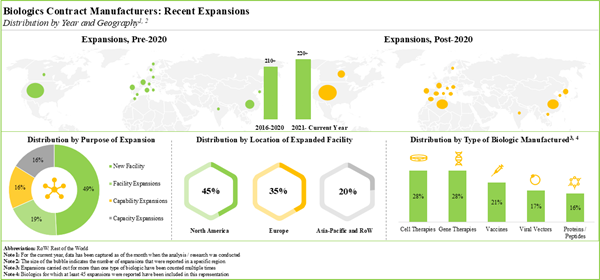
Core Insights - The global biologics contract manufacturing market is projected to grow from USD 22.2 billion in the current year to USD 58 billion by 2035, with a CAGR of 9.12% during the forecast period [3] - Increasing reliance on contract manufacturers for end-to-end solutions is driving the growth of the biologics contract manufacturing market [8] Market Segmentation - The market is segmented by type of service, with the majority captured by Active Pharmaceutical Ingredients (APIs) due to significant capital investments required for their production [9] - Cell therapies are identified as the fastest-growing segment within the biologics contract manufacturing market [10] - The mammalian expression system is expected to dominate the market due to its high protein yield and improved product consistency [11] - Commercial scale manufacturing is projected to be the primary driver of the market, although preclinical/clinical scale is expected to grow at a higher CAGR [12] - Large and very large companies hold the maximum market share, but small companies are anticipated to experience substantial growth [13] - North America currently accounts for the largest share of the market, with Asia-Pacific expected to grow at a higher CAGR in the coming years [14] Industry Trends - Over 305 contract manufacturing organizations (CMOs) are engaged in biologics production, with over 90% providing finished dosage form (FDF) manufacturing services [15] - The biopharmaceutical contract manufacturing industry has seen a shift towards developing regions in Asia-Pacific for manufacturing facilities [17] - More than 695 deals have been made by biologics CMOs in the past five years, primarily for vaccines, antibodies, and cell therapies [17] - Significant investments amounting to USD 7.5 billion have been made by investors in the biologics contract manufacturing sector over the past eight years [17] - The existing installed capacity is sufficient to meet current demand, but incremental capacity investments are anticipated to meet long-term demand [17]