DR Tulu

Search documents
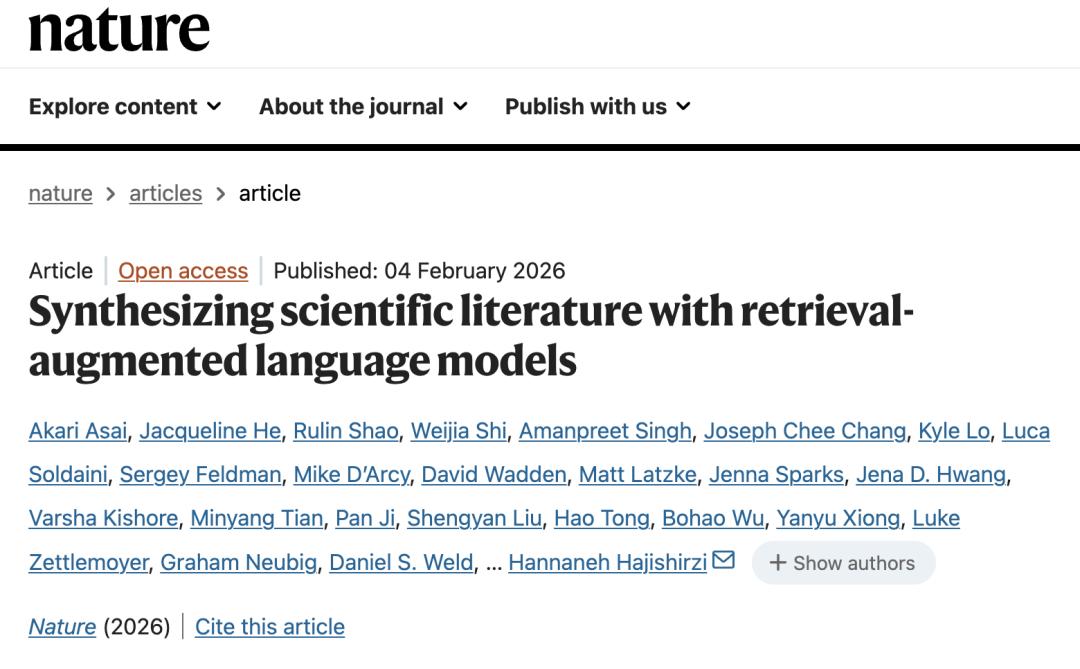
Nature和Science同时报道了一篇论文,试图根治AI幻觉
3 6 Ke· 2026-02-05 12:24
Core Insights - The article discusses the release of OpenScholar, an 8 billion parameter model that surpasses flagship models in scientific literature review tasks, signaling a shift away from "parameter worship" towards a more reliable knowledge retrieval approach [1][4][6] Model Performance - OpenScholar, with only 8 billion parameters, outperformed flagship models in scientific literature review tasks, demonstrating a significant reduction in reasoning costs to approximately $0.003 per query [4][6] - In benchmark tests, OpenScholar-8B achieved higher accuracy rates compared to existing models, showcasing its effectiveness in retrieving and verifying information [6][8] Methodology - OpenScholar employs a unique process that includes retrieving relevant segments from a database of 45 million open-access papers, reordering them for accuracy, and generating answers through self-review to ensure evidence-backed responses [5][6] - The model's approach contrasts with traditional models that rely on memorization, instead teaching the AI to "look up" information like a human researcher [5][8] Future Developments - The upcoming model, DR Tulu, aims to tackle deeper research tasks by utilizing Reinforcement Learning with Evolving Rubrics, allowing the model to dynamically generate evaluation criteria during research [9][10] - DR Tulu is designed to enhance planning capabilities, enabling it to create outlines and synthesize information from multiple sources for comprehensive reports [9][10] Key Contributors - Akari Asai, a prominent figure in the development of OpenScholar and DR Tulu, emphasizes the importance of democratizing access to advanced AI tools for researchers worldwide [13][15] - Asai's philosophy advocates for models that embrace the vastness of knowledge rather than attempting to encapsulate it entirely within their parameters [15][16]