
OpenScholar

Search documents
Nature认定的论文综述神器来了
量子位· 2026-02-07 04:22
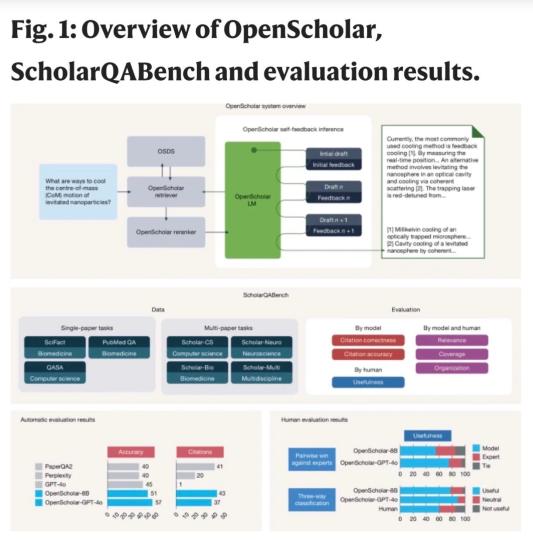
Core Viewpoint - The article discusses the launch of OpenScholar, an AI system developed by the Allen Institute for AI and the University of Washington, which aims to eliminate the issue of false citations in academic writing by leveraging a vast database of 45 million scientific papers [2][5]. Group 1: OpenScholar's Features - OpenScholar connects to a large database called ScholarStore, which contains full texts and abstracts of 45 million papers, significantly reducing the false citation rate of traditional large language models (LLMs) [9][11]. - The system employs Retrieval-Augmented Generation (RAG) technology to ensure that each knowledge point is backed by a real paper, enhancing the accuracy of citations [12][13]. - OpenScholar's feedback loop allows it to refine its outputs by searching, generating, self-reviewing, and revising, which helps confirm the existence of supporting literature [12][13]. Group 2: Performance Comparison - In a benchmark test called Scholar QABench, OpenScholar-8B outperformed GPT-4o by 5% in correctness and matched human expert citation accuracy [16]. - A double-blind experiment showed that 51% of OpenScholar's answers were rated better than those written by human researchers, with an upgraded version achieving a 70% success rate [18]. - Experts noted that OpenScholar's strengths lie in its comprehensive information coverage, clearer structure, and stronger logical coherence compared to traditional models [19].


Nature:首个能写综述论文的开源AI模型来了,大幅减少科研“幻觉”,堪比人类专家
生物世界· 2026-02-06 04:26
Core Viewpoint - The article discusses the development of OpenScholar, an AI assistant designed specifically for researchers to synthesize scientific literature accurately and efficiently, addressing the issue of "hallucination" in existing large language models [2][5][21]. Group 1: OpenScholar Overview - OpenScholar is a retrieval-augmented language model that can intelligently retrieve relevant paragraphs from 45 million open-access papers and generate comprehensive review papers with accurate citations [5][7]. - The model's citation accuracy is comparable to that of human experts and surpasses mainstream models like GPT-4o in multiple tests [5][11]. Group 2: Functionality and Workflow - OpenScholar operates through a three-step process: retrieval of relevant content, generation of answers with citations, and self-feedback for iterative improvement [7][9]. - The system is built on a dedicated data store (OpenScholar DataStore) that allows for transparent and reproducible research [7][21]. Group 3: Evaluation and Performance - The ScholarQABench benchmark was developed to assess AI systems' reliability in synthesizing scientific literature, featuring nearly 3,000 expert-written questions across various fields [12][13]. - OpenScholar demonstrated impressive results in the benchmark, outperforming GPT-4o in citation accuracy and overall usefulness, with human experts favoring OpenScholar's responses over those of GPT-4o [16][18][19]. Group 4: Implications for Research - The introduction of OpenScholar signifies a significant advancement in the application of AI in scientific research, potentially transforming literature reviews from a burdensome task into an efficient exploration process [21][23]. - Future developments may enhance OpenScholar's capabilities, making it a true collaborator for researchers, allowing them to focus more on innovation rather than information filtering [23].

【太平洋科技-每日观点&资讯】(2026-02-06)
远峰电子· 2026-02-05 13:03
Market Overview - Major indices showed declines: Shanghai Composite Index (-0.64%), Shenzhen Component Index (-1.44%), STAR Market 50 (-1.44%), ChiNext Index (-1.55%), and North Exchange 50 (-2.03%) [1] - TMT sector led the gainers with SW Film and Animation Production (+3.70%), SW Brand Consumer Electronics (+2.10%), and SW Security Equipment (+0.86%) [1] - TMT sector faced losses with SW Communication Cables and Accessories (-5.86%), SW Other Electronics III (-3.27%), and SW Communication Network Equipment and Devices (-2.57%) [1] Domestic News - Tianhong Technology announced the delivery of the world's first 310×310mm panel-level packaging PLP PVD equipment, indicating a shift towards self-sufficiency in Taiwan's equipment supply chain [2] - MuChuang released a new 100G smart network security chip RSP-S30, which boasts a threefold increase in cryptographic acceleration capabilities compared to its predecessor [2] - Suzhou Qizhong's production line was temporarily halted due to a fire, leading to a projected 5-8% decrease in revenue growth for 2026 compared to initial forecasts [2] - MediaTek anticipates its mobile business revenue to exceed $10 billion in 2025, marking an 8% year-on-year increase, although it expects a significant decline in Q1 2026 due to rising storage chip costs [2] Overseas News - Qualcomm expects Q2 revenue between $10.2 billion and $11 billion, impacted by a global shortage of memory chips, affecting smartphone production plans [3] - Infineon announced price adjustments for certain products starting April 2026 due to ongoing supply constraints and rising raw material costs [3] - The global smartphone market revenue is projected to grow by 13% year-on-year in Q4 2025, reaching $143 billion, with average selling prices surpassing $400 for the first time [3] AI Insights - Shanghai AI Laboratory released the Intern-S1-Pro model with 1 trillion parameters, enhancing performance and computational efficiency [4] - ByteDance launched the "Doubao 4.0" AI model, which can adapt to 12 industry scenarios and features real-time learning capabilities [4] - A new open-source model, OpenScholar, developed by the University of Washington and the Allen Institute, matches human experts in citation accuracy [4] - Adobe's Firefly platform now offers unlimited AI image and video generation services to paid subscribers, enhancing creative efficiency [4] Industry Tracking - Tianbing Technology's satellite launch facility passed pre-acceptance review, aiming to double launch efficiency and reduce costs by over 30% [5] - Faraday Future introduced three series of EAI robots, including humanoid and quadruped models for various applications [5] - A Chinese team successfully opened the blood-brain barrier non-invasively for glioma patients, significantly improving drug concentration in tumor areas [5] - Asahi Kasei developed a new PFAS-free polyamide material for low-friction applications, maintaining stable performance under high load and temperature [5]

Nature和Science同时报道了一篇论文,试图根治AI幻觉
3 6 Ke· 2026-02-05 12:24
Core Insights - The article discusses the release of OpenScholar, an 8 billion parameter model that surpasses flagship models in scientific literature review tasks, signaling a shift away from "parameter worship" towards a more reliable knowledge retrieval approach [1][4][6] Model Performance - OpenScholar, with only 8 billion parameters, outperformed flagship models in scientific literature review tasks, demonstrating a significant reduction in reasoning costs to approximately $0.003 per query [4][6] - In benchmark tests, OpenScholar-8B achieved higher accuracy rates compared to existing models, showcasing its effectiveness in retrieving and verifying information [6][8] Methodology - OpenScholar employs a unique process that includes retrieving relevant segments from a database of 45 million open-access papers, reordering them for accuracy, and generating answers through self-review to ensure evidence-backed responses [5][6] - The model's approach contrasts with traditional models that rely on memorization, instead teaching the AI to "look up" information like a human researcher [5][8] Future Developments - The upcoming model, DR Tulu, aims to tackle deeper research tasks by utilizing Reinforcement Learning with Evolving Rubrics, allowing the model to dynamically generate evaluation criteria during research [9][10] - DR Tulu is designed to enhance planning capabilities, enabling it to create outlines and synthesize information from multiple sources for comprehensive reports [9][10] Key Contributors - Akari Asai, a prominent figure in the development of OpenScholar and DR Tulu, emphasizes the importance of democratizing access to advanced AI tools for researchers worldwide [13][15] - Asai's philosophy advocates for models that embrace the vastness of knowledge rather than attempting to encapsulate it entirely within their parameters [15][16]

助力降低AI引文幻觉提升准确率 新款开源语言模型与人类专家相仿
Zhong Guo Xin Wen Wang· 2026-02-05 07:28
Core Insights - The article discusses the development of an open-source language model called OpenScholar, which surpasses commercial large language models (LLMs) in accuracy for literature reviews, achieving citation accuracy comparable to human experts [1][4]. Group 1: Model Performance - OpenScholar demonstrates a citation accuracy rate that is similar to human experts, while the commercial model GPT-4o exhibits citation hallucinations in 78%-90% of cases [1][4]. - The accuracy of OpenScholar is reported to be 6.1% higher than GPT-4o and 5.5% higher than another literature review tool, PaperQA2 [4]. Group 2: Research Context - The increasing volume of published scientific literature makes it challenging for researchers to keep up, highlighting the need for effective tools to assist in literature reviews [4]. - OpenScholar is designed specifically for research tasks and integrates a professional database containing 45 million open-access research papers along with a self-assessment mechanism to enhance its output [4]. Group 3: Future Implications - The results indicate a significant reduction in citation hallucinations, suggesting that OpenScholar has the potential to support and advance further research efforts [5]. - The authors emphasize that while OpenScholar shows promise, it still has limitations and cannot fully automate the literature review process [5].
连续三日净流入超亿元,科创人工智能ETF华夏(589010)低位盘整
Mei Ri Jing Ji Xin Wen· 2026-02-05 03:37
Group 1 - The core viewpoint of the news highlights the performance of the Huaxia Sci-Tech AI ETF (589010), which has seen a decline in its price and a majority of its constituent stocks experiencing losses, indicating a challenging market environment for AI-related investments [1][2] - The ETF's latest price is reported at 1.510 yuan, down 2.202% from the opening price, with 27 out of 30 tracked stocks declining, including significant drops from companies like Chip Origin and Lingyun Optics [1] - Despite the downturn, the ETF has recorded a trading volume of 41.28 million yuan and a turnover rate of 1.65%, reflecting sustained high trading activity and a strong willingness for low-position investments over the past three days, with net inflows exceeding 100 million yuan [1][2] Group 2 - The report mentions the emergence of the open-source language model "OpenScholar," which has shown superior literature review capabilities compared to commercial large language models, potentially aiding scientists in managing complex scientific literature [1] - Citic Securities emphasizes the accelerating penetration of general and vertical agents in the AI industry, with companies like Anthropic and MiniMax launching products for office scenarios, indicating a trend towards multi-agent collaboration and coexistence between large and independent firms [2] - The Huaxia Sci-Tech AI ETF closely tracks the Shanghai Stock Exchange Sci-Tech AI Index, covering high-quality enterprises across the entire industry chain, benefiting from high R&D investment and policy support, which positions it well to capture significant moments in the AI industry [2]
刚刚,全球首个完全开放科学文献综述AI,登上Nature
3 6 Ke· 2026-02-05 02:24
Core Insights - OpenScholar is the world's first fully open-source retrieval-augmented generation (RAG) language model specifically designed for scientific research, developed by the University of Washington and the Allen Institute for AI [1][4] - The model aims to assist scientists in managing the increasing complexity and volume of scientific literature reviews by providing accurate citations and high-quality responses [1][4] Technology Innovations - OpenScholar features a proprietary database (OSDS) that includes 45 million open-access scientific papers and 236 million paragraph embedding vectors, ensuring comprehensive and timely retrieval [4] - The system employs an adaptive retrieval mechanism that goes beyond simple keyword matching, allowing for precise identification and extraction of relevant literature based on semantic depth [4] - A self-feedback mechanism is integrated, enabling the model to iteratively check and optimize its outputs for factual accuracy, coverage, and citation correctness, significantly enhancing response quality [4][6] Performance Evaluation - OpenScholar was evaluated using ScholarQABench, a large-scale, multi-domain benchmark that simulates real-world scientific challenges, containing 2,967 expert-written queries and 208 long-form answers across various fields [7] - The lightweight OpenScholar-8B model outperformed GPT-4o by 6.1% in overall accuracy and surpassed the dedicated system PaperQA2 by 5.5%, demonstrating comprehensive performance superiority [8] - In citation accuracy, OpenScholar achieved results comparable to human experts, with its performance only slightly below that of human-generated answers [8][10] Practical Applications - OpenScholar's design emphasizes practicality, utilizing a lightweight dedicated retriever that significantly reduces operational and computational costs compared to large general models, making high-quality literature review assistance more sustainable and widely applicable [12] Future Directions - The research team plans to integrate user feedback to continuously improve retrieval quality, citation accuracy, and overall usability, while also expanding the model's application to more scientific fields and multilingual scenarios [15] - Collaboration with academic publishing institutions is being sought to explore compliant data usage mechanisms that balance intellectual property rights with open access [15]
引文幻觉大幅下降的AI模型诞生
Ke Ji Ri Bao· 2026-02-04 23:03
Core Insights - The article discusses the open-source language model "OpenScholar," which surpasses commercial large language models in accurately conducting literature reviews, with a citation accuracy rate comparable to human experts [1][2] - "OpenScholar" is designed to assist scientists in managing the increasing volume of scientific literature, addressing the limitations of existing commercial models that often produce errors such as citation hallucinations [1][2] Group 1: Model Performance - In experiments, "OpenScholar" demonstrated a 6.1% higher accuracy than GPT-4o and a 5.5% higher accuracy than PaperQA2, another literature review tool [2] - The answers generated by "OpenScholar" were found to be more useful than those from expert annotators in 50% to 70% of cases [2] Group 2: Importance of Literature Reviews - Scientific literature reviews are crucial for evidence-based decision-making, refining scientific processes, and guiding new discoveries, but the growing number of publications makes it challenging for researchers to keep up [1] - The introduction of "OpenScholar" aims to alleviate the burden on researchers by providing a reliable tool specifically designed for the scientific literature landscape [3] Group 3: Future Development - The research team has made both "ScholarQABench" and "OpenScholar" available to the academic community to encourage further research and optimization [2] - While "OpenScholar" shows promise, the team acknowledges that language model-based systems cannot fully automate the literature review process [2]