DiffusionDriveV2

Search documents
以DiffusionDriveV2为例,解析自动驾驶中强化学习的使用
自动驾驶之心· 2026-01-20 09:03
Core Viewpoint - The rapid development of large models has propelled reinforcement learning (RL) to unprecedented prominence, becoming an essential part of post-training in the autonomous driving sector. The shift to end-to-end (E2E) learning necessitates the use of RL to address challenges that imitation learning cannot solve, such as the centering problem in driving behavior [1]. Understanding Reinforcement Learning Algorithms in Autonomous Driving - Proximal Policy Optimization (PPO) and Generalized Recurrent Policy Optimization (GRPO) are currently the most prevalent algorithms in the field. The article emphasizes the importance of understanding reward optimization through classic algorithms [2]. PPO and GRPO Algorithm Insights - The classic PPO algorithm, particularly the PPO CLIP variant, is discussed with a focus on its application in autonomous driving. The formula for the algorithm is provided, highlighting the interaction between the system and the environment over multiple steps [3]. - The evaluation of actions in trajectory generation is based on overall trajectory quality rather than individual points, which is crucial for effective RL training [3]. RL Loss and DiffusionDriveV2 Architecture - The RL loss function is composed of three parts: anchor design, group design from GRPO, and the denoising process of diffusion. Each component plays a critical role in trajectory generation and optimization [9]. - The denoising process is framed as a Markov Decision Process (MDP), where each denoising step represents a decision-making step within the MDP framework [10]. Intra-Anchor and Inter-Anchor GRPO - Intra-Anchor GRPO modifies the group concept to ensure that each anchor has its own group, which is essential for distinguishing different driving behaviors. This prevents the dominance of straight driving data over other behaviors [12]. - Inter-Anchor GRPO addresses the risk of lacking global constraints between different anchors, optimizing the advantage calculation further [13]. Additional Improvements - The article discusses improvements such as trajectory noise management and the introduction of a model selector, which are crucial for ensuring the reliability and effectiveness of the RL approach in autonomous driving [15]. Conclusion - The article uses DiffusionDriveV2 to elucidate the application of reinforcement learning in autonomous driving, indicating that the current state of RL in this field is still evolving. The expectation is for advancements in closed-loop simulation and deeper applications of RL [15].

DiffusionDriveV2核心代码解析
自动驾驶之心· 2025-12-28 09:23
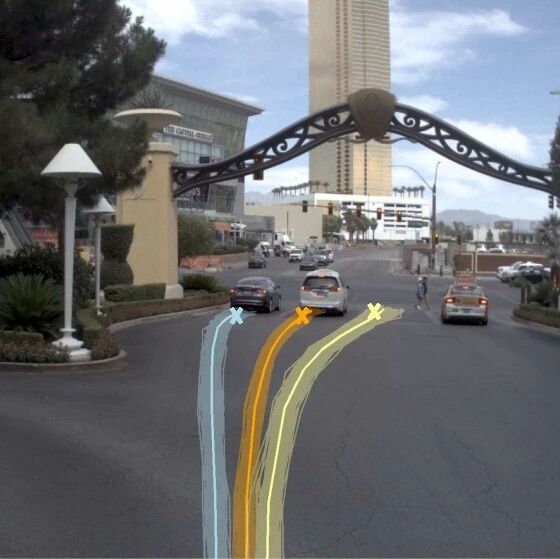
Core Viewpoint - The article discusses the DiffusionDrive model, which utilizes a truncated diffusion approach for end-to-end autonomous driving, emphasizing its architecture and the integration of reinforcement learning to enhance trajectory planning and safety [1]. Group 1: Model Architecture - DiffusionDriveV2 employs a reinforcement learning-constrained truncated diffusion model, focusing on the overall architecture for autonomous driving [3]. - The model incorporates environment encoding, including bird's-eye view (BEV) features and vehicle status, to enhance the understanding of the driving context [5]. - The trajectory planning module utilizes multi-scale BEV features to improve the accuracy of trajectory predictions [8]. Group 2: Trajectory Generation - The model generates trajectories by first clustering the true future trajectories of the vehicle using K-Means to create anchors, which are then perturbed with Gaussian noise [12]. - The trajectory prediction process involves cross-attention mechanisms between the trajectory features and BEV features, allowing for more accurate trajectory generation [15][17]. - The model also integrates time encoding to enhance the temporal aspect of trajectory predictions [14]. Group 3: Reinforcement Learning Integration - The Intra-Anchor GRPO method is proposed to optimize strategies within specific behavior intentions, enhancing safety and goal-oriented trajectory generation [27]. - The reinforcement learning loss function is designed to mitigate instability during early denoising steps, using a discount factor to adjust the influence of rewards over time [28]. - The model incorporates a clear learning signal by truncating negative advantages and applying strong penalties for collisions, ensuring safer trajectory outputs [30]. Group 4: Noise Management - The model introduces multiplicative noise rather than additive noise to maintain the structural integrity of trajectories, ensuring smoother exploration paths [33]. - This approach addresses the inherent scale inconsistencies in trajectory segments, allowing for more coherent and realistic trajectory generation [35]. Group 5: Evaluation Metrics - The model evaluates generated trajectories based on safety, comfort, rule compliance, progress, and feasibility, aggregating these into a comprehensive score [27]. - Specific metrics are employed to assess safety (collision detection), comfort (acceleration and curvature), and adherence to traffic rules, ensuring a holistic evaluation of trajectory performance [27].
DiffusionDriveV2核心代码解析
自动驾驶之心· 2025-12-22 03:23
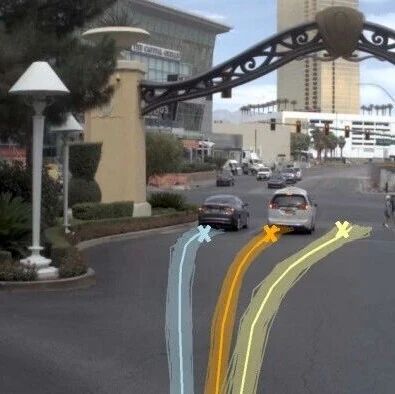
Core Viewpoint - The article discusses the DiffusionDrive model, which utilizes a truncated diffusion approach for end-to-end autonomous driving, emphasizing its architecture and the integration of reinforcement learning to enhance trajectory planning and safety [1]. Group 1: Model Architecture - DiffusionDriveV2 incorporates reinforcement learning constraints within a truncated diffusion modeling framework for autonomous driving [3]. - The model architecture includes environment encoding through bird's-eye view (BEV) features and vehicle status, facilitating effective data processing [5]. - The trajectory planning module employs multi-scale BEV features to enhance the model's ability to predict vehicle trajectories accurately [8]. Group 2: Trajectory Generation - The model generates trajectories by first clustering true future trajectories of the vehicle using K-Means to create anchors, which are then perturbed with Gaussian noise to simulate variations [12]. - The trajectory prediction process involves cross-attention mechanisms that integrate trajectory features with BEV features, enhancing the model's predictive capabilities [15][17]. - The final trajectory is derived from the predicted trajectory offsets combined with the original trajectory, ensuring continuity and coherence [22]. Group 3: Reinforcement Learning and Safety - The Intra-Anchor GRPO method is proposed to optimize strategies within specific behavioral intentions, enhancing safety and goal-oriented trajectory generation [27]. - A comprehensive scoring system evaluates generated trajectories based on safety, comfort, rule compliance, progress, and feasibility, ensuring robust performance in various driving scenarios [28]. - The model incorporates a modified advantage estimation approach to provide clear learning signals, penalizing trajectories that result in collisions [30]. Group 4: Noise and Exploration - The model introduces multiplicative noise to maintain trajectory smoothness, addressing the inherent scale inconsistencies between proximal and distal trajectory segments [33]. - This approach contrasts with additive noise, which can disrupt trajectory integrity, thereby improving the quality of exploration during training [35]. Group 5: Loss Function and Training - The total loss function combines reinforcement learning loss with imitation learning loss to prevent overfitting and ensure general driving capabilities [39]. - The trajectory recovery and classification confidence contribute to the overall loss, guiding the model towards accurate trajectory predictions [42].
时隔一年DiffusionDrive升级到v2,创下了新纪录!
自动驾驶之心· 2025-12-11 03:35
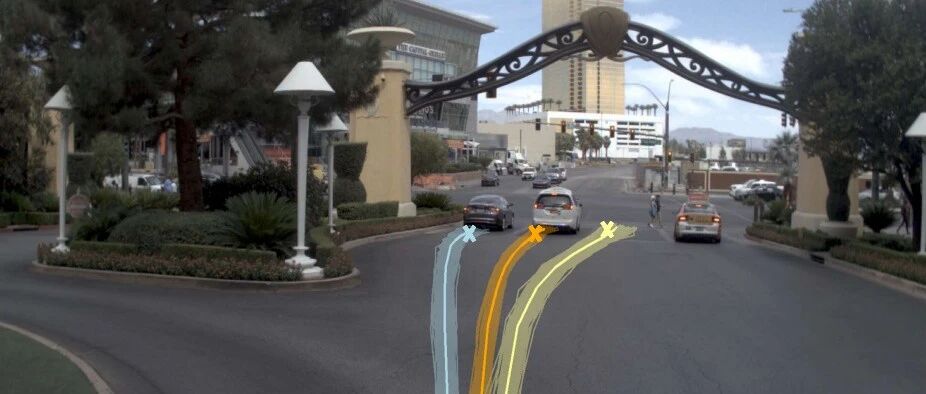
Core Insights - The article discusses the upgrade of DiffusionDrive to version 2, highlighting its advancements in end-to-end autonomous driving trajectory planning through the integration of reinforcement learning to address the challenges of diversity and sustained high quality in trajectory generation [1][3][10]. Background Review - The shift towards end-to-end autonomous driving (E2E-AD) has emerged as traditional tasks like 3D object detection and motion prediction have matured. Early methods faced limitations in modeling, often generating single trajectories without alternatives in complex driving scenarios [5][10]. - Previous diffusion models applied to trajectory generation struggled with mode collapse, leading to a lack of diversity in generated behaviors. DiffusionDrive introduced a Gaussian Mixture Model (GMM) to define prior distributions for initial noise, promoting diverse behavior generation [5][13]. Methodology - DiffusionDriveV2 introduces a novel framework that utilizes reinforcement learning to overcome the limitations of imitation learning, which previously led to a trade-off between diversity and sustained high quality in trajectory generation [10][12]. - The framework incorporates intra-anchor GRPO and inter-anchor truncated GRPO to manage advantage estimation within specific driving intentions, preventing mode collapse by avoiding inappropriate comparisons between different intentions [9][12][28]. - The method employs scale-adaptive multiplicative noise to enhance exploration while maintaining trajectory smoothness, addressing the inherent scale inconsistency between proximal and distal segments of trajectories [24][39]. Experimental Results - Evaluations on the NAVSIM v1 and NAVSIM v2 datasets demonstrated that DiffusionDriveV2 achieved state-of-the-art performance, with a PDMS score of 91.2 on NAVSIM v1 and 85.5 on NAVSIM v2, significantly outperforming previous models [10][33]. - The results indicate that DiffusionDriveV2 effectively balances trajectory diversity and sustained quality, achieving optimal performance in closed-loop evaluations [38][39]. Conclusion - The article concludes that DiffusionDriveV2 successfully addresses the inherent challenges of imitation learning in trajectory generation, achieving an optimal trade-off between planning quality and diversity through innovative reinforcement learning techniques [47].