Dry bulk shipping services

Search documents
Star Bulk Highlights Operating Leverage As Dry Bulk Fundamentals Strengthen - Star Bulk Carriers (NASDAQ:
Benzinga· 2026-03-30 18:35
Company Positioning and Scale - Fleet growth is projected to increase modestly by approximately 3.5% over the next two years, but this will be partially offset by structural inefficiencies, including increased drydock activity due to aging vessels over 15 years, reducing effective fleet growth by at least 0.5% annually [1] - The order book is relatively low at about 12.5% of the fleet, with shipyard capacity constrained until at least the second half of 2029, as shipyards prioritize more complex vessel types like LNG carriers and container ships [2] Market Dynamics: Supply Side - Environmental regulations and efficiency requirements are expected to incentivize slower steaming and fleet renewal, which will support tighter effective supply [2] Geopolitics and Rate Support Dynamics - Geopolitical developments have led to significant increases in bunker fuel prices, which can support freight markets and incentivize slower vessel speeds, thereby reducing available capacity and acting as a natural support mechanism for charter rates [3] Demand Outlook and Trade Flows - The demand environment is generally supportive, with dry bulk trade volumes increasing by approximately 5% year-over-year in 2025, driven by strong export growth, particularly in bauxite shipments from West Africa and stable iron ore demand [4] - China's import profile remained stable, with a first-half decline offset by a second-half recovery due to easing geopolitical tensions and stockpiling, although elevated inventory levels may pose downside risks [5] - Outside of China, imports grew by approximately 3.2% in 2025, supported by lower commodity prices, a weaker U.S. dollar, and resilient demand across Southeast Asia, India, the Middle East, and Africa [5] Strategic Acquisitions and Fleet Expansion - Management expressed confidence in the strategic rationale behind the proposed conditional acquisition of vessels linked to the Diana Shipping–Genco transaction, which, if completed, would enhance Star Bulk's scale, earnings capacity, and market positioning [6]


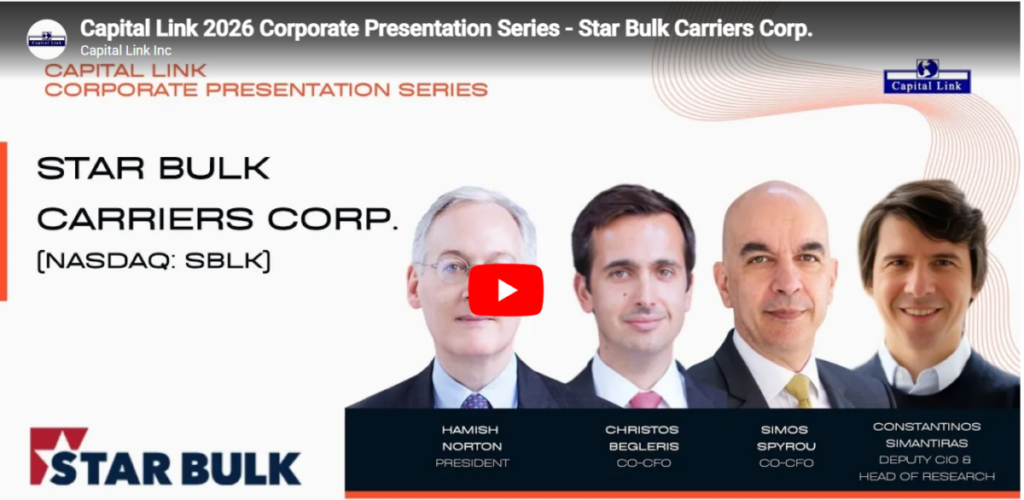
Star Bulk Highlights Operating Leverage As Dry Bulk Fundamentals Strengthen
Benzinga· 2026-03-30 18:35
Company Positioning and Scale - Fleet growth is expected to increase modestly to approximately 3.5% over the next two years, but structural inefficiencies, including increased drydock activity due to aging vessels, may reduce effective fleet growth by at least 0.5% annually [1][2] Market Dynamics: Supply Side - The order book remains low at approximately 12.5% of the fleet, with shipyard capacity constrained through at least the second half of 2029, as yards prioritize complex vessel types like LNG carriers and container ships [2] - Environmental regulations and efficiency requirements are expected to incentivize slower steaming and fleet renewal, supporting tighter effective supply [2] Geopolitics and Rate Support Dynamics - Geopolitical developments have driven bunker fuel prices significantly higher, which can support freight markets and incentivize slower vessel speeds, thereby reducing available capacity [3] Demand Outlook and Trade Flows - In 2025, dry bulk trade volumes increased by approximately 5% year-over-year, supported by strong export growth, particularly in bauxite shipments from West Africa and stable iron ore demand [4] - China's import profile remained stable, with a first-half decline offset by a second-half recovery, although elevated inventory levels may present potential downside risks [5] - Outside China, imports grew by approximately 3.2% in 2025, supported by lower commodity prices, a weaker U.S. dollar, and resilient demand across Southeast Asia, India, the Middle East, and Africa [5] Strategic Acquisitions and Fleet Expansion - Management expressed confidence in the strategic rationale behind the proposed conditional acquisition of vessels linked to the Diana Shipping–Genco transaction, which would enhance Star Bulk's scale, earnings capacity, and market positioning if completed [6]

Genco Shipping & Trading (NYSE:GNK) Conference Transcript
2026-03-19 15:02
Genco Shipping & Trading Conference Summary Company Overview - Genco Shipping & Trading is the largest U.S.-based dry bulk shipowner, headquartered in New York with offices in Singapore and Copenhagen - The company operates a fleet of 43 modern high-quality dry bulk vessels, capable of transporting a wide range of commodities including iron ore, coal, grains, cement, fertilizers, sugar, and salt [2][3] Core Business Strategy - Genco has a robust commercial platform that allows direct engagement with cargo owners, providing full-service logistics solutions and generating revenue above daily indices [3] - The company employs a low leverage model with a net loan-to-value ratio of approximately 12%, coupled with a high dividend payout strategy [4][7] - Genco's fleet includes 19 Newcastlemax and Capesize vessels focused on major bulk commodities, and 26 Ultramax and Supramax vessels for minor bulk commodities, providing a balance of high beta and stability [5][11] Financial Performance - In 2025, Genco's cargo composition was 48% iron ore, 14% grains, and 13% coal, with iron ore being crucial for steel production [6] - The company has paid $270 million in dividends and reduced debt by nearly $250 million, maintaining a strong financial position [7][8] - Genco's Q4 2025 dividend was $0.50 per share, representing an annualized yield of close to 10%, the highest since Q4 2022 [14][19] - EBITDA for Q4 2025 reached $42 million, contributing to half of the total EBITDA for the year [16] Market Dynamics - The Baltic Dry Index has shown strong performance, with Cape rates averaging $23,000 per day and Supramax rates at $12,000 per day, driven by robust Atlantic iron ore exports, particularly from Brazil [21][22] - Guinean bauxite exports have increased by 30% year-to-date, with 75% shipped to China, indicating strong demand for Capesize vessels [22] - The current order book for dry bulk vessels is about 12%-13% of the fleet, with 11% of the existing fleet being over 20 years old, suggesting a need for replacement tonnage [23] Corporate Governance - Genco is recognized for its strong corporate governance, being the only U.S. filer with no related party transactions and ranking in the top quartile among public shipping companies [12][13] Risk Management - The company is well-positioned to manage geopolitical risks and market volatility due to its low leverage and strong balance sheet, allowing for continuous capital returns to shareholders [49][50] - Genco monitors macroeconomic factors and commodity demand closely, particularly in developing Asia and China, which are significant for the dry bulk market [48] Future Outlook - Genco is optimistic about 2026 and beyond, expecting continued growth in iron ore and bauxite trades, with a focus on larger ships to capitalize on these trends [25][34] - The company plans to maintain its strategy of prioritizing dividends while also investing in fleet renewal and growth opportunities as market conditions allow [41][50]

United Maritime (USEA) - 2025 Q4 - Earnings Call Transcript
2026-03-12 15:02
Financial Data and Key Metrics Changes - In Q4 2025, the company generated net revenues of $6.6 million and EBITDA of $1.5 million, reflecting a decline compared to the same period last year due to a reduction in fleet and softer market conditions [3][12] - For the full year 2025, net revenue totaled $37.8 million, adjusted EBITDA was $12.9 million, and the net loss reached $6.2 million [12] - Daily operating expenses were successfully reduced to approximately $6,300 per day [13] Business Line Data and Key Metrics Changes - The company executed strategic initiatives to enhance earnings, including divesting lower-returning assets and redeploying proceeds into higher-earning Capesize exposure [4] - The fleet utilization remained high at 97.6%, and the fourth quarter TCE was $14,129, consistent with the same period in 2024 [6] Market Data and Key Metrics Changes - The Baltic Kamsarmax Index averaged about $14,800 in early 2026, up from $9,600 during the same period in 2025, while the Baltic Capesize Index averaged about $23,000, compared to $13,000 for the same period last year [8] - The Panamax market showed strong growth in grain and minor bulk ton-miles, while coal trade has moderated [9] Company Strategy and Development Direction - The company aims to transform into a strong cash flow engine, with a disciplined capital allocation approach and a focus on profitable investments [18][19] - The strategy includes acquiring Capesize vessels under profitable time charters and maintaining a balanced commercial strategy between index-linked exposure and fixed rates [7][8] Management's Comments on Operating Environment and Future Outlook - Management expressed confidence in sustaining competitive distributions while pursuing growth opportunities, citing strong fundamentals in the Panamax market and improved market conditions [4][7] - The geopolitical crisis in the Middle East adds uncertainty, but management expects increased coal trade flows to offset reduced cargo demand from the Arabian Gulf [9][25] Other Important Information - The company declared its thirteenth consecutive quarterly dividend, reflecting a commitment to capital returns, with cumulative cash dividends of approximately $1.84 per share since the program's initiation [3][18] - The company has engaged in extensive share repurchases as part of its capital returns options [18] Q&A Session Summary Question: Dividend policy and future payouts - Management intends to establish a clear formula for dividends, emphasizing a commitment to generous shareholder returns [21][22] Question: Acquisition details of the Squireship - The fixed rate for the Squireship is approximately $28,000, with a strategy to finance the acquisition at a leverage ratio of around 60%-65% [23] Question: Implications of coal trade flows - Management expects increased coal trades due to disruptions in LNG trade, particularly in the context of rising electrification needs [24][25] Question: Fleet presence in the Gulf area - Management noted that about 2% of the global fleet is in the Gulf area, which could impact market dynamics [26]
HTCO Leverages Upward BDI Cycle to Unleash Full Momentum for Earnings Growth
Prnewswire· 2026-03-11 13:00
Core Insights - The company believes that a window for earnings growth has opened due to the continuous rise of the Baltic Dry Index (BDI), which is a leading indicator of the global dry bulk shipping market [1] - The upward trend of the BDI is expected to enhance the profit potential of the company's core business, driven by sustained freight rate hikes and expanded market demand [1] - The company is well-positioned to capture freight rate increases and translate growing market demand into incremental business revenue [1] Industry Context - The BDI is highly correlated with the operating performance of dry bulk shipping enterprises, and its upward trend drives up freight rates across all vessel types [1] - The industry's operating leverage, characterized by rigid fixed costs, allows revenue increments from rising freight rates to be rapidly converted into profit growth [1] Company Strategy - The company has been optimizing fleet operational efficiency and maximizing profit margins per unit of shipping capacity by improving vessel turnover and controlling operating costs [1] - Efficient route scheduling and customer resource integration capabilities enable the company to quickly satisfy newly added transportation demand and boost market share [1] - The company's precise planning in fleet structure and route layout allows it to effectively capture freight rate dividends from the upward movement of various vessel types [1]

Pangaea Logistics Solutions(PANL) - 2025 Q4 - Earnings Call Presentation
2026-03-11 12:00
Safe Harbor 4Q25 Earnings Call Presentation This presentation may include certain forward-looking statements within the meaning of the Private Securities Litigation Reform Act of 1995, including statements regarding future financial performance, future growth and future acquisitions. These statements are based on Pangaea's and managements' current expectations or beliefs and are subject to uncertainty and changes in circumstances. Actual results may vary materially from those expressed or implied by the sta ...

PACIFIC BASIN(02343) - 2025 Q4 - Earnings Call Transcript
2026-03-03 11:02
Financial Performance - In 2025, the company generated an EBITDA of $263.1 million, an underlying profit of $39.2 million, and a net profit of $58.2 million [2][3] - The balance sheet remained strong with a net cash position of $134 million and an undrawn committed facility of $485.5 million [3][10] - Total shareholder return for 2025 was 46%, with a total distribution of $19.5 million through share buybacks and dividends [3][4] Business Line Performance - Average daily TCE earnings for Handysize and Supramax vessels were $11,490 and $12,850, representing decreases of 11% and 6% year-on-year respectively [6][8] - Operating activity margin improved, contributing $22.9 million in 2025, with operating activity days increasing by 1% year-on-year [8] - The company maintained cost efficiency, with average daily operating costs for both segments remaining stable at around $4,780 [8][9] Market Dynamics - Market freight rates fell significantly in the first half of 2025 but gradually picked up in the latter part of the year [5] - The average market spot rates for Handysize and Supramax vessels were approximately $10,570 and $11,610 per day, reflecting a decrease of 5% and 10% year-on-year respectively [5][6] - Ton-mile demand grew by 4%, supported by China's exports and imports, while grain loadings decreased by 6% due to reduced exports from Ukraine and Russia [17][19] Company Strategy and Industry Competition - The company is committed to returning value to shareholders through dividends and share buybacks, with an amended dividend policy to pay out 50% to 100% of annual net profit [4][14] - The strategic focus for 2026 includes renewing and expanding the fleet selectively, improving cost structure, and leveraging digitalization and AI technologies for efficiency [26][27] - The company plans to acquire four newbuildings for $119.2 million, scheduled for delivery in the first half of 2028, enhancing fleet capabilities [21][22] Management Commentary on Operating Environment and Future Outlook - Management acknowledged the geopolitical risks and market challenges, particularly the recent escalation of conflict in the Middle East [2][5] - The outlook for 2026 appears stable, with freight forward agreements indicating a healthy market despite potential disruptions [6][26] - The company expects ton-mile demand to rise by about 3.5% in 2025 and a further 2.5% in 2026, reinforcing structural demand support [23][25] Other Important Information - The company realized $66.8 million from the sale of older vessels and maintained a disciplined approach to capital allocation [10][12] - The total net book value of the fleet was $1.6 billion, with an estimated market value of $1.96 billion, indicating a healthy buffer above book values [11] Q&A Session Summary Question: Shareholder returns and buyback strategy - Management explained the rationale behind the $40 million buyback, emphasizing the importance of signaling confidence in the business while acknowledging the market cap above NAV [30][32] Question: Outlook on supply and demand - Management discussed the current market dynamics, noting that disruptions could lead to improved market conditions despite supply potentially exceeding demand [30][34] Question: Dry bulk market rates sustainability - Management indicated that various disruptions, including geopolitical tensions, are influencing market rates, making it difficult to predict sustainability [41][44] Question: Fleet transfer to Singapore - Management confirmed that the transfer of vessels to Singapore is ongoing, with expected costs decreasing as the process continues [45][46] Question: Performance versus index - Management acknowledged past performance fluctuations and indicated that the company is positioned to catch up with market trends as conditions improve [49][50] Question: Vessel acquisition strategy - Management expressed a desire to maintain optionality in vessel acquisitions, balancing newbuilds and time charters to optimize fleet performance [51][52]

PACIFIC BASIN(02343) - 2025 Q4 - Earnings Call Transcript
2026-03-03 11:02
Financial Data and Key Metrics Changes - In 2025, the company generated an EBITDA of $263.1 million, an underlying profit of $39.2 million, and a net profit of $58.2 million [2][3] - The balance sheet remained strong with a net cash position of $134 million and an undrawn committed facility of $485.5 million, indicating strong liquidity [3][12] - Total shareholder return for 2025 was 46%, with a total distribution of $19.5 million through share buybacks and dividends [3][4] Business Line Data and Key Metrics Changes - Average daily TCE earnings for Handysize and Supramax vessels were $11,490 and $12,850, representing decreases of 11% and 6% year-on-year respectively [6][10] - Operating activity margin improved, contributing $22.9 million in 2025, with operating activity days increasing by 1% year-on-year to 27,850 days [9] - The average daily operating costs for both Handysize and Supramax vessels remained stable at around $4,780, while depreciation costs rose slightly [9][10] Market Data and Key Metrics Changes - Market freight rates fell significantly in the first half of 2025 but gradually picked up later in the year, with average spot rates for Handysize and Supramax vessels at $10,570 and $11,610 per day, down 5% and 10% year-on-year respectively [5][6] - The FFA saw an uplift since the beginning of 2026, averaging $13,730 for Handysize and $15,580 for Supramax, indicating a stable outlook [6] - Ton-mile demand grew 4% in 2025, supported by China's exports and imports, while grain loadings decreased by 6% due to reduced exports from Ukraine and Russia [18][19] Company Strategy and Development Direction - The company remains committed to returning value to shareholders through dividends and share buybacks, with a new dividend policy to pay out 50% to 100% of annual net profit, excluding disposal gains, when in a net cash position [4][15] - The strategy includes renewing and expanding the fleet selectively, focusing on modern second-hand vessels and targeted new buildings [27][28] - The company is transforming its fuel team into a sustainable energy solution team to drive further decarbonization and improve efficiency [28] Management's Comments on Operating Environment and Future Outlook - The management highlighted the geopolitical risks and market challenges, particularly the recent escalation of conflict in the Middle East, which could create market inefficiencies [2][5] - Despite the challenges, the management expressed confidence in the company's ability to navigate the market and capture opportunities [12][28] - The outlook for the dry bulk market remains positive, with expectations of stable growth in demand despite geopolitical disruptions [23][26] Other Important Information - The company realized $66.8 million from the sale of older vessels and maintained a disciplined approach to capital allocation, remaining debt-free on a net basis [12][13] - The total net book value of the fleet was $1.6 billion, with an estimated market value of $1.96 billion, reflecting a healthy buffer above book values [12] Q&A Session Summary Question: Shareholder returns and buyback strategy - The management explained that the $40 million buyback is a signal of confidence in the business and market, despite trading above fair market NAV [33][34] Question: Outlook on strong rates versus supply exceeding demand - The management noted that disruptions in the market, including geopolitical events, have positively impacted rates, and they remain optimistic about future market conditions [35][36] Question: Dry bulk market rates sustainability - The management indicated that ongoing disruptions are holding up rates, but predicting future trends remains challenging [42][44] Question: Fleet transfer to Singapore and associated costs - The transfer is ongoing, with expected costs decreasing as the process continues, and it is primarily a corporate organizational change rather than operational [46][48] Question: Performance versus index and future outperformance - The management acknowledged past performance variations and expressed confidence in catching up with market trends as conditions improve [50][52] Question: Vessel acquisition strategy - The management emphasized the importance of maintaining optionality in vessel acquisitions and the potential for both new orders and exercising options [54][56]
PACIFIC BASIN(02343) - 2025 Q4 - Earnings Call Transcript
2026-03-03 11:00
Financial Data and Key Metrics Changes - In 2025, the company generated an EBITDA of $263.1 million, an underlying profit of $39.2 million, and a net profit of $58.2 million [2][3] - The balance sheet remained strong with a net cash position of $134 million and an undrawn committed facility of $485.5 million, indicating strong liquidity [3][12] - Total shareholder return for 2025 was 46%, with a total distribution of $19.5 million through share buybacks and dividends [3][4] Business Line Data and Key Metrics Changes - Average daily TCE earnings for Handysize and Supramax vessels were $11,490 and $12,850, representing decreases of 11% and 6% year-on-year respectively [6][8] - Operating activity margin improved, contributing $22.9 million in 2025, with operating activity days increasing by 1% year-on-year to 27,850 days [8][10] - Average daily operating expenses remained stable at around $4,780, while depreciation costs rose slightly by 2% for Handysize and 6% for Supramax [9][10] Market Data and Key Metrics Changes - Market freight rates fell significantly in the first half of 2025, with Handysize and Supramax vessels averaging about $10,570 and $11,610 per day, down 5% and 10% year-on-year respectively [5][6] - The FFA saw an uplift since the beginning of 2026, averaging $13,730 for Handysize and $15,580 for Supramax, indicating a stable outlook [6][28] - Ton-mile demand grew 4% in 2025, supported by China's exports and imports, while grain loadings decreased by 6% due to reduced exports from Ukraine and Russia [19][20] Company Strategy and Development Direction - The company remains committed to returning value to shareholders through dividends and share buybacks, with a new dividend policy allowing for distributions of up to 100% of annual net profit when in a net cash position [4][15] - The strategic focus for 2026 includes renewing and expanding the fleet selectively, improving cost structure, and leveraging digitalization and AI technologies for efficiency [29][30] - The company plans to acquire four new Handysize vessels for $119.2 million, scheduled for delivery in the first half of 2028, enhancing fleet capabilities [22][23] Management's Comments on Operating Environment and Future Outlook - The management highlighted that geopolitical risks remain elevated, particularly with the recent escalation in the Middle East, which could create market inefficiencies [2][5] - Despite the challenges, the company is optimistic about the market outlook, noting that disruptions could lead to increased ton-mile demand [24][28] - The management expects the dry bulk market to remain resilient, with structural demand support despite geopolitical and energy transition impacts [24][27] Other Important Information - The company realized $66.8 million from the sale of older vessels and maintained a disciplined approach to capital allocation, remaining debt-free on a net basis [12][13] - The total net book value of the fleet was $1.6 billion, with an estimated market value of $1.96 billion, reflecting a healthy buffer above book values [12] Q&A Session Summary Question: Shareholder returns and buyback strategy - The management explained that the $40 million buyback is a signal of confidence in the business, despite trading above NAV, and they are ready to act when the timing is right [32][34] Question: Outlook on TCE rates and market disruptions - The management noted that disruptions, including geopolitical events, have positively impacted market conditions, leading to improved rates despite supply exceeding demand [42][46] Question: Impact of fleet transfer to Singapore - The transfer of vessels to Singapore is ongoing, with expected costs decreasing as the project progresses, and it is primarily a corporate organizational change rather than operational [46][48] Question: Performance versus index and future acquisitions - The management acknowledged past performance fluctuations but expressed optimism about catching up with market indices as conditions improve [50][54]
Diana Shipping(DSX) - 2025 Q4 - Earnings Call Transcript
2026-02-26 15:02
Financial Data and Key Metrics Changes - For Q4 2025, time charter revenues were $52.1 million, down from $57.1 million in Q4 2024, while adjusted EBITDA decreased to $19.3 million from $25.9 million year-on-year [9][10] - Net income for Q4 2025 was $3.1 million, compared to $9.7 million in the same quarter last year, with diluted earnings per share remaining at $0.02 for both quarters [10][12] - For the full year 2025, time charter revenues totaled $213.5 million, down from $228.2 million in 2024, while net income increased to $17.8 million from $12.7 million in 2024 [13][14] Business Line Data and Key Metrics Changes - Fleet utilization reached 99.7% for the year ended December 31, 2025, with an average of 36 vessels operated compared to 38 vessels in the same quarter last year [5][12] - Time charter equivalent for Q4 averaged $15,397, a 1% decrease from $16,589 in Q4 2024, with operating expenses increasing by 6% to $20.3 million [12][13] Market Data and Key Metrics Changes - The dry bulk market saw a recovery in the second half of 2025, with Capesize vessels peaking at $45,000 per day in December, up from less than $10,000 per day earlier in the year [3][19] - Global dry seaborne volumes edged up to 7.2 billion metric tons in 2025, with iron ore and coal accounting for around 55% [22][23] Company Strategy and Development Direction - The company is focused on a disciplined chartering strategy, securing medium to long-term charters to ensure earnings visibility and resilience against market downturns [8][17] - Diana Shipping is pursuing strategic acquisitions, including a proposal to acquire Genco Shipping & Trading, and has nominated candidates for Genco's board to explore this opportunity [6][32] Management's Comments on Operating Environment and Future Outlook - Management noted that 2025 was marked by geopolitical disruptions affecting trade, but the second half saw a recovery supported by China's economic stimulus and infrastructure spending [3][21] - The company anticipates continued growth in iron ore trade and a stable global GDP growth of around 3.3% for 2026, despite potential declines in coal imports [26][29] Other Important Information - The company declared a quarterly cash dividend of $0.01 per common share for Q4 2025, totaling approximately $1.16 million, bringing cumulative dividends paid since 2021 to $2.70 per share [7][17] - Diana Shipping achieved a CDP score of B for environmental disclosure and a 31% score from S&P Global for investor-focused ESG ratings [31] Q&A Session Summary - No questions were raised during the Q&A session, and the call concluded with management expressing gratitude for participation [34][36]