FLUX

Search documents
X @Santiment
Santiment· 2026-02-17 21:16
RT Santiment (@santimentfeed)🧑💻 Here are crypto's top BSC & Binance Chain projects by development. Directional indicators represent each project's ranking rise or fall since last month:➡️ 1) @binance $BTCB 🥇📈 2) @duskfoundation $DUSK 🥈📈 3) @zcash $ZEC 🥉📈 4) @runonflux $FLUX📉 5) @trustwallet $TWT📉 6) @binance $BNB📉 7) @beefyfinance $BIFI📈 8) @bandprotocol $BAND📉 9) @automatanetwork $ATA📈 10) @saito $SAITO📖 Read about @santimentfeed's methodology for covering development activity for each project, objectivel ...
X @Santiment
Santiment· 2026-02-17 19:50
RT Santiment (@santimentfeed)🧑💻 Here are crypto's top BSC & Binance Chain projects by development. Directional indicators represent each project's ranking rise or fall since last month:➡️ 1) @binance $BTCB 🥇📈 2) @duskfoundation $DUSK 🥈📈 3) @zcash $ZEC 🥉📈 4) @runonflux $FLUX📉 5) @trustwallet $TWT📉 6) @binance $BNB📉 7) @beefyfinance $BIFI📈 8) @bandprotocol $BAND📉 9) @automatanetwork $ATA📈 10) @saito $SAITO📖 Read about @santimentfeed's methodology for covering development activity for each project, objectivel ...
X @Santiment
Santiment· 2026-02-17 19:10
RT Santiment (@santimentfeed)🧑💻 Here are crypto's top BSC & Binance Chain projects by development. Directional indicators represent each project's ranking rise or fall since last month:➡️ 1) @binance $BTCB 🥇📈 2) @duskfoundation $DUSK 🥈📈 3) @zcash $ZEC 🥉📈 4) @runonflux $FLUX📉 5) @trustwallet $TWT📉 6) @binance $BNB📉 7) @beefyfinance $BIFI📈 8) @bandprotocol $BAND📉 9) @automatanetwork $ATA📈 10) @saito $SAITO📖 Read about @santimentfeed's methodology for covering development activity for each project, objectivel ...
X @Santiment
Santiment· 2026-02-17 16:44
🧑💻 Here are crypto's top BSC & Binance Chain projects by development. Directional indicators represent each project's ranking rise or fall since last month:➡️ 1) @binance $BTCB 🥇📈 2) @duskfoundation $DUSK 🥈📈 3) @zcash $ZEC 🥉📈 4) @runonflux $FLUX📉 5) @trustwallet $TWT📉 6) @binance $BNB📉 7) @beefyfinance $BIFI📈 8) @bandprotocol $BAND📉 9) @automatanetwork $ATA📈 10) @saito $SAITO📖 Read about @santimentfeed's methodology for covering development activity for each project, objectively, using enhanced github even ...
40倍推理加速!复旦&微软:用「非线性流」拟合复杂轨迹,2步生成媲美原画
量子位· 2026-02-15 03:45
Core Insights - The article introduces ArcFlow, a novel image generation acceleration framework developed by Fudan University and Microsoft Research Asia, which addresses the long inference time and high computational costs associated with diffusion models by employing a non-linear flow mechanism instead of traditional linear simplification strategies [2][9]. Group 1: ArcFlow Innovations - ArcFlow achieves significant improvements, requiring only 2 steps (2 NFE) while maintaining high image quality comparable to the teacher model, resulting in approximately 40 times faster inference and 4 times faster training convergence [3][14]. - The method requires fine-tuning of less than 5% of the parameters, making it resource-efficient and quick to converge [3][15]. Group 2: Challenges in Existing Methods - Existing distillation methods assume a linear shortcut between noise and the final image, leading to geometric mismatch and poor image quality due to the complex, curved trajectories of teacher models [5][6]. - Traditional methods often require 40 to 100 steps for denoising, making real-time applications challenging and resulting in quality degradation when attempting to reduce steps [5][6]. Group 3: ArcFlow's Mechanisms - ArcFlow introduces momentum parameterization to capture the continuity of speed, eliminating sampling redundancy by modeling the speed field as a mixture of continuous momentum processes [11]. - The framework derives a closed-form analytical solution based on momentum equations, allowing for precise trajectory integration and high-accuracy flow matching [12]. - ArcFlow's trajectory distillation strategy preserves the non-linear characteristics of the teacher model, aligning instantaneous speeds without disrupting the pre-trained weight distribution, thus enhancing training efficiency [13]. Group 4: Experimental Results - ArcFlow has been validated on large-scale models like Qwen-Image-20B and FLUX.1-dev, demonstrating superior image quality and semantic consistency in benchmark tests compared to existing state-of-the-art methods [15][19]. - The results indicate that ArcFlow generates clearer images with rich details and diversity, avoiding issues like background blurriness and structural distortion seen in linear distillation methods [19]. Group 5: Conclusion - ArcFlow represents a significant advancement in knowledge distillation for image generation, effectively leveraging the prior knowledge of pre-trained teacher models while ensuring faster convergence and higher quality outputs [22].

X @Santiment
Santiment· 2025-11-24 18:28
RT Santiment (@santimentfeed)🧑💻 Here are crypto's top BSC & Binance Chain projects by development. Directional indicators represent each project's ranking rise or fall since last month:➡️ 1) @binance $BTCB 🥇📈 2) @runonflux $FLUX 🥈📈 3) @binance $BNB 🥉📉 4) @zcash $ZEC➡️ 5) @trustwallet $TWT📈 6) @duskfoundation $DUSK➡️ 7) @bandprotocol $BAND📈 8) @beefyfinance $BIFI📈 9) @0xproject $ZRX📉 10) @saito $SAITO📖 Read about @santimentfeed's methodology for covering development activity for each project, objectively, u ...
ICCV 2025|训练太复杂?对图片语义、布局要求太高?图像morphing终于一步到位
机器之心· 2025-07-18 00:38
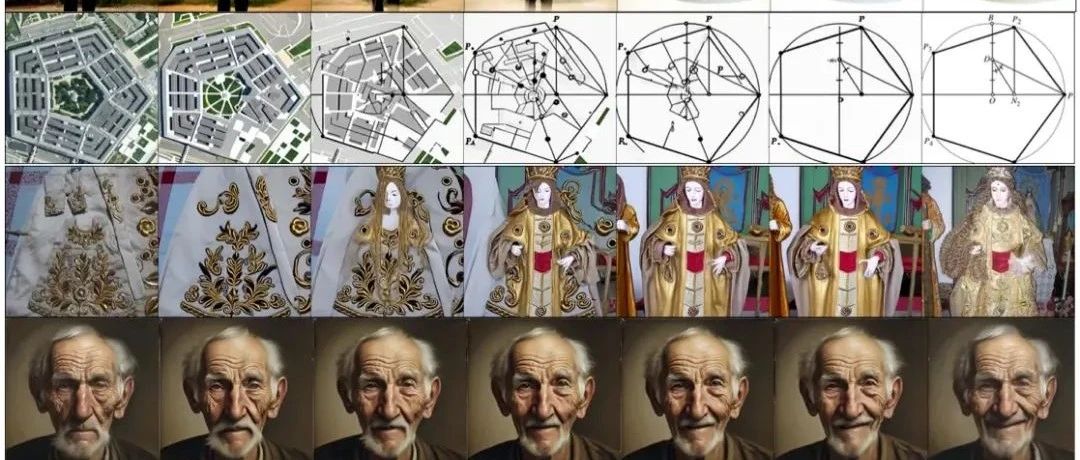
Core Viewpoint - The article introduces FreeMorph, a novel training-free image morphing method that enables high-quality and smooth transitions between two input images without the need for pre-training or additional annotations [5][32]. Group 1: Background and Challenges - Image morphing is a creative task that allows for smooth transitions between two distinct images, commonly seen in animations and photo editing [3]. - Traditional methods relied on complex algorithms and faced challenges with high training costs, data dependency, and instability in real-world applications [4]. - Recent advancements in deep learning methods like GANs and VAEs have improved image morphing but still struggle with training costs and adaptability [4][5]. Group 2: FreeMorph Methodology - FreeMorph addresses the challenges of image morphing by eliminating the need for training, achieving effective morphing with just two images [5]. - The method incorporates two key innovations: spherical feature aggregation and prior-driven self-attention mechanisms, enhancing the model's ability to maintain identity features and ensure smooth transitions [11][32]. - A step-oriented motion flow is introduced to control the transition direction, allowing for a coherent and gradual morphing process [21][32]. Group 3: Experimental Results - FreeMorph has been evaluated against existing methods, demonstrating superior performance in generating high-fidelity results across diverse scenarios, including images with varying semantics and layouts [27][30]. - The method effectively captures subtle changes, such as color variations in objects or nuanced facial expressions, showcasing its versatility [27][30]. Group 4: Limitations - Despite its advancements, FreeMorph has limitations, particularly when handling images with significant semantic or layout differences, which may result in less smooth transitions [34]. - The method inherits biases from the underlying Stable Diffusion model, affecting accuracy in specific contexts, such as human limb structures [34].
2025年哪款模型最受欢迎?Poe最新报告:DeepSeek降温、可灵成黑马
Founder Park· 2025-05-15 11:34
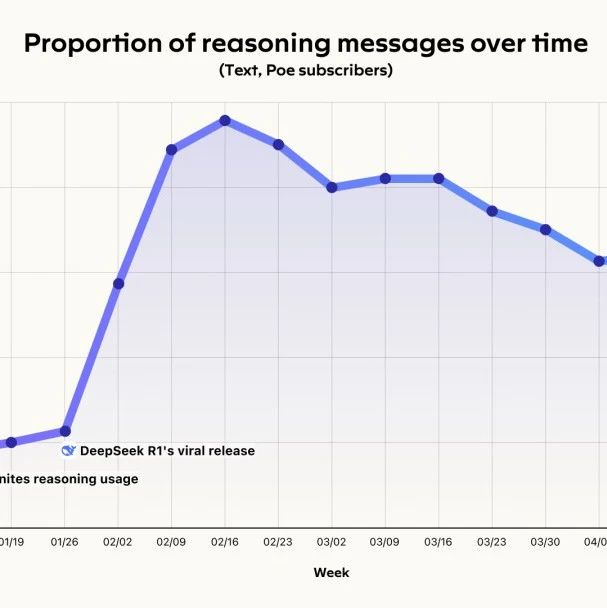
Core Insights - Poe's latest report analyzes AI model usage trends from January to May 2025, focusing on user engagement across text, reasoning, image, video, and audio domains [1][2] Group 1: Model Performance and Market Trends - The popularity of the DeepSeek model has declined, with its market share dropping from a peak of 7% in mid-February to 3% by the end of April [4][7] - New flagship models from the same provider tend to capture market share from their predecessors, leading to a rapid shift in user preferences towards newer models [4][7] - The share of text messages sent to reasoning models increased from approximately 2% to about 10%, peaking during DeepSeek's popularity [9][11] Group 2: Reasoning Models - The number of reasoning models has significantly increased, reflecting a growing trend towards more precise and reliable handling of complex tasks [8] - Gemini 2.5 Pro gained approximately 30% of reasoning message share within six weeks of its release [11] - Users are quickly transitioning to OpenAI's latest reasoning models, indicating a strong preference for newer, more powerful options [12] Group 3: Image Generation Models - The GPT image generation model, GPT-Image-1, achieved a usage rate of 17% within two weeks of its API launch [17] - Google's Imagen 3 series saw its usage grow from about 10% to 30%, while Black Forest Labs' FLUX series maintained a market share of approximately 35% [17][18] Group 4: Video Generation Models - Kuaishou's Kling video generation model rapidly captured about 30% of the market share, with Kling-2.0-Master accounting for 21% of all video generation requests within three weeks of its release [21][22] - Runway, a pioneer in video generation, experienced a 40% decline in usage share, dropping to around 20% [23] Group 5: Audio Generation Models - ElevenLabs dominated the audio generation space, handling about 80% of TTS requests from subscribers [24] - The audio generation market is becoming increasingly competitive, with new players offering unique voice options and performance features [24]