Foreign exchange reserves

Search documents
Gold Reserves Drop Hit Forex Reserves
Rediff· 2026-03-28 06:15
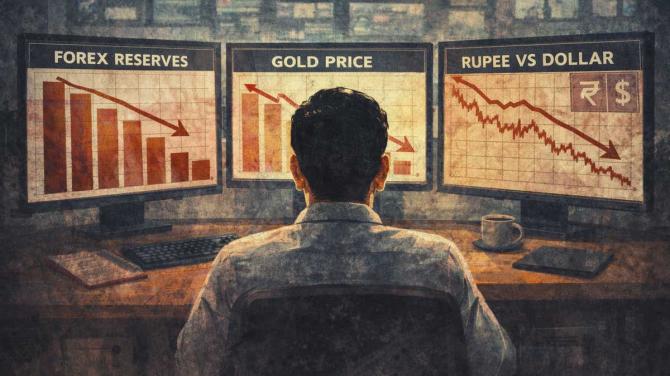
Core Insights - India's foreign exchange reserves have decreased significantly, falling by $11.41 billion to $698.35 billion during the week ended March 20, marking a total decline of over $30 billion in the past three weeks [4][7]. Group 1: Forex Reserves Overview - The decline in total reserves was primarily due to a sharp drop in gold reserves, which fell by $13.49 billion to $117.19 billion during the reported week [6][7]. - Foreign currency assets, however, increased by $2.13 billion to $557.69 billion, indicating some resilience in this component of the reserves [6][7]. Group 2: Economic Implications - The Reserve Bank of India's (RBI) large forward dollar short position is tightening effective reserve adequacy, reducing the import cover buffer [7][9]. - Current forex reserves provide import cover for 11 months, but after adjusting for forward positions, this drops to 9.4 months [9]. - The rupee has depreciated over 4% in March and nearly 10% in FY26, the worst performance since 2011-2012 [11]. Group 3: Future Projections - If the current geopolitical tensions in West Asia persist, India's forex reserves could decline to $636 billion by FY27, with a projected balance of payments deficit of $40 billion [16]. - Rising crude oil prices are expected to increase India's import bill to $911 billion in FY27, up from $814 billion in FY26 [15].


Forex Reserves See Sharp Weekly Fall
Rediff· 2026-01-12 02:31
Core Insights - India's foreign exchange reserves experienced a significant decline of $9.8 billion, reaching $686.80 billion in the week ended January 2, marking the steepest weekly drop in over a year [2][3] - The decline was primarily driven by a sharp decrease in foreign currency assets, which fell by $7.6 billion to $552 billion, alongside a $2.1 billion reduction in gold reserves [2][3] Group 1: Reserve Decline Factors - The Reserve Bank of India (RBI) increased its efforts to stabilize the foreign exchange market, responding to pressure on the rupee amid ongoing capital outflows [3][7] - The decline in reserves was attributed to approximately $7 billion in dollar sales by the RBI, with an additional $2.7 billion loss due to revaluation from falling gold prices, which decreased by 4.4% week-on-week [4][8] Group 2: Market Conditions - The rupee depreciated by 0.38% against the US dollar during the reported week, influenced by corporate demand for dollars and uncertainties surrounding a delayed US trade deal [7][9] - The RBI's intervention aimed to mitigate volatility in the foreign exchange market, with no specific target level for the rupee but a focus on reducing excessive market shocks [8] Group 3: Future Outlook - The rupee has faced continued pressure, having depreciated 4.74% in 2025, with an additional decline of 0.32% noted in January [9] - Factors contributing to ongoing pressure include potential US sanctions, an unlikely trade deal, and a significant stock of maturing short forward positions, which reached $66.04 billion by the end of November [9]
Global Markets Brace for UBS Fund Exposure to Bankrupt First Brands, Rising JGB Yields, and Robust Australian Reserves
Stock Market News· 2025-10-08 06:08
Group 1: UBS Funds and First Brands Bankruptcy - UBS funds are facing over $500 million in exposure to the bankrupt auto-parts supplier First Brands Group, with UBS Hedge Fund Solutions holding the largest unsecured claim of $233.7 million [3] - First Brands Group filed for Chapter 11 bankruptcy protection with liabilities exceeding $10 billion, following an unsuccessful attempt to refinance $6 billion in loans [4] - The bankruptcy filing indicated estimated liabilities ranging from $10 billion to $50 billion against assets of $1 billion to $10 billion, raising concerns about broader stress in corporate debt markets [4] Group 2: Japanese Government Bond Yields - The yield on the 10-year Japanese government bond (JGB) rose by 2.0 basis points to 1.695%, nearing 17-year highs amidst political uncertainty and expectations of continued monetary easing under new Prime Minister Sanae Takaichi [5][6] - The upward trend in JGB yields reflects a broader market shift as investors respond to changing economic conditions and the Bank of Japan's cautious normalization of monetary policy [6] - The Japanese government faces higher servicing costs on its substantial debt load, which exceeds 250% of GDP, due to rising yields [6] Group 3: Australia's Foreign Exchange Reserves - Australia's foreign exchange reserves increased to A$107.13 billion in September from A$103.9 billion in August, indicating economic stability and capacity for exchange rate management [7][8] - Healthy foreign exchange reserves are crucial for maintaining exchange rate stability, influencing interest rates, and bolstering investor confidence [8] - The Reserve Bank of Australia is expected to maintain reserves at historically high levels through 2025, with a focus on diversification into non-traditional assets and currencies [9]