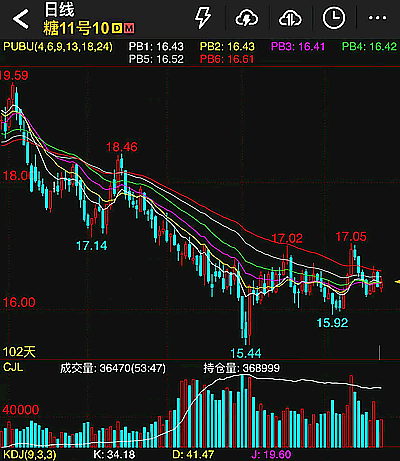
ICE 11号原糖期货

Search documents
本周原糖期货周评:多空博弈加剧,市场在震荡中寻求平衡
Sou Hu Cai Jing· 2025-08-23 15:11
Core Viewpoint - The sugar market is experiencing a delicate balance due to mixed factors, with concerns over Brazilian sugarcane quality providing support while a weaker dollar has injected upward momentum into prices [3][5]. Price Movements - As of Friday, October futures for New York raw sugar closed at 16.48 cents per pound, up 0.13 cents (0.79%), with a weekly increase of 0.24%. March contracts reached 17.15 cents per pound, up 0.41%, while May contracts slightly rose to 16.85 cents per pound [3]. - London white sugar futures also increased, with the October contract rising by $4.10 to $486.70 per ton, reflecting a 0.85% increase and a weekly rise of 1.14% [3]. Key Factors Analysis - Concerns over Brazilian sugarcane quality are the primary support for the market. The Brazilian Sugarcane Industry Association (Unica) reported a year-on-year decline in the ATR (total recoverable sugar) levels in the second half of July, which is a fundamental reason for the anticipated drop in production [3]. - Analysts from Safras & Mercado noted that the peak harvesting period for Brazilian sugarcane has passed in July, leading to a gradual decrease in crushing volumes, which will tighten market supply and support prices, particularly in the domestic market [4]. Demand Signals - Positive signals in global demand have emerged, with China's sugar imports in July surging 76% year-on-year to 740,000 tons, and Pakistan recently tendering for 200,000 tons of refined sugar, indicating robust global sugar demand [5]. Market Outlook - The ICE raw sugar market is expected to continue a pattern of technical consolidation alongside favorable fundamentals in the short term, with Brazilian sugarcane quality and subsequent crushing data remaining focal points [6]. - As long as the supply issues in Brazil are not substantively resolved, the logic for rising sugar prices will persist. Technical indicators suggest that the market is not in extreme overbought or oversold conditions, indicating potential for continued price fluctuations around the mid-band of Bollinger Bands [6].