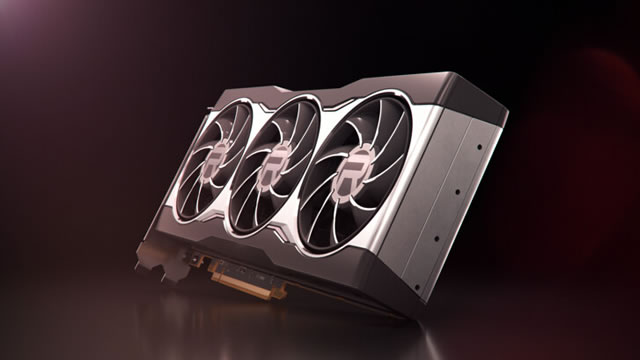
Instinct data center GPUs

Search documents
The Hidden Driver Behind AMD's Most Bullish 2026 Guidance
The Motley Fool· 2026-02-07 11:20
Core Insights - AMD anticipates a 60% annual growth in its data center segment over the next three to five years, driven by its EPYC server CPUs and Instinct data center GPUs, with a revenue increase of 39% in the fourth quarter [2][9] - The company reported a 34% year-over-year revenue increase in the fourth quarter and expects a 32% growth in the first quarter of 2026 [1][2] - AMD's AI accelerators, particularly the MI400 series chips and Helios rack-scale solutions, will significantly contribute to its growth, alongside a resurgence of CPU demand due to the evolving AI landscape [3][8] Data Center Segment - The data center segment is expected to be a major growth driver, with AMD's CEO projecting revenue growth exceeding 60% annually [2] - The server CPU market is anticipated to expand by "strong double digits" in 2026, with AMD increasing its supply capacity to meet this demand [9] - AMD is gaining market share from Intel in the server CPU market, although competition is intensifying [10][11] AI and CPU Dynamics - The evolution of AI from simple chatbots to complex agents is increasing the role of CPUs, as these agents require significant CPU resources for tasks such as web searches and data manipulation [5][6][8] - AI agents operate in a loop, utilizing both CPU and GPU resources, with the CPU handling the majority of traditional tasks [6][8] - Despite the competitive landscape with Nvidia in the GPU market, AMD's EPYC server CPUs are positioned to drive strong growth in the data center segment [11]


Meet the Monster Artificial Intelligence (AI) Chip Stock That's Crushing Nvidia and Broadcom in 2025
The Motley Fool· 2025-11-22 20:00
Core Insights - Nvidia and Broadcom are leading players in the AI semiconductor market, with Nvidia's stock price increasing by 39% and Broadcom's by 48% this year, although both are below AMD's 99% spike [2] - AMD's recent gains are attributed to its rising stature in the AI chip market, particularly in the data center segment [3][4] Company Performance - AMD's data center business is experiencing significant growth, with a 60% increase in its Fortune 100 CPU enterprise customer base this year and a doubling of new customers in the first nine months of 2025 [6] - AMD aims for a 40% revenue share of the server CPU market by the end of 2025, with a long-term goal of exceeding 50% market share [7] - The company projects a $60 billion addressable market opportunity for its data center CPUs by 2030, more than double the expected $26 billion revenue for the current year [8] Product Development - AMD's next-generation server CPU, code-named Venice, is expected to be 1.7 times more powerful and efficient than current offerings, which could enhance the adoption of its Epyc server processors [7] - The upcoming MI450 series of data center GPUs is projected to significantly boost compute performance starting in 2026 [9] Customer Adoption - AMD's data center GPUs are already being deployed by major companies, including OpenAI, Oracle, and Meta Platforms, with seven of the top 10 AI companies using its Instinct data center GPUs [10] Financial Projections - AMD anticipates a compound annual growth rate (CAGR) of over 60% for its data center business over the next three to five years, while other segments are expected to grow at 10% annually [11] - The company expects overall revenue to increase at a 35% CAGR during the same period, targeting non-GAAP earnings to exceed $20 per share [12] - If AMD achieves $20 per share in earnings before 2030, with a trading multiple of 34 times earnings, its stock price could potentially reach $680, representing a 2.8x increase from its current price [14][15]
Prediction: This AI Stock Could Become a Household Name by 2030
The Motley Fool· 2025-10-10 07:50
Core Viewpoint - The rapid growth of AI technology presents significant investment opportunities, particularly for companies like Advanced Micro Devices (AMD), which has the potential to become a leading name in the AI sector by 2030 [1][3]. Company Overview - AMD is currently overshadowed by Nvidia in the AI chip market but has diversified business operations that could enhance its prominence in the future [3][10]. - AMD's product offerings include central processing units (CPUs) and graphics processing units (GPUs) for PCs, as well as semi-custom processors for gaming consoles and embedded processors for various applications [4][5]. Market Position and Growth Potential - AMD has been selected to produce semi-custom processors for the next generation of gaming consoles from Sony and Microsoft, which are expected to feature AI capabilities [6]. - AMD's client CPU market share increased to 23.9% in Q2 2025 from 21.1% in the previous year, indicating a growing presence in the AI PC market [7]. - The revenue share for AMD's products rose by 9.8 percentage points to 27.8%, reflecting strong pricing power and demand for its AI-focused Ryzen processors [8]. Future Prospects - AMD's involvement in AI-powered gaming consoles and its increasing share in the AI PC market position it well for growth by the end of the decade [9]. - The company is also expected to gain traction in the data center GPU market through partnerships, such as with Oracle, which is expanding its data center operations [10]. - A significant contract with OpenAI for AMD's Instinct data center GPUs is anticipated to boost AMD's market presence and stock performance [11]. Valuation Metrics - AMD has a price/earnings-to-growth (PEG) ratio of 0.52, indicating that it is undervalued relative to its projected growth over the next five years [12]. - The low PEG ratio suggests that investing in AMD now could yield substantial returns as the company capitalizes on its growth potential in AI-related markets [13].
AMD's Shopping Spree Continues. Is the AI Stock a Buy?
The Motley Fool· 2025-06-09 07:55
Core Viewpoint - AMD is currently viewed as a potential sleeper stock in the AI chip market, with its stock down nearly 50% from its peak last year, as investors may have overestimated its ability to compete with Nvidia in AI chips [1] Group 1: Financial Performance - AMD's data center business is experiencing significant growth, with AI-focused revenue increasing by 57% in the first quarter to $3.7 billion, driven by its EPYC CPU and Instinct GPU franchises [2] - In the first quarter, AMD reported overall revenue growth of 36% to $7.44 billion and a 55% increase in adjusted earnings per share to $0.96 [8] - For the second quarter, AMD anticipates revenue growth of 27% to $7.4 billion, which includes an $800 million impairment due to Chinese export restrictions [9] Group 2: Strategic Acquisitions - AMD has made several strategic acquisitions to enhance its AI capabilities, including the $4.9 billion acquisition of ZT Systems to provide rack-scale solutions and high-performance systems [3] - The company also announced the acquisition of Brium, which aids in making AI software compatible across various hardware platforms, further positioning AMD to compete with Nvidia [3][4] - These acquisitions are part of a broader strategy, with AMD having made four AI-related acquisitions in the last two years, including Silo AI, Nod.AI, and Mipsology, to strengthen its AI ecosystem [4][6] Group 3: Competitive Landscape - AMD's current programming software platform, ROCm, has not achieved the same level of adoption as Nvidia's CUDA, which is critical for its future success in AI [7] - The company's ability to close the gap with Nvidia in programming software and other capabilities will be crucial for its competitive positioning in the AI market [7] - Despite the challenges, AMD's aggressive strategy and acquisitions are seen as enhancing its prospects in the growing AI market [9]