JUPITER Booster

Search documents
欧洲首台E级超算诞生
Guan Cha Zhe Wang· 2025-11-19 14:54
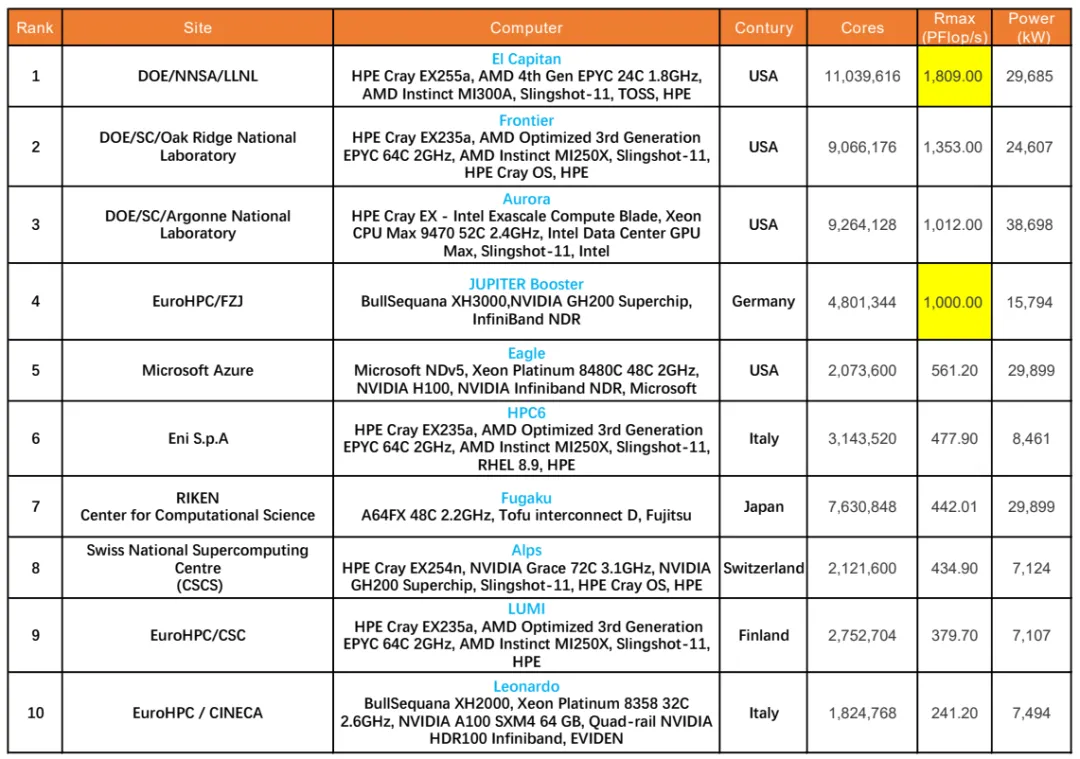
Core Insights - The 66th TOP500 supercomputer ranking was announced at the SC25 conference, highlighting the deployment of Germany's JUPITER Booster, which has achieved exascale performance, marking it as Europe's first exascale supercomputer and the fourth globally [1][8]. Group 1: Supercomputer Rankings - The top three positions in the ranking are held by the U.S. Department of Energy's El Capitan, Frontier, and Aurora, with El Capitan achieving a performance of 1.809 Exaflop/s, an increase from 1.742 Exaflop/s in the previous ranking [3][5]. - Frontier maintains its second position with a performance of 1.353 Exaflop/s, while Aurora remains third at 1.012 Exaflop/s, showing no change compared to previous rankings [5]. Group 2: European Achievements - The JUPITER Booster, based on the BullSequana XH3000 architecture, has successfully crossed the exascale threshold with a performance of 1 Exaflop/s, representing a significant milestone for Europe in the supercomputing domain [8][10]. - The presence of JUPITER, along with Finland's LUMI and Italy's Leonardo, in the TOP10 reflects the success of the EU's EuroHPC initiative, which aims to enhance Europe's competitiveness in supercomputing through collaborative resource integration [10][11]. Group 3: Global Investment Trends - Countries are significantly increasing their investments in supercomputing, with the U.S. planning to invest $1 billion for two new generation supercomputers, the UK launching a £2 billion investment for a world-class computing ecosystem, and the EU enhancing its EuroHPC network to strengthen its AI capabilities [12]. - Despite not having new systems in the TOP500 recently, China continues to advance its supercomputing research and development, indicating a trend towards a multipolar global computing landscape [12]. Group 4: International Collaboration - The competition in the supercomputing field is not a zero-sum game, as demonstrated by Europe's EuroHPC initiative, which promotes cross-national collaboration and resource integration to achieve exascale breakthroughs [13]. - There is a need for an open collaborative system across regions and disciplines to address global challenges such as climate change and energy transition, emphasizing the role of supercomputers in advancing technology for sustainable development [13].

欧洲首台E级超算诞生!TOP500新榜发布,美国三强持续领跑
Guan Cha Zhe Wang· 2025-11-19 14:48
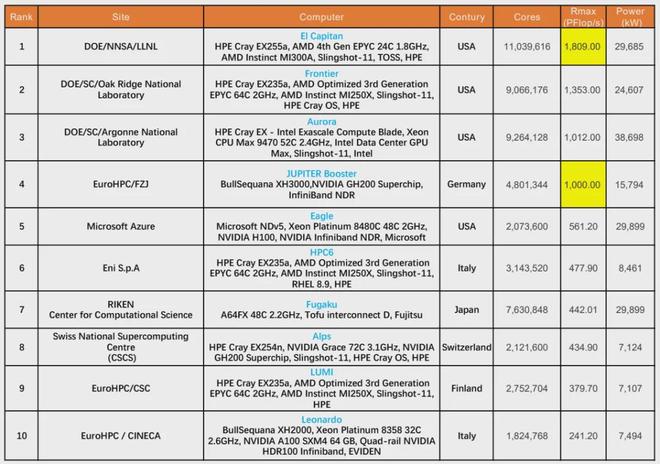
Core Insights - The 66th TOP500 list reveals that the "JUPITER Booster" from Germany has become the first E-class supercomputer in Europe, achieving a performance of 1 Exaflop/s, marking a significant milestone for European supercomputing [1][4] - The top three positions in the list remain dominated by U.S. Department of Energy's supercomputers: "El Capitan," "Frontier," and "Aurora," which have maintained their rankings without any new entrants in the top ten [1][3] Group 1: Supercomputer Rankings - "El Capitan" retains the top position with a performance of 1.809 Exaflop/s, an increase from 1.742 Exaflop/s in the previous ranking, and continues to lead in multiple benchmark tests [3] - "Frontier" holds the second position with a consistent performance of 1.353 Exaflop/s, while "Aurora" remains third with a performance of 1.012 Exaflop/s, showing no change from previous rankings [3] - The "JUPITER Booster" ranks fourth, achieving a performance of 1 Exaflop/s, making it the fourth E-class supercomputer globally [4] Group 2: Investment and Development Trends - Global investment in supercomputing is increasing, with the U.S. planning to invest $1 billion for two new generation supercomputers, focusing on integrated computing [5] - The UK has initiated the Isambard-AI project with a £2 billion investment plan to create a world-class computing ecosystem [5] - The EU is enhancing its EuroHPC high-performance computing network through the "AI Continent Action Plan," aiming to strengthen its competitive edge in the AI era [5] Group 3: International Collaboration and Future Directions - The EuroHPC initiative exemplifies successful multinational collaboration in achieving E-class breakthroughs, providing a model for international cooperation in supercomputing [6] - The supercomputing sector is characterized by technological competition, including architecture innovation and energy efficiency, necessitating a collaborative approach across regions and disciplines [6] - The focus on building a shared ecosystem and collaborative research is essential for addressing global challenges such as climate change and energy transition [6]