KeychainOS

Search documents
2025年四季度食品科技风险投资趋势(英)
PitchBook· 2026-02-24 02:55
Investment Rating - The report indicates a selective and disciplined funding environment in the foodtech sector, with a focus on higher-conviction themes and established players, suggesting a cautious investment approach moving forward [13][14][27]. Core Insights - Q4 2025 foodtech VC investment totaled $2.5 billion across 128 deals, reflecting an 8.6% decline in capital and a 16.3% drop in deal count compared to previous periods, indicating a market reset from the peak activity in 2021 [13][14]. - The exit environment for foodtech remains challenging, with total exits in 2025 amounting to only $287.7 million across 85 transactions, a significant decrease from $12.8 billion in 2024, highlighting a disconnect between public market valuations and venture-backed foodtech assets [35][36]. - Capital is increasingly concentrated in large, late-stage rounds, with notable investments in e-commerce players such as Picnic ($498.1 million), Zepto ($450 million), and GoBrands ($250 million), which together accounted for a substantial portion of the total capital invested [13][15][32]. - The alt-proteins segment, particularly precision fermentation, has shown sustained growth, with $243.9 million raised across 13 deals, indicating strong investor confidence in this category [13][16]. - The food production technology segment experienced significant growth, reaching $356.6 million across 20 deals, driven by automation solutions like Mujin's $234.5 million Series D [25][27]. Summary by Sections Foodtech Landscape - The foodtech landscape includes various segments such as alt-proteins, bioengineered foods, e-commerce, and food production, with a focus on automation and supply chain efficiency [8][9]. Quarterly Analysis - Q4 2025 saw a total of $2.5 billion in foodtech VC funding, with a notable decline in both deal value and count, reflecting a more selective investment climate [14][27]. - E-commerce startups led the funding with $1.4 billion across 31 deals, marking the highest aggregate deal value since Q3 2022 [15][27]. - The report highlights a shift towards funding established players and technologies that demonstrate clear paths to profitability [13][14]. VC Activity - The report notes a significant decline in foodtech VC activity in 2025, with total funding of $8.6 billion across 679 deals, down 22.6% in deal value and 41.2% in deal count compared to previous years [27][28]. Notable Deals - Key deals in Q4 2025 included significant funding rounds for Picnic, Zepto, and GoBrands, which underscored investor confidence in established e-commerce platforms [32][34]. Exits - The exit environment in 2025 was marked by a stark decline, with total exit value dropping to $287.7 million, reflecting a challenging landscape for venture-backed foodtech companies [35][36]. AI Update - AI technology has become integral in foodtech, with applications in R&D, manufacturing, and operations, exemplified by partnerships like Barry Callebaut and NotCo [39][40].
Keychain expands in UK, securing £7.5m, adding new investors such as Retail Fund W23 Global, backed by Tesco
Retail Times· 2025-11-19 09:22
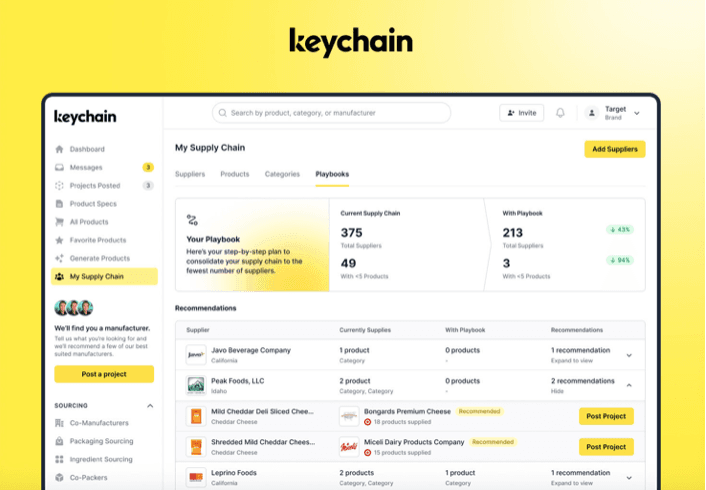
Core Insights - Keychain, an AI-powered manufacturing platform, is expanding into the UK, marking a significant phase in its European growth strategy [1] - The company has secured £7.5 million in new funding from W23 Global and other investors, which will support its expansion efforts [2] - Keychain's platform is designed to help brands and retailers create more efficient supply chains while addressing sustainability concerns [4][10] Company Overview - Keychain is already utilized by 8 of the 10 largest retailers in the US, including notable names like 7-Eleven and Whole Foods [2] - The platform has analyzed over 500,000 British products and has a list of over 1,000 brands and retailers eager to use its services [6] - Since its launch in 2024, Keychain has raised a total of $78 million in venture capital and built a network of over 30,000 manufacturers and 20,000 brands and retailers [12] Technology and Innovation - KeychainOS, the company's proprietary AI-based operating system, enhances production cycle management, providing insights into product creation and enabling new product development [7] - The platform is designed to be implemented quickly, in days rather than months, differentiating it from traditional ERP systems [8] - Keychain's technology is already being applied in various sectors, including beauty and personal care, showcasing its versatility across consumer goods categories [9] Market Context - The UK market is experiencing a shift due to the Extended Producer Responsibility Scheme (EPR), which imposes fines on brands for packaging, thus increasing costs for consumers [3] - Keychain's expansion is timely, as it aims to support brands in navigating these new regulations while maintaining product quality and sustainability [11] - The backing from major global retailers positions Keychain to connect local manufacturers with international partners, enhancing market reach and product development [11]