Kunlun AI chips

Search documents
MetaX and Moore Threads' IPOs underscore Chinese chipmakers' growing challenge to Nvidia
CNBC· 2025-12-18 01:00
Core Insights - Chinese AI chip companies are gaining significant investor interest as they aim to develop a self-sufficient semiconductor ecosystem to compete with Nvidia amid U.S. export restrictions [2][3][5] Group 1: Market Performance - MetaX Integrated Circuits saw a 700% increase in its stock price during its Shanghai market debut, while Moore Threads surged over 400% on its first trading day just two weeks prior [1][2] - MetaX raised nearly $600 million in its initial public offering, which will be used to accelerate research and development for new AI training and inference GPU chips [17] Group 2: Competitive Landscape - Major Chinese tech companies like Huawei, Alibaba, and Baidu are investing heavily in AI chip development, although none have yet produced chips that match Nvidia's most advanced offerings [5][6] - Huawei is developing the Ascend series of chips, with the next-generation model, the 950, set to launch in 2026, and is focusing on building high-performance clusters to compete with Nvidia [6][7] - Baidu is a majority shareholder in chip designer Kunlunxin and has a five-year roadmap for its AI chips, aiming to position itself as a full-stack provider [9][10][11] - Alibaba has been developing AI chips since the late 2010s and is focusing on inference rather than training, with reports of improved performance contributing to revenue growth in its cloud division [13][14] Group 3: Emerging Players - Cambricon reported a revenue increase of over 4,000% year-on-year to 2.88 billion Chinese yuan ($402.7 million) in the first half of 2025, positioning itself as a strong contender in China's AI accelerator market [15][16] - Biren Technology, founded in 2019, is also designing high-performance GPUs and has received approval for an IPO [19]


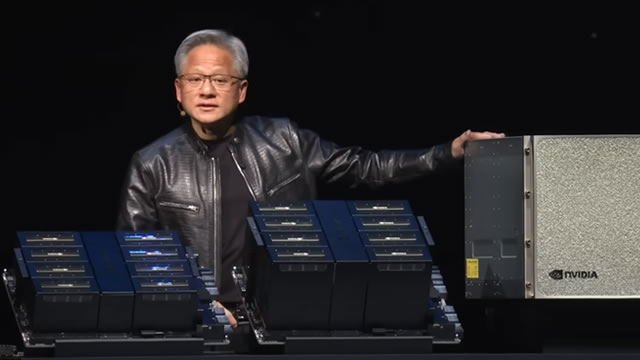
AI Policy, Chips, & China: What Investors Need to Know
ZACKS· 2025-12-08 23:21
Group 1: AI Regulation and Policy - The Trump Administration plans to create a national AI regulation framework to avoid a patchwork of state regulations that could hinder innovation [2][3] - The need for federal oversight is emphasized due to the interstate nature of AI development and deployment, which could lead to conflicting state regulations [3] Group 2: Market Implications and Corporate Developments - Nvidia is reportedly allowed to sell its H200 AI chips to China, indicating a potential easing of trade tensions between the US and China [4][8] - Concerns exist regarding the military implications of selling powerful AI chips to China, while some argue that an open market is necessary [5] - Baidu's stock has risen approximately 10% following reports of a potential spin-off and IPO of its Kunlun AI chip unit, with Citi maintaining a buy rating and a $181 price target [6][8] Group 3: Overall AI Landscape - The developments in AI regulation, trade, and corporate strategies highlight the increasing intertwining of technology with policy and global competition [7]


Baidu is emerging as a major AI chip player in China to fill the Nvidia gap
CNBC· 2025-11-28 06:20
Core Viewpoint - Baidu is positioning itself as a significant player in China's AI chip market, aiming to challenge Huawei and fill the gap left by Nvidia's absence in the country [1][7]. Company Strategy - Baidu has shifted its focus from being primarily a search engine to developing driverless cars and AI technologies, including its majority-owned subsidiary Kunlunxin, which specializes in chip design [2][4]. - The company has outlined a five-year roadmap for its Kunlun AI chips, starting with the M100 in 2026 and the M300 in 2027, and is already utilizing its self-developed chips in data centers for its ERNIE AI models [3][4]. Market Position - Baidu generates revenue by selling chips to third parties for data centers and renting out computing capacity through its cloud services, aiming to create a comprehensive AI infrastructure [4]. - Analysts have noted that Kunlunxin has become a leading domestic AI chip developer, focusing on high-performance chips for various applications, including large language model training [5]. Competitive Landscape - With Nvidia's advanced GPUs being restricted from sale in China, Baidu is expected to capitalize on the growing domestic demand for AI computing, especially as Huawei is currently out of the market [6][7]. - Analysts from JPMorgan predict that Baidu's chip sales could increase six-fold, reaching 8 billion Chinese yuan (approximately $1.1 billion) by 2026, indicating strong growth potential [7]. Valuation Insights - Analysts at Macquarie estimate that Baidu's Kunlun chip unit could be valued at around $28 billion, highlighting the significant market potential for the company in the semiconductor space [8].

Baidu (BIDU) Gets Big Upgrade from JPMorgan: AI Chips and Cloud Now Driving the Story
Yahoo Finance· 2025-11-26 09:43
Core Insights - Baidu, Inc. has been upgraded by JP Morgan to "Overweight" with a price target increase from $110.0 to $188.0, driven by optimism regarding AI and cloud as growth engines for the company [1] - Analyst Alex Yao believes the market is underestimating Baidu's transition, suggesting investors should buy the stock now to benefit from valuation rerating [2] - Baidu's cloud revenue growth is projected to accelerate to approximately 61% in 2026, up from 23% in 2025, primarily due to a six-fold increase in sales of Kunlun AI chips [2][3] Company Performance - The SOTP (Sum of the Parts) valuation framework attributes around $34 billion to Baidu's cloud business, which constitutes about 53% of the target price [3][4] - The domestic demand for AI compute in China is intense, with local hyperscalers increasingly sourcing from domestic providers, positioning Kunlun AI chips favorably for significant sales growth [3] Market Trends - GPU compute revenue is expected to maintain triple-digit growth due to enterprise demand for model training, fine-tuning, and inference, further supporting Baidu's cloud revenue growth projections [4] - The shift towards AI and cloud technologies is seen as a fundamental transformation for Baidu, justifying the dedicated SOTP valuation approach [4]
10 Hot AI Stocks to Keep on Your Radar
Insider Monkey· 2025-11-25 13:45
Group 1: Genesis Mission and AI Development - The U.S. government has initiated the "Genesis Mission" to create an integrated AI platform leveraging federal scientific datasets for next-generation technology development [1] - The mission aims to automate research workflows, accelerate scientific breakthroughs, and shorten discovery timelines from years to days or hours [1] - Partnerships with major computing firms like Nvidia and Dell are anticipated as part of this initiative [1] Group 2: Baidu, Inc. (NASDAQ:BIDU) - Baidu is recognized as a significant player in AI, with a recent upgrade from JP Morgan raising its price target from $110 to $188, reflecting optimism about AI and cloud as growth drivers [5] - Analyst projections indicate Baidu's cloud revenue growth may accelerate to approximately 61% in 2026, up from 23% in 2025, driven by a six-fold increase in Kunlun AI chip sales [6][8] - The market is perceived to be underestimating Baidu's transformation, with a valuation framework attributing around $34 billion to its cloud business [7] Group 3: Marvell Technology, Inc. (NASDAQ:MRVL) - Marvell is identified as an important AI player, with a neutral rating from HSBC and a price target of $85, although it lacks the same level of conviction as stronger competitors [9] - Analysts express skepticism about Marvell's ASIC strategy compared to Broadcom, which is seen as having clearer momentum in the ASIC market [10][11] - Marvell's share price has declined by 26% year-to-date, contrasting with Broadcom's 53% increase, indicating challenges in its market position [11]