Latent Forcing

Search documents
李飞飞团队新作:简单调整生成顺序,大幅提升像素级图像生成质量
量子位· 2026-02-14 10:09
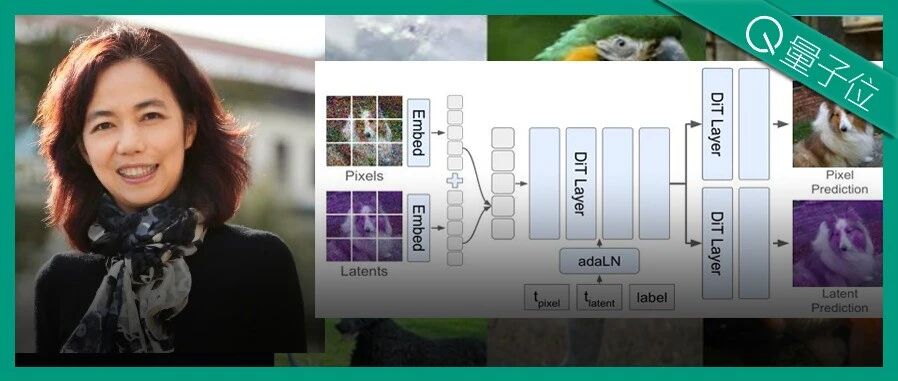
Core Viewpoint - The article discusses the breakthrough of the Latent Forcing method proposed by Li Fei-Fei's team, which challenges the traditional understanding of AI image generation by emphasizing the importance of the sequence in the generation process rather than the architecture itself [4][6]. Group 1: Traditional Methods and Their Limitations - Traditional pixel-level diffusion models struggle with generating accurate images due to interference between high-frequency texture details and low-frequency semantic structures during the denoising process [8][12]. - The industry has largely shifted towards latent space models to overcome these limitations, which compress images into lower-dimensional spaces for faster generation, but this approach introduces reconstruction errors and loses the ability to model raw data end-to-end [10][12]. Group 2: Latent Forcing Method - Latent Forcing reorders the diffusion trajectory to retain pixel-level lossless precision while gaining structural guidance from latent space [14][26]. - The method introduces a dual time variable mechanism, allowing the model to process both pixel and latent variables simultaneously, with a customized denoising rhythm for each [16][19]. - In the initial generation phase, latent variables establish the semantic structure before pixel details are refined, resulting in a final output that is 100% lossless without any decoder [20][21]. Group 3: Performance Metrics - Latent Forcing has demonstrated superior performance on the ImageNet leaderboard, achieving a conditional generation FID score of 9.76, significantly improved from the previous best score of 18.60 [22]. - In a 200-epoch training scenario, Latent Forcing achieved a conditional generation FID of 2.48 and an unconditional generation FID of 7.2, setting a new state-of-the-art for pixel space diffusion Transformers [23][24]. Group 4: Research Team - The Latent Forcing project is led by Li Fei-Fei, with contributions from Stanford co-authors Eric Ryan Chan, Kyle Sargent, Changan Chen, and Ehsan Adeli, as well as collaboration from Michigan University professor Justin Johnson [27][28][29].