AI生图

Search documents
谷歌NanoBanana2亮相,多模态步入产业重构深水区
China Post Securities· 2026-03-18 04:23
Industry Investment Rating - The industry investment rating is "Outperform the Market" and is maintained [1] Core Insights - The report highlights the performance of Google's Nano Banana 2, which has achieved top rankings in generative image benchmarks, indicating a significant advancement in AI capabilities [5] - The cost of using Nano Banana 2 has been reduced to $60 per million tokens, halving the previous price, which is expected to enhance the industrial application of visual creation [5] - The report emphasizes the competitive landscape in the multimodal AI sector, with major players like Alibaba and ByteDance launching their own models, suggesting 2026 could be a pivotal year for commercialization [6] Summary by Relevant Sections Industry Overview - The closing index is at 825.13, with a 52-week high of 1021.75 and a low of 591.71 [1] Investment Highlights - The report suggests that advertising and marketing sectors are highly sensitive to cost and efficiency, with companies like Easy Point, BlueFocus, and others likely to benefit from advancements in multimodal AI [7] - The transformation of text-based IP into video content is expected to lower barriers significantly, with companies like Light Chaser Animation and others poised for value reassessment [7] - The acceleration of multimodal industrialization is anticipated to drive changes in the gaming industry, with recommendations to focus on Tencent, NetEase, and others [8]

Nano Banana 2免费上线,超Pro版本100分登顶竞技场,API价格还对半砍了
3 6 Ke· 2026-02-27 09:50
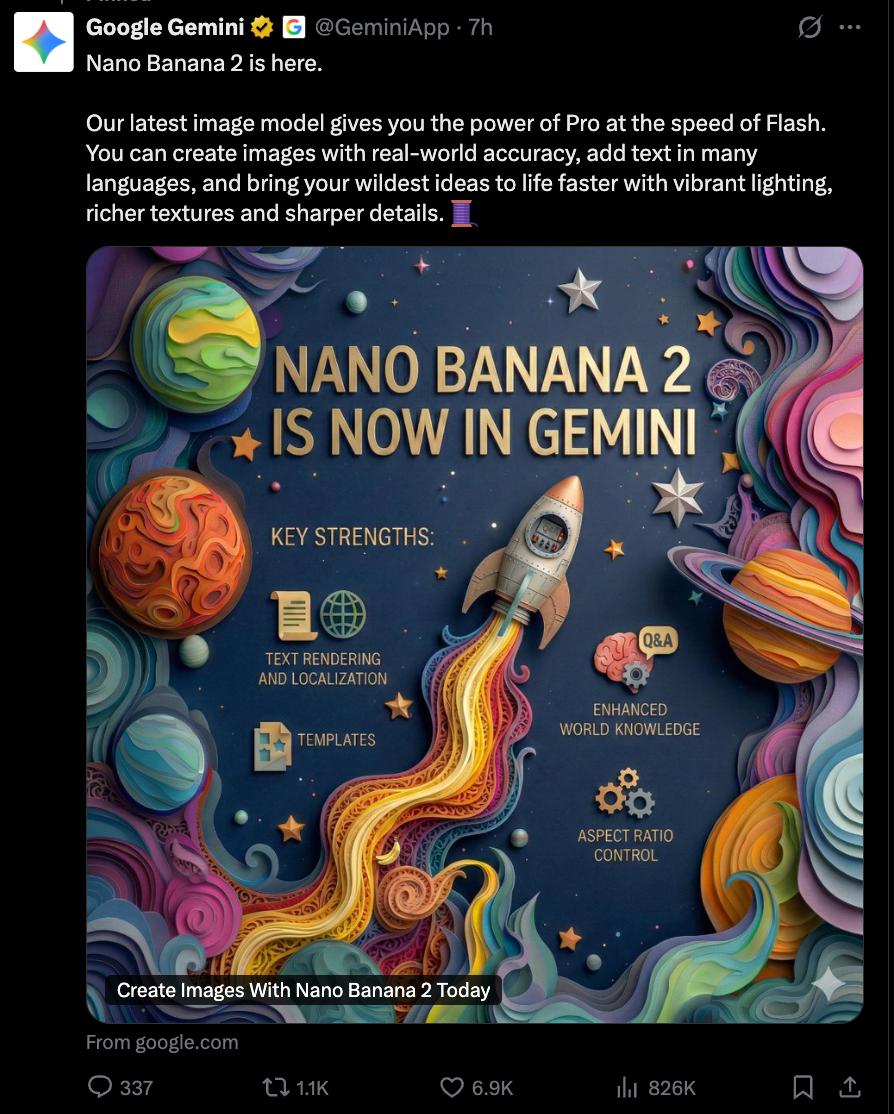
Core Insights - The launch of Nano Banana 2 has redefined image generation and editing capabilities, surpassing its predecessor, Nano Banana Pro, in both performance and cost-effectiveness [4][16]. Group 1: Product Features - Nano Banana 2 combines professional-grade image generation capabilities with high-speed performance, allowing for image creation in just a few seconds [4][6]. - The model enhances creative control, maintaining consistency for up to 5 characters and fidelity for up to 14 objects within a single workflow [8]. - It features improved instruction-following capabilities, enabling the execution of complex prompts with greater accuracy [10]. Group 2: Performance and Pricing - Official tests indicate that Nano Banana 2 outperforms Nano Banana Pro in overall performance, visual quality, and information accuracy [16]. - The pricing structure for image generation is significantly lower, with a 1K resolution image costing approximately $0.067, which is half the price of Nano Banana Pro [15]. - The model has been integrated into Google's search services and advertising business, enhancing its utility and reach [18]. Group 3: Market Impact - The introduction of Nano Banana 2 has sparked discussions about the potential end of the designer era, as users express excitement over the model's capabilities and affordability [21]. - Users are already exploring innovative applications of Nano Banana 2, indicating a strong interest in its creative possibilities [22].

谷歌Nano Banana 2来了,设计师时代结束了?
Di Yi Cai Jing· 2026-02-27 05:54
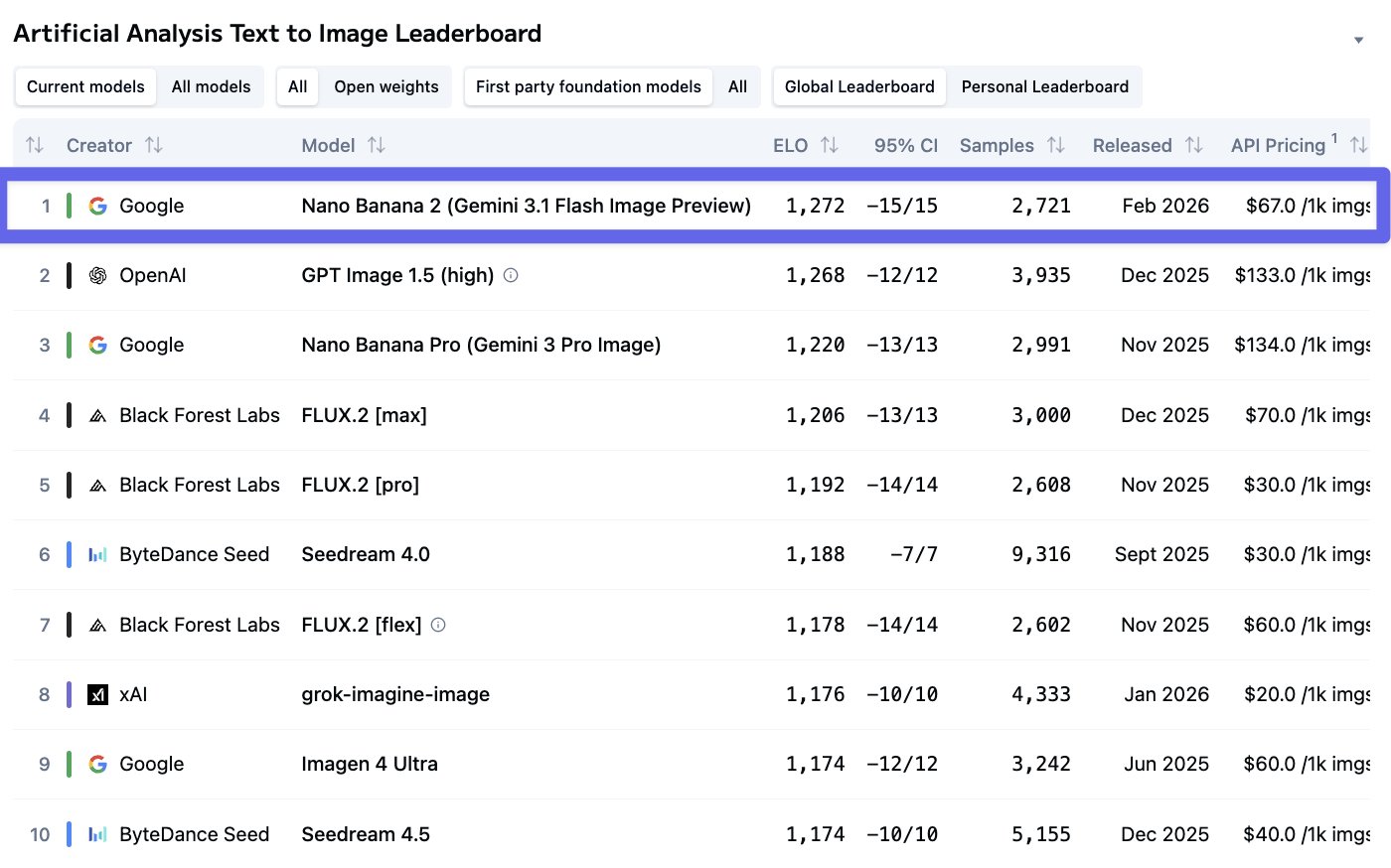
Core Insights - Google has launched Nano Banana 2 (Gemini 3.1 Flash Image), which combines speed and performance at a lower price point, marking it as the best image generation and editing model to date [1][4]. Group 1: Product Performance - Nano Banana 2 ranks first in the text-to-image leaderboard and third in the image editing leaderboard, outperforming GPT Image 1.5 and Nano Banana Pro [1][4]. - The model offers advanced world knowledge, precise text rendering and translation, thematic consistency, accurate instruction execution, and improved visual fidelity [4][13]. - It can generate high-quality, photo-realistic images while maintaining character likeness and object consistency, enhancing narrative creation [16]. Group 2: Pricing and Cost Efficiency - Nano Banana 2 is priced at half the cost of Nano Banana Pro, with a per-image cost of $0.067 for 1k images and $0.5 for input, compared to $0.134 and $2 for the Pro version [4][5]. - The model's cost-effectiveness has been highlighted by both evaluation agencies, emphasizing its superior performance and speed [4]. Group 3: User Experience and Applications - Google has developed a program called "Window Seat" to demonstrate the model's capabilities, allowing users to generate realistic images based on real-time weather data [5]. - The model supports advanced text rendering and localization, enabling dynamic UI generation and multi-language text integration in images, which is valuable for international businesses [13]. - Users have reported mixed experiences, with some noting issues in accuracy and stability, particularly in complex scenarios [11][16].
告别“鬼画符”!谷歌Nano Banana 2深夜空降,强势修复文字短板,AI生图进入“闪电时代”,价格直降37%
Jin Rong Jie· 2026-02-27 02:13
Core Insights - Google has quietly launched a new image generation model called Nano Banana 2 on its Gemini platform, enhancing its capabilities without a formal announcement [1] - The model aims to deliver professional quality at flash speeds, replacing the older Nano Banana model and providing advanced features previously exclusive to the Pro version [2] Performance and Features - Nano Banana 2 has upgraded its output resolution from 2K to 4K and supports various aspect ratios, enhancing its versatility for developers [2] - The model integrates real-time search and image retrieval, allowing it to generate contextually accurate images based on geographical and cultural factors [3] - Significant improvements in text rendering have been made, reducing errors in multilingual outputs and enabling reliable generation of text for commercial use [3] Speed and Cost Efficiency - The pricing for Nano Banana 2 is significantly lower than its predecessor, with costs for 4K images dropping by approximately 37%, making it more accessible for businesses [5][6] - The generation speed has nearly doubled, allowing for quicker production of high-quality images, which is crucial for commercial applications [5][6] Industrial Transformation - The introduction of Nano Banana 2 marks a shift in AI image generation from a creative tool to an industrial production line, addressing previous limitations such as text errors and cost issues [7] - The model aims to provide predictable outputs by incorporating world knowledge and improving text rendering, making it suitable for direct use in advertising and design [7][8] Competitive Landscape - The launch of Nano Banana 2 signifies a new phase in the AI image generation competition, focusing on speed, accuracy, and cost-effectiveness [9] - Competitors like ByteDance and Alibaba are also advancing their models, indicating a rapidly evolving market where Google seeks to maintain a competitive edge [9] Conclusion - The evolution of AI image generation is moving towards a more integrated and functional role in business processes, with Nano Banana 2 serving as a pivotal development in this transformation [10]
谷歌生图新王Nano Banana 2深夜突袭,性能屠榜速度飞升,价格腰斩
3 6 Ke· 2026-02-27 00:15
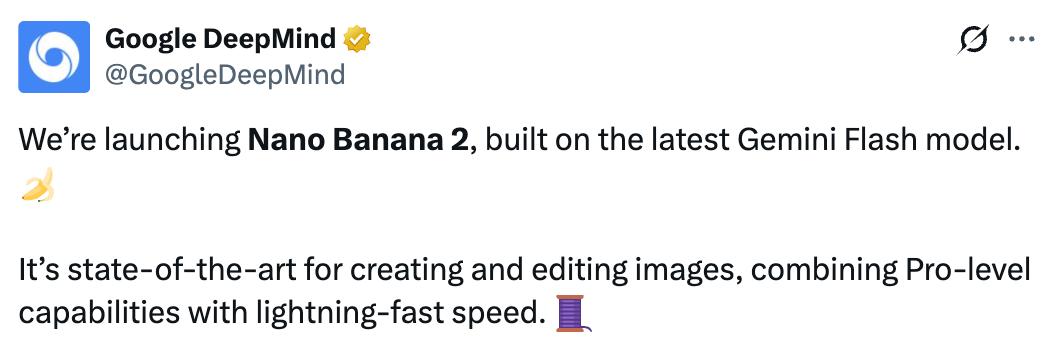
Core Insights - Google has officially launched its latest image generation and editing model, Nano Banana 2 (Gemini 3.1 Flash Image), which is now integrated across its product line including Gemini applications, search, and AI Studio [1][2]. Performance and Features - Nano Banana 2 combines professional-level features with flash-speed performance, achieving significant upgrades in world knowledge, image quality, reasoning ability, and subject consistency, outperforming leading models like GPT-Image 1.5 and Seedream 5.0 Lite in benchmark tests [2][4]. - The model generates images with enhanced detail realism and improved instruction execution, particularly in rendering text and understanding traditional Chinese culture [4][12]. Pricing and Accessibility - Despite its enhanced capabilities, the pricing for Nano Banana 2 has decreased, with input image costs dropping from $2 to $0.5 and output image costs halving from $0.134 to $0.067 on the Google AI Studio platform [8][10]. - Nano Banana 2 has replaced Nano Banana Pro in various Google applications, while Pro and Ultra subscription users can still opt to use Nano Banana Pro for specific tasks [10][40]. Technical Upgrades - The model features advanced world knowledge, allowing it to accurately present specific themes and create infographics, as well as improved text rendering and translation capabilities [32]. - It maintains subject consistency across multiple characters and objects, enhancing narrative creation and storyboard development [35]. Applications and Use Cases - Google has developed several demonstration applications utilizing Nano Banana 2, including "Window Seat," which creates realistic window views inspired by global locations and real-time weather data, and "Global Ad Localizer," which translates advertisements for international markets [37][38]. - The model supports various resolutions from 512px to 4K, optimizing efficiency and allowing for quick iterations in high-load processing workflows [39]. Industry Context - The global AI image generation competition is intensifying, with Google shifting focus from mere image quality to integrating world knowledge, precise instruction execution, and production efficiency [42]. - The launch of Nano Banana 2 marks a strategic move in Google's product matrix, positioning the Pro version for professional accuracy while targeting broader applications with the Flash version's speed and affordability [42].
李飞飞团队新作:简单调整生成顺序,大幅提升像素级图像生成质量
量子位· 2026-02-14 10:09
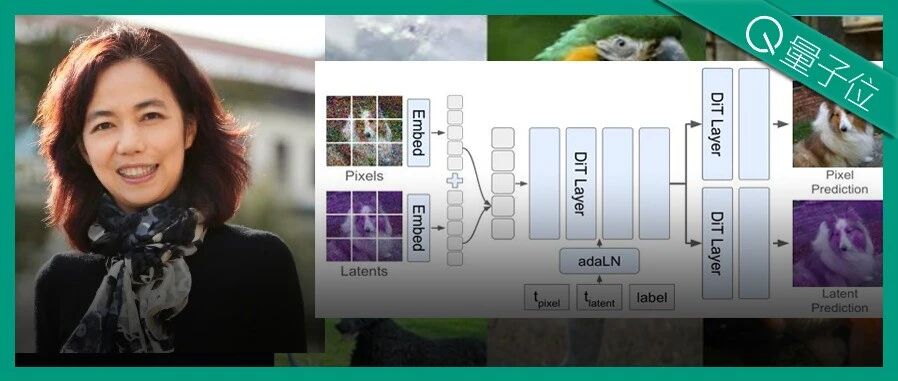
Core Viewpoint - The article discusses the breakthrough of the Latent Forcing method proposed by Li Fei-Fei's team, which challenges the traditional understanding of AI image generation by emphasizing the importance of the sequence in the generation process rather than the architecture itself [4][6]. Group 1: Traditional Methods and Their Limitations - Traditional pixel-level diffusion models struggle with generating accurate images due to interference between high-frequency texture details and low-frequency semantic structures during the denoising process [8][12]. - The industry has largely shifted towards latent space models to overcome these limitations, which compress images into lower-dimensional spaces for faster generation, but this approach introduces reconstruction errors and loses the ability to model raw data end-to-end [10][12]. Group 2: Latent Forcing Method - Latent Forcing reorders the diffusion trajectory to retain pixel-level lossless precision while gaining structural guidance from latent space [14][26]. - The method introduces a dual time variable mechanism, allowing the model to process both pixel and latent variables simultaneously, with a customized denoising rhythm for each [16][19]. - In the initial generation phase, latent variables establish the semantic structure before pixel details are refined, resulting in a final output that is 100% lossless without any decoder [20][21]. Group 3: Performance Metrics - Latent Forcing has demonstrated superior performance on the ImageNet leaderboard, achieving a conditional generation FID score of 9.76, significantly improved from the previous best score of 18.60 [22]. - In a 200-epoch training scenario, Latent Forcing achieved a conditional generation FID of 2.48 and an unconditional generation FID of 7.2, setting a new state-of-the-art for pixel space diffusion Transformers [23][24]. Group 4: Research Team - The Latent Forcing project is led by Li Fei-Fei, with contributions from Stanford co-authors Eric Ryan Chan, Kyle Sargent, Changan Chen, and Ehsan Adeli, as well as collaboration from Michigan University professor Justin Johnson [27][28][29].
这个春节P图不求人!小红书开源图像编辑新SOTA
量子位· 2026-02-12 11:00
Core Viewpoint - The article highlights the launch of Xiaohongshu's foundational model FireRed-Image-Edit, which demonstrates exceptional capabilities in AI image generation and editing, achieving state-of-the-art (SOTA) performance in various benchmarks [2][3]. Group 1: Performance and Evaluation - FireRed-Image-Edit excels in handling complex editing instructions, style transfers, and high-precision text editing, showcasing superior understanding and efficiency compared to competitors [3][4]. - The model's performance is validated through a newly introduced evaluation framework called RedEdit Bench, which includes 15 sub-tasks covering real-world editing scenarios such as portrait beautification and low-quality enhancement [9][10]. - The RedEdit Bench will be open-sourced to establish a new standard for evaluating image editing models in the open-source community [11]. Group 2: Technical Foundation - The model's architecture is supported by a robust data engine and a three-phase training process, which includes pre-training, fine-tuning, and reinforcement learning stages to enhance its capabilities [13][16]. - The data engine efficiently generates training data by breaking down complex editing tasks into manageable sub-tasks, ensuring high-quality data through a rigorous cleaning process [14]. Group 3: Core Capabilities - FireRed-Image-Edit features advanced instruction adherence, allowing it to understand the semantic relationship between commands and images rather than relying on rote memorization [20]. - The model introduces a Layout-Aware OCR-based Reward system during the reinforcement learning phase, improving text editing accuracy by penalizing errors in character placement and layout [26][27]. - It supports creative scene generation and multi-reference image generation, enabling style transfer and image fusion capabilities [33]. Group 4: Future Developments - Xiaohongshu plans to further enhance the foundational model's capabilities in portrait beautification, consistency, and text editing, with ongoing updates and open-source releases in the coming months [49].

春节前打响“百模大战”:AI生图为何突然“开窍”了?
Xin Lang Cai Jing· 2026-02-12 07:27
Core Insights - The release of Alibaba's Qwen-Image-2.0 and ByteDance's Seedream 5.0 marks a significant moment in the AI image generation sector, showcasing advancements in controllable generation, text restoration, and multi-scenario adaptation [2][31][32] - The evolution of AI image generation has transitioned from niche applications to mainstream usage within four years, with key milestones including the success of Midjourney in 2022 and the emergence of Google’s Nano Banana in 2025 [2][30][31] Group 1: Technological Advancements - The past year has seen a qualitative shift in AI image generation capabilities, moving from mere image creation to practical applications that emphasize controllability, narrative ability, and real-world applicability [4][32] - Key breakthroughs include: - Multi-modal native integration, allowing for accurate text generation alongside images [6][33] - Alignment with physical world principles, ensuring generated images adhere to realistic lighting, material textures, and spatial relationships [6][33] - Enhanced controllability, enabling precise detail adjustments without affecting the overall image [6][33] - Dynamic narrative capabilities, allowing AI to understand complex requirements and generate comprehensive outputs [6][33] Group 2: Competitive Landscape - The competition in the AI image generation market has intensified, with Qwen-Image-2.0 and Seedream 5.0 representing the latest advancements from leading domestic firms, while Nano Banana has opened up the market to a broader audience [4][31][32] - The industry is shifting from creative exploration to efficient production, with a focus on controllability and scene adaptability becoming critical evaluation metrics [24][52] - Current competitive focal points include: - Controllability, ensuring precise response to user demands [52] - Scene adaptability, with models being tailored for specific applications such as e-commerce and video production [52] - Ecosystem integration, making tools accessible and user-friendly [52] Group 3: Future Directions - The future of AI image generation is expected to see increased accessibility, with lightweight technologies enabling smooth operation on various devices [26][54] - Future models are anticipated to better understand user needs, interpreting underlying intentions rather than just executing commands [53][54] - There will be a deeper integration of technology with specific scenarios, allowing for streamlined processes in fields like e-commerce and video production [54]

阿里、字节同日上新图像生成模型,对标Nano Banana Pro
Mei Ri Jing Ji Xin Wen· 2026-02-12 00:50
Core Insights - The competition between Chinese tech giants Alibaba and ByteDance in AI image generation is intensifying, with both companies launching new models aimed at competing with Google's Nano Banana Pro [1][2] - Alibaba's Qwen-Image-2.0 focuses on semantic understanding and practical editing, while ByteDance's Seedream5.0Preview emphasizes image retrieval and fine-tuning capabilities [1][2] Group 1: Model Features - Alibaba's Qwen-Image-2.0 supports 1K tokens for long text input and 2K high resolution, enhancing the ability to render complex instructions and generate professional presentations [2] - The model integrates image generation and editing into a single framework, significantly improving performance compared to previous versions [2] - ByteDance's Seedream5.0Preview offers 2K and 4K resolution outputs, currently available for free trials on its platform [2] Group 2: Industry Applications - AI image generation technology is expanding beyond visual creation to enterprise-level applications, particularly in e-commerce and animation markets [2][4] - The AI animation market is experiencing rapid growth, with AI-generated images being transformed into videos, significantly reducing production costs by up to 90% [4][5] - In e-commerce, AI image generation is becoming a major demand, with applications in product detail pages and model outfit displays, enhancing efficiency for sellers [6] Group 3: Challenges and Limitations - Current AI image generation models face challenges in maintaining text detail and image consistency, primarily due to the limitations of the Variational Autoencoder (VAE) technology used [3] - The reliance on AI's understanding and reasoning capabilities in the animation sector raises concerns about the quality of generated content, particularly in style consistency and emotional expression in voiceovers [5]
对标Nano Banana Pro 阿里、字节同一天发布图像生成模型 AI生图将迎来规模化应用市场?
Mei Ri Jing Ji Xin Wen· 2026-02-11 15:51
Core Insights - Alibaba and ByteDance both launched new image generation models on February 10, targeting Google's Nano Banana Pro [1] - Alibaba's Qwen-Image-2.0 focuses on semantic understanding and practical editing, while ByteDance's Seedream 5.0 Preview emphasizes image retrieval and fine-tuning [1][3] - The advancements in AI image generation are expected to penetrate e-commerce and animation markets by 2025, with potential for large-scale applications by 2026 [1] Company Developments - Alibaba's Qwen-Image-2.0 supports 1K tokens for long text input and 2K high resolution, enhancing the ability to render complex instructions and generate professional presentations [3] - ByteDance's Seedream 5.0 Preview offers 2K and 4K resolution outputs, currently available for free on the Jiyun platform [3] - Both companies aim to unify image generation and editing into a single model, significantly improving performance [3] Industry Trends - AI image generation is increasingly being applied in e-commerce, with significant token consumption noted in digital human applications and AI-generated images [7] - The AI animation market is experiencing rapid growth, with AI technology reducing production costs by up to 90% and streamlining the creation process from 11 steps to 4 [5][6] - Despite the benefits, challenges remain in maintaining visual consistency and emotional expression in AI-generated content [5][6] Market Potential - The integration of AI image generation in e-commerce is seen as a mainstream application, with the potential to enhance efficiency for sellers by combining image editing and generation tasks [7] - The AI animation market is expected to see explosive growth, driven by the dual pressures of cost reduction and the need for improved content quality [6]