LocDiff

Search documents
图像地理定位新突破,缅因大学/谷歌/OpenAI等提出LocDiff框架,实现无需网格与参考库的全球级精准定位
3 6 Ke· 2025-11-19 10:14
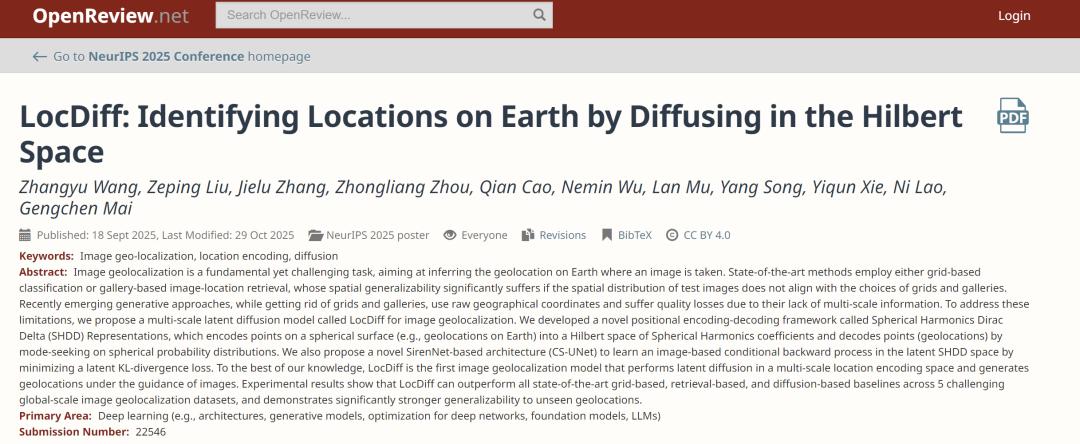
Core Insights - A collaborative team from the University of Maine, Google, and Harvard University has introduced the Spherical Harmonics Dirac Delta (SHDD) function and the integrated framework LocDiff, which enables precise location identification without relying on pre-defined grids or external image libraries, marking a significant technological advancement in the field [1][2]. Group 1: Technological Innovations - The SHDD and LocDiff framework utilize a coding method adapted to spherical geometry and a diffusion architecture to achieve accurate location decoding through contextual information inference [1][2]. - The research addresses the challenges of geographic coordinate modeling, which differs from conventional data due to its spatial properties, leading to the development of a new approach that overcomes limitations of traditional methods [2][5]. Group 2: Research Methodology - The study employs the GeoCLIP model as a benchmark, utilizing the MP16 dataset containing 4.72 million images with precise geographic annotations for training, and three global-scale datasets (Im2GPS3k, YFCC26k, GWS15k) for testing [3][4]. - The model's performance is evaluated across five spatial scales: street level (1 km), city level (25 km), regional level (200 km), national level (750 km), and continental level (2,500 km) [4]. Group 3: Model Performance - LocDiff demonstrates superior performance in most test scenarios, particularly when combined with a hybrid model (LocDiff-H) that limits GeoCLIP's search range to a 200 km radius around LocDiff-generated locations [14]. - The model's efficiency is highlighted by its ability to converge in approximately 2 million steps on the YFCC dataset, significantly faster than competing models that require up to 10 million steps [19]. Group 4: Industry Applications - The advancements in image geolocation technology are being translated into practical applications, with companies like NASA and Google leveraging these innovations to enhance their geospatial data processing capabilities [20][22]. - The integration of AI-driven semantic segmentation and dynamic optimization algorithms in platforms like PRISM Intelligence exemplifies the real-world impact of these academic breakthroughs [21][22].