Mi:dmK2.5Pro

Search documents
丢脸丢大了,韩国国家级AI赛事惊爆抄袭丑闻,6成企业套皮中国AI,韩国主权AI困局何解?
3 6 Ke· 2026-02-10 11:49
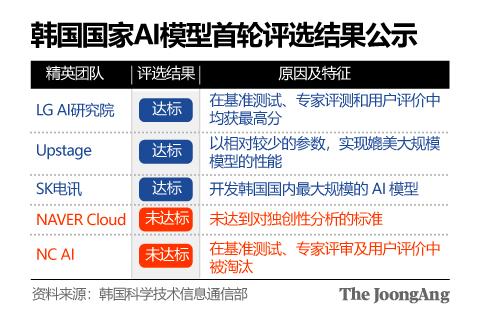
Core Insights - The first round of evaluations for South Korea's autonomous AI foundational model selection revealed that LG AI Research Institute scored the highest at 90.2, advancing to the next round, while NAVER Cloud was unexpectedly eliminated due to not meeting originality standards [1][2][3] - The evaluation aimed to objectively assess the capabilities of South Korea's top AI models, reflecting the country's aspirations to develop independent core technologies in the AI field [1][3] Group 1: Evaluation Results - LG AI Research Institute achieved the highest score in all assessment categories, including benchmark tests, expert evaluations, and user feedback [2] - Upstage and SK Telecom also advanced, with Upstage demonstrating competitive performance with relatively fewer parameters [2] - NAVER Cloud was disqualified for using the Chinese open-source AI model Tongyi Qianwen, violating the competition's requirements for model independence [3][11] Group 2: Controversies and Reactions - Three out of five participating teams were recently accused of plagiarism related to Chinese AI technologies, raising concerns about the fairness of the evaluation process [2][3] - The controversy has sparked significant public backlash in South Korea, with citizens expressing disappointment over the perceived decline in technological superiority [3][12] Group 3: Government Initiatives and Funding - The South Korean government plans to invest approximately 530 billion KRW (about 383 million USD) to support the five selected teams, with a focus on providing hardware and ensuring data security for AI training [7][8] - Future evaluations will occur every six months, with one team being eliminated each round until a final winner is determined [8] Group 4: Challenges in the AI Industry - South Korea's AI industry faces significant challenges, including a lack of original large models, over-reliance on external open-source technologies, and slow application of AI across various sectors [12][13][16] - The small population and language barriers limit data accumulation and market size, hindering the development of competitive AI models [16][17] Group 5: Future Directions - To overcome current challenges, South Korea's AI industry must focus on core technology development and hardware support, while fostering a more innovative ecosystem free from conglomerate dominance [30][31] - The government has introduced new laws to enhance the AI development environment, aiming to address the fundamental issues hindering the industry's growth [25][27]