Nested Learning

Search documents
LLM 的记忆问题「很快」就不再是问题了?
机器之心· 2026-02-15 01:30
Group 1 - The core viewpoint of the article emphasizes the paradigm shift in intelligent agents from efficient single-task execution to continuous adaptation, capability evolution, and experience accumulation in dynamic environments, with AI Memory as a foundational element [1][2] - AI Memory has diverged into two distinct evolutionary paths: "Agent Memory" and "LLM Memory," each serving different functions and addressing unique challenges [1][4][5] Group 2 - OpenClaw, an open-source project, gained significant attention for its ability to maintain persistent memory over weeks or months, transforming AI into a more understanding digital assistant [4][5] - The AI community is particularly focused on whether OpenClaw's "long-term memory" signifies a future where AI possesses enduring memory capabilities, which is seen as a critical bottleneck for advancing higher-level intelligence [5][6] - Various initiatives have emerged to improve AI Memory, including Meta's "SMF," Google's "Nested Learning," and MIT's "BEYOND CONTEXT LIMITS," indicating a growing academic interest in this area [5][6][7] Group 3 - LLM Memory serves as the foundational computational mechanism, characterized by two forms: parameterized memory embedded in pre-trained model weights and runtime memory managed through context windows, prioritizing immediate accuracy over coherent autonomous behavior [5][6] - Agent Memory extends beyond LLM Memory to support systematic autonomous behavior, enabling the coordination of perception, planning, and action to execute complex tasks [6] - The exploration of AI Memory is evolving, with researchers examining its theoretical foundations, operational mechanisms, and boundaries, viewing it as a transformative tool for enhancing AI systems [6][7]


谷歌刚掀了模型记忆的桌子,英伟达又革了注意力的命
3 6 Ke· 2026-01-20 01:12
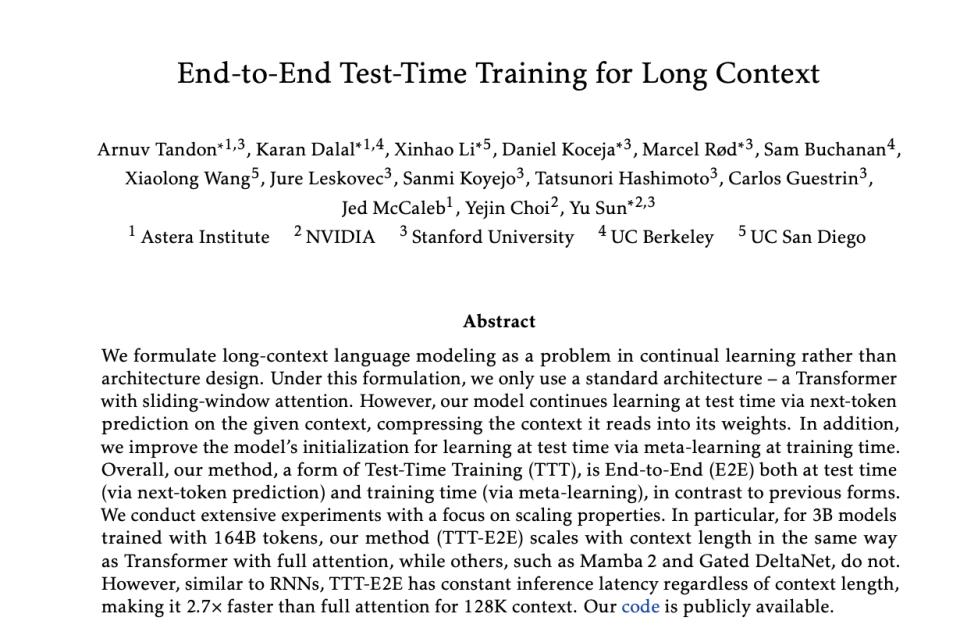
Core Insights - Google's Nested Learning has sparked a significant shift in the understanding of model memory, allowing models to change parameters during inference rather than being static after training [1][5] - NVIDIA's research introduces a more radical approach with the paper "End-to-End Test-Time Training for Long Context," suggesting that memory is essentially learning, and "remembering" equates to "continuing to train" [1][10] Group 1: Nested Learning and Test-Time Training (TTT) - Nested Learning allows models to incorporate new information into their internal memory during inference, rather than just storing it temporarily [1][5] - TTT, which has roots dating back to 2013, enables models to adapt their parameters during inference, enhancing their performance based on the current context [5][9] - TTT-E2E proposes a method that eliminates the need for traditional attention mechanisms, allowing for constant latency regardless of context length [7][9] Group 2: Memory Redefined - Memory is redefined as a continuous learning process rather than a static storage structure, emphasizing the importance of how past information influences future predictions [10][34] - The TTT-E2E method aligns the model's learning objectives directly with its ultimate goal of next-token prediction, enhancing its ability to learn from context [10][16] Group 3: Engineering Stability and Efficiency - The implementation of TTT-E2E incorporates meta-learning to stabilize the model's learning process during inference, addressing issues of catastrophic forgetting and parameter drift [20][22] - Safety measures, such as mini-batch processing and sliding window attention, are introduced to ensure the model retains short-term memory while updating parameters [24][25] Group 4: Performance Metrics - TTT-E2E demonstrates superior performance in loss reduction across varying context lengths, maintaining efficiency even as context increases [27][29] - The model's ability to learn continuously from context without relying on traditional attention mechanisms results in significant improvements in prediction accuracy [31][34] Group 5: Future Implications - The advancements in TTT-E2E suggest a shift towards a more sustainable approach to continuous learning, potentially becoming a leading solution in the industry for handling long-context scenarios [34][35] - This approach aligns with the growing demand for models that can learn and adapt without the high computational costs associated with traditional attention mechanisms [33][34]