
PRP

Search documents
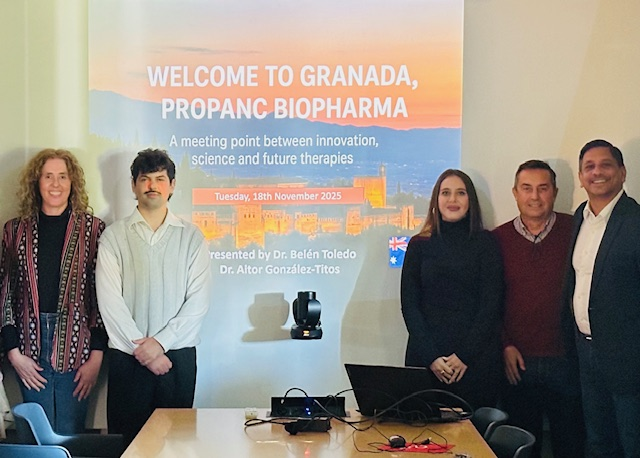
Propanc Biopharma Executes Multi-Yr, Anti-Aging & Cancer Research Collaboration with the Universities of Jaén and Granada, Spain
Globenewswire· 2026-03-24 12:45
Core Viewpoint - Propanc Biopharma, Inc. has established a multi-year Joint Research Collaboration Agreement with the Universities of Jaén and Granada, marking the fifth agreement over a 17-year period, aimed at advancing research in chronic diseases, particularly cancer [1][2]. Group 1: Collaboration Details - The collaboration focuses on evaluating a senescence-modulating compound to mitigate aging effects and support claims related to recently filed patent applications concerning fibrosis and cancer [2]. - Prof. Macarena Perán Quesada from the University of Jaén will manage the project, with two postdoctoral fellows conducting in vitro and in vivo experiments [2][3]. Group 2: Project Goals and Market Potential - The company aims to advance its lead asset, PRP, to a Phase 1b, First-In-Human study in advanced cancer patients within the year, while strengthening its intellectual property [4]. - The market potential for PRP is significant, with expectations of broadening its therapeutic applications in life-threatening diseases through cell and tissue rejuvenation [4][5].

Propanc Biopharma Targets $3B+ Pancreatic Cancer Market with PRP: 85%+ Tumor Inhibition in Breakthrough Proenzyme Therapy
Globenewswire· 2026-03-12 12:45
Core Insights - Propanc Biopharma, Inc. is developing PRP, a proenzyme therapy aimed at disrupting the pancreatic cancer treatment market, which is valued at over $3 billion and has a low five-year survival rate of 13% [1][2] Company Overview - Propanc Biopharma, Inc. focuses on creating novel treatments for chronic diseases, particularly recurrent and metastatic cancer [3] - The company is advancing PRP towards clinical development for advanced solid tumors, prioritizing pancreatic and ovarian cancers [2] Product Development - PRP has shown over 85% tumor growth inhibition in preclinical pancreatic models [5] - The therapy targets cancer stem cells, aiming to prevent recurrence and metastasis by addressing the underlying drivers of cancer proliferation [3][5] - PRP is designed to sensitize resistant tumors to standard chemotherapy, potentially offering higher efficacy with lower toxicity [5] Clinical Trials - Phase 1b First-In-Human trials for PRP are scheduled for 2026, with a $100 million facility in place to support development [2]

Propanc Biopharma Executes Service Agreement with FyoniBio to Establish & Validate Pharmacokinetics Assay for Phase 1b First-In-Human Study
Globenewswire· 2026-03-10 12:45
Core Insights - Propanc Biopharma, Inc. has entered into a service agreement with FyoniBio GmbH to establish and validate a liquid chromatography-mass spectrometry (LC-MS) based pharmacokinetics (PK) assay for its lead asset, PRP, aimed at advanced cancer patients [1][3] Company Overview - Propanc Biopharma, Inc. is focused on developing novel treatments for chronic diseases, particularly recurrent and metastatic cancer, by targeting cancer stem cells through proenzyme activation [4] Study Design and Objectives - The PK assay will measure the concentration of PRP and its analytes over time in advanced cancer patients, evaluating systemic concentration sufficient for anti-tumor activity while monitoring safety and tolerability [2] - Secondary efficacy endpoints will be observed to support treatment duration for responders, with the LC-MS PK assay designed to quantify analytes in serum with a sensitivity of at least 0.1µg/mL [2] Development Milestones - Establishing the PK method is one of three key activities in preparation for the First-In-Human study, alongside GMP manufacture of PRP and clinical trial application [3] - The company plans to commence the study in the fourth calendar quarter of this year, with confidence in the method development translating into a validated approach for decision-making [3]
Propanc Biopharma’s Lead Asset PRP Shows >85% Tumor Growth Inhibition in Preclinical Pancreatic Models
Globenewswire· 2026-03-03 13:45
Core Insights - Propanc Biopharma's lead asset, PRP, is positioned as a novel therapeutic approach for treating and preventing metastatic cancer, particularly in aggressive solid tumors like pancreatic cancer, which has a low five-year survival rate of 13% compared to an overall cancer survival rate of 70% [1][2]. Company Overview - Propanc Biopharma, Inc. is focused on developing innovative treatments for chronic diseases, including cancer, by targeting cancer stem cells to prevent recurrence and metastasis [7]. Product Details - PRP is an investigational proenzyme therapy composed of trypsinogen and chymotrypsinogen in a 1:6 ratio, delivered intravenously. It aims to selectively target cancer stem cells, inhibit metastasis, disrupt the tumor microenvironment, reduce angiogenesis, and enhance the effectiveness of standard treatments with lower toxicity [3][6]. Market Potential - The global pancreatic cancer treatment market is valued at approximately $4.42 billion in 2026 and is projected to grow to $14.43 billion by 2034, reflecting a compound annual growth rate (CAGR) of around 16% due to increasing cases and demand for improved treatment options [5]. Clinical Development - Propanc is preparing for a Phase 1b First-In-Human trial in 2026, which will involve 30-40 patients with advanced solid tumors. The company has secured $100 million in funding, obtained new patents, and received FDA Orphan Drug status for pancreatic cancer [5]. Preclinical Data - Preclinical studies have shown that PRP can achieve over 85% tumor growth inhibition in pancreatic cancer models, reduce fibrosis and resistance markers, and has a favorable safety profile with no major side effects reported in limited prior human use [4].
Propanc Biopharma's Lead Asset PRP Shows >85% Tumor Growth Inhibition in Preclinical Pancreatic Models
Globenewswire· 2026-03-03 13:45
Core Insights - Propanc Biopharma, Inc. is focusing on developing PRP, a novel therapeutic approach for treating and preventing metastatic cancer, particularly pancreatic cancer, which has a low five-year survival rate of 13% [1][2] Company Overview - Propanc Biopharma, Inc. is a biopharmaceutical company dedicated to creating treatments for chronic diseases, including recurrent and metastatic cancer [1][7] - The lead product candidate, PRP, aims to target cancer stem cells and prevent cancer recurrence and metastasis through proenzyme activation [7] Product Details - PRP is an investigational proenzyme therapy consisting of trypsinogen and chymotrypsinogen in a 1:6 ratio, delivered intravenously [3] - Unlike traditional cytotoxic drugs, PRP specifically targets cancer stem cells, suppresses epithelial-mesenchymal transition (EMT), disrupts the tumor microenvironment, curbs angiogenesis, and enhances chemosensitivity [3] Preclinical Data - Preclinical studies show over 85% tumor growth inhibition in pancreatic cancer models, with reduced fibrosis and resistance markers, and a favorable safety profile with no major side effects reported in limited human use [4] - A small compassionate study indicated that PRP extended survival from approximately 5.6 months to 9 months in advanced cases [4] Market Potential - The global pancreatic cancer treatment market is valued at approximately $4.42 billion in 2026 and is projected to grow to $14.43 billion by 2034, with a compound annual growth rate (CAGR) of around 16% [5] - Propanc is preparing for a Phase 1b First-In-Human trial in 2026, involving 30-40 advanced solid tumor patients, supported by a $100 million funding facility and FDA Orphan Drug status for pancreatic cancer [5] Competitive Advantages - PRP has the potential to enhance the effectiveness of standard treatments while reducing toxicity, making it a promising alternative to existing therapies [6][9] - The therapy may also sensitize resistant tumors to chemotherapy and remodel the tumor microenvironment to improve immunotherapy outcomes [9]

Propanc Biopharma Provides Corporate Update and Reports Half Yearly 2025/26 Results
Globenewswire· 2026-02-18 13:45
Core Insights - Propanc Biopharma, Inc. is advancing its biopharmaceutical development focused on novel treatments for recurrent and metastatic cancer, with significant updates on corporate progress and financial results as of December 31, 2025 [1] Corporate and R&D Highlights - The company has filed four provisional patent applications to enhance global protection for its breakthrough proenzyme formulations, which is expected to increase its IP portfolio from approximately 90 to over 200 patents [2] - Key findings regarding the impact of proenzymes on pancreatic ductal adenocarcinoma fibroblasts were published in a peer-reviewed journal, highlighting the potential of PRP as a disruptor of the tumor microenvironment [3] Financial Updates - Propanc has entered into a private placement agreement for up to $100 million to accelerate clinical development, receiving an initial investment of $1 million [4] - The company reported total assets of $15.11 million and reduced total liabilities by $2.07 million, with convertible notes decreasing to $55,000 from $538,000 [8] Management Commentary - The CEO expressed satisfaction with the advancements in R&D programs, particularly the lead asset PRP, which is being prepared for a Phase 1b, First-In-Human study in advanced cancer patients [7] Financial Performance - For the quarter ended December 31, 2025, the company reported a net loss of $3,091,394, with total operating expenses of $3,654,734 [15] - The basic and diluted net loss per share was reported at $0.30 for the three months ended December 31, 2025 [16]
Propanc Biopharma Unveils PRP: A Game-Changing Proenzyme Therapy Poised to Challenge Standard Cancer Treatments in the $3+ Billion Pancreatic Cancer Market
Globenewswire· 2026-02-05 13:45
Core Viewpoint - Propanc Biopharma, Inc. is advancing its lead proenzyme therapy, PRP, as a novel treatment for chronic diseases, particularly targeting solid tumors with high unmet needs like pancreatic cancer [1][5]. Company Overview - Propanc Biopharma, Inc. focuses on developing innovative treatments aimed at preventing cancer recurrence and metastasis by targeting cancer stem cells through proenzyme activation [10]. - The company has received FDA Orphan Drug Designation for PRP in pancreatic cancer, highlighting its potential in a critical treatment gap [5]. Product Details - PRP is an intravenous formulation combining two pancreatic proenzymes, trypsinogen and chymotrypsinogen, designed to inhibit tumor growth and enhance chemosensitivity, showing over 85% tumor growth inhibition in preclinical studies [2][3]. - The therapy aims to address the root causes of cancer proliferation and metastasis, offering a potentially less toxic alternative to existing therapies [3]. Market Opportunity - The global pancreatic cancer treatment market was valued at approximately $3.25 billion in 2025 and is projected to reach $3.70 billion in 2026, with significant growth expected to $10.25 billion by 2034, reflecting a CAGR of 13.62% [6]. - Solid tumors, including pancreatic, ovarian, and colorectal cancers, account for about 80% of all cancers, representing a substantial commercial opportunity for Propanc [7]. Clinical Development - Propanc is preparing for a Phase 1b First-In-Human study in 2026, targeting approximately 30-40 patients with advanced solid tumors, which will inform subsequent Phase 2 studies [8]. - The company is enhancing its intellectual property portfolio with recent provisional patent filings to protect its formulations and therapeutic applications [8]. Strategic Vision - The CEO of Propanc expressed optimism about PRP's potential to transform cancer care by targeting the mechanisms of metastasis, aiming to provide hope to patients with limited treatment options [9].
Propanc Biopharma Accelerates IP Momentum: Files Fourth Provisional Patent Application in Just Two Months – Strengthening Global Protection for Breakthrough Proenzyme Formulations
Globenewswire· 2026-01-27 13:45
Core Insights - Propanc Biopharma, Inc. has filed its fourth new provisional patent application in two months, focusing on innovative formulations of pancreatic proenzymes, which are critical for addressing challenges in stability and transport for biomedical applications [1][2] - The company aims to double its intellectual property portfolio from approximately 90 to over 200 patents, covering various aspects of its proenzyme technology, which targets and prevents metastasis from solid tumors [2][3] - Propanc's lead asset, PRP, is designed to selectively attack cancer stem cells and circulating tumor cells while sparing healthy tissue, offering a potential long-term therapy with reduced toxicity compared to conventional treatments [3][4] Company Developments - The recent patent applications are part of a strategy to secure leadership in a field with significant unmet medical needs, particularly for aggressive cancers with limited treatment options [2][3] - Preparations for a Phase 1b First-In-Human study of PRP in advanced cancer patients are advancing rapidly, with expectations for further updates on the clinical pathway and broader pipeline soon [3] Industry Context - Propanc is developing a novel approach to cancer treatment by targeting cancer stem cells through proenzyme activation, which addresses the underlying drivers of cancer proliferation and spread [4]
Propanc Biopharma Files New Provisional Patent Application for Methods of Producing Trypsinogen & Chymotrypsinogen with IP Australia
Globenewswire· 2026-01-20 13:45
Core Insights - Propanc Biopharma has filed a provisional patent application for a fully synthetic recombinant version of PRP, aimed at treating and preventing metastatic cancer from solid tumors [1][3] - The global metastatic cancer market is projected to reach $111 billion by 2027, indicating significant market potential for Propanc's innovations [1] - The synthetic version of trypsinogen and chymotrypsinogen, named Rec-PRP, offers advantages such as longer shelf life and suitability for distribution in regions lacking refrigeration [2] Company Developments - The recent patent application is the third filed in two months, enhancing the company's intellectual property portfolio as it prepares for national phase applications worldwide [3] - The company is focused on developing a platform technology that targets cancer stem cells, aiming to provide a treatment option with fewer side effects compared to standard therapies [4] - Propanc is also expanding its research into other therapeutic areas with significant unmet medical needs, indicating a strategic approach to long-term growth [3]
Propanc Biopharma Explains How PRP Could Impact Pancreatic Cancer
Globenewswire· 2026-01-15 13:45
Core Insights - Propanc Biopharma is focused on developing novel treatments for chronic diseases, particularly pancreatic cancer, which has a high unmet medical need due to low survival rates and ineffective traditional therapies [1][4] Group 1: Product Overview - Propanc's lead clinical candidate, PRP, is a proprietary mixture of two pancreatic proenzymes, trypsinogen and chymotrypsinogen, formulated in a 1:6 ratio and administered intravenously [2] - PRP is designed to target cancer stem cells and modulate processes linked to metastasis and drug resistance, such as the epithelial to mesenchymal transition (EMT) [2] Group 2: Clinical Development - The FDA granted Orphan Drug Designation to PRP in 2017 for pancreatic cancer treatment, acknowledging the severe unmet need [3] - Propanc plans to initiate Phase I/II clinical trials in 2026, starting with dose-finding studies and progressing to proof-of-concept studies in pancreatic and other cancers [4] Group 3: Market Opportunity - The global pancreatic cancer therapeutics market is projected to grow from approximately USD 2.9 billion in 2024 to around USD 5.8 billion by 2030, representing a CAGR of about 12.3% [7] - The broader pancreatic cancer market, including therapies and diagnostics, is expected to expand from approximately USD 3.25 billion in 2025 to over USD 10.25 billion by 2034, with a CAGR of around 13.6% [7] - The pancreatic cancer segment targeted by PRP is forecasted to reach roughly USD 6.93 billion by 2030, with the total addressable market for PRP, including ovarian cancer, estimated between USD 14 billion to USD 18 billion over the next decade [12] Group 4: Mechanistic Findings - PRP has shown potential in preclinical studies by reducing angiogenesis and cell migration in pancreatic cancer models, as well as reversing EMT markers associated with invasiveness [6] - Laboratory data suggest that PRP enhances chemosensitivity, making resistant pancreatic tumor cells more responsive to standard chemotherapies [6] - In vivo studies indicated significant tumor growth inhibition, with over 85% growth reduction at certain PRP doses compared to controls [6] Group 5: Financial Position - Propanc Biopharma is a pre-revenue biotechnology company focused on early-stage clinical development, with significant annual net losses primarily due to non-cash stock-based compensation [13] - A recent IPO raised approximately USD 4 million in gross proceeds, positioning the company for clinical advancement of PRP and a follow-on candidate [13] - The company has entered into structural financing arrangements, including a potential USD 100 million private placement facility to support further development [13]