ProShares UltraPro QQQ (TQQQ)

Search documents
There Is An Easy Way To Use Leverage To Boost QQQ
Yahoo Finance· 2026-03-24 14:01
Core Viewpoint - ProShares UltraPro QQQ (TQQQ) is designed to capture three times the daily performance of the Nasdaq-100 Index, but this leverage also amplifies losses, resulting in significant declines during market downturns [2][5][9]. Performance Summary - Year to date in 2026, TQQQ has lost 15.5%, while the underlying Nasdaq-100 ETF, QQQ, is down only 4.3%, illustrating the amplified losses due to the leveraged structure [3][9]. - Historical data shows that during the 2022 bear market, QQQ dropped 35.6% from November 2021 through December 2022, while TQQQ fell 81.7% over the same period, highlighting the risks associated with leveraged ETFs [6][9]. Mechanism of Loss Amplification - TQQQ achieves its threefold exposure through swap agreements and futures that reset at the end of each trading day, which can lead to volatility drag during prolonged market declines [5][7]. - The daily reset mechanism locks in losses, causing TQQQ to lose value on every market oscillation, even if the underlying index ends the week flat [7][9]. Market Conditions - Current market conditions, characterized by a rising VIX near 27 and increasing Treasury yields, are creating an environment where TQQQ's daily reset mechanism exacerbates losses during market fluctuations [9].
From AI Mega-Spend to Tax Cash Flood—Nasdaq's Hidden Tailwinds
Yahoo Finance· 2026-03-16 20:28
Core Insights - Analysts from firms like Goldman Sachs and Morgan Stanley anticipate 10%–20% market corrections in 2026, viewing them as buying opportunities rather than exit signals, supported by strong institutional and retail buying, along with record corporate buybacks and M&A activity [1] - The market is experiencing a breadth expansion, with industrial and cyclical sectors participating in the rally alongside mega-cap tech, indicating a healthier bull market as evidenced by the narrowing spread between SPY and RSP ETFs [2] - Earnings growth for the S&P 500 is projected at 14%–15%, with specific tech sectors expected to see a 33% increase in 2026, driven by AI-related efficiency gains translating into profits [3] - AI infrastructure spending is forecasted to reach at least $500 billion in 2026, with some estimates exceeding $650 billion, marking AI as a structural driver of economic growth [4] - Legislative measures like the One Big Beautiful Act (OBBBA) are expected to enhance corporate cash flow and consumer liquidity in early 2026 through retroactive tax incentives [5] - The Federal Reserve's monetary policy is nearing a neutral range after easing by 75–175 basis points since late 2024, creating a stable liquidity environment with a current fed funds rate of 3.50%–3.75% [6] Market Dynamics - The Nasdaq has transitioned from speculative hype to a focus on fundamental execution as it approaches the end of Q1 [7] - Following a significant pullback in April 2025, the Nasdaq QQQ ETF reached an all-time high in October 2025, but has since entered a sideways market as profit-taking occurred [9] - A 15-year seasonal pattern indicates that the Nasdaq 100 mini June futures contract has historically closed higher on June 08 than on March 18 in 87% of cases, suggesting a favorable trading window for bullish positions [10][15] Investment Opportunities - The combination of a neutral monetary policy, fiscal boosts from OBBBA, and substantial AI infrastructure investments positions the market for sustained growth [13] - Double-digit earnings growth, expanding market breadth beyond mega-caps, and a tendency for the market to buy dips of 10%–20% create a conducive environment for investment [14] - The historical seasonal pattern tracked by MRCI presents a compelling opportunity for traders to adopt a bullish stance, whether for long-term positions or short-term trades [15][16]
TQQQ vs. QLD: Which High-Risk, High-Reward Leveraged ETF Is the Better Buy for Investors?
The Motley Fool· 2025-12-27 11:00
Core Insights - The article compares two leveraged ETFs, ProShares Ultra QQQ (QLD) and ProShares UltraPro QQQ (TQQQ), focusing on their structure, risk profile, and performance for investors seeking Nasdaq-100 exposure [1][2]. Cost & Size - QLD has an expense ratio of 0.95% and TQQQ has a lower expense ratio of 0.82% - As of December 22, 2025, QLD's one-year return is 28.60% while TQQQ's is 30.72% - TQQQ offers a higher dividend yield of 0.72% compared to QLD's 0.18% - TQQQ has a larger assets under management (AUM) of $30.9 billion versus QLD's $10.6 billion [3]. Performance & Risk Comparison - Over the last five years, QLD experienced a maximum drawdown of -63.68%, while TQQQ faced a more severe drawdown of -81.65% - An investment of $1,000 would have grown to $2,564 with QLD and $2,500 with TQQQ over the same period [4]. Portfolio Composition - TQQQ holds 101 positions, with a focus on technology (55%), communication services (17%), and consumer cyclical (13%) - Major holdings in TQQQ include Nvidia, Apple, and Microsoft [5]. Investment Strategy - Both QLD and TQQQ are designed for short-term investments due to their daily leverage reset mechanism, which can lead to significant divergence from the underlying index if held long-term [6][10]. - TQQQ's higher leverage factor aims for three times the daily return, making it potentially more lucrative but also riskier compared to QLD, which targets two times the daily return [8]. Recent Performance Trends - Despite TQQQ's higher risk profile, its 12-month returns have only marginally outperformed QLD, and it has underperformed QLD over the last five years [9].


Making Sense of Leveraged ETFs: Are They the Right Choice for Long-Term Investors?
Yahoo Finance· 2025-12-04 15:02
Core Insights - Leveraged ETFs, such as ProShares UltraPro QQQ (TQQQ) and ProShares Ultra S&P 500 (SSO), are designed to amplify daily returns of their respective indices, but they may not be suitable for long-term buy-and-hold investors due to their inherent risks and volatility [5][8]. Group 1: Fund Characteristics - SSO provides 2x daily exposure to the S&P 500, with a sector mix including technology (31%), cash and others (30%), and financial services (9%), featuring top holdings like Nvidia, Apple, and Microsoft [2]. - TQQQ aims for triple the daily returns of the Nasdaq-100, heavily weighted in technology (54%), with significant allocations in communication services (17%) and consumer cyclical stocks (13%), and has been operational for nearly 16 years [3]. - TQQQ has a slightly lower expense ratio compared to SSO, making it more appealing for cost-conscious traders, and it also offers a higher dividend yield [4]. Group 2: Performance and Risks - TQQQ has shown a much higher one-year return and greater exposure to technology, but it has also experienced significant historical drawdowns, including an 82% drop in 2022 [5]. - The daily leverage reset mechanism means that these ETFs do not deliver 2x or 3x returns over longer periods, as evidenced by TQQQ's five-year compound annual growth rate (CAGR) of 22.9%, compared to a theoretical 48% if it were to maintain 3x returns [7]. - Both funds charge above-average expense ratios, exceeding 0.80%, which can impact long-term returns [7][8].

TQQQ Offers Broader Tech Exposure Than SOXL
The Motley Fool· 2025-11-08 12:00
Core Insights - The article compares two leveraged ETFs: ProShares UltraPro QQQ (TQQQ) and Direxion Daily Semiconductor Bull 3X Shares (SOXL), focusing on their appeal based on diversification, costs, and risk profile [1] Cost & Size Comparison - SOXL has a lower expense ratio of 0.75% compared to TQQQ's 0.82% - As of October 31, 2025, TQQQ has a one-year return of 68.1%, outperforming SOXL's 58.8% - TQQQ also offers a higher dividend yield at 0.76% versus SOXL's 0.63% - TQQQ has a larger AUM of $27.54 billion compared to SOXL's $12.34 billion [2] Performance & Risk Comparison - SOXL has a max drawdown of 90.46% over five years, while TQQQ's max drawdown is 81.65% - An investment of $1,000 in TQQQ would grow to $3,253 over five years, compared to $2,419 for SOXL [3] Fund Composition - TQQQ provides exposure to the Nasdaq-100, with a portfolio comprising 54% technology, 17% communication services, and 13% consumer cyclical, featuring major holdings like Nvidia, Apple, and Microsoft [4] - SOXL focuses exclusively on the semiconductor sector with 44 holdings, including Advanced Micro Devices, Broadcom, and Nvidia, leading to higher potential volatility [5] Investment Strategy - Both TQQQ and SOXL are characterized as higher-risk, higher-reward investments, with TQQQ showing a slight edge in one-year total returns while both funds have outperformed the S&P 500 [6] - SOXL's concentrated focus on semiconductors can yield high returns during industry booms but increases risk during downturns, whereas TQQQ offers a more diversified investment approach [7][8]
ProShares' ETF Suite Rises Past $100 Billion AUM Threshold
Etftrends· 2025-10-28 18:23
Core Insights - The ETF industry has seen significant growth, with ProShares surpassing $100 billion in total ETF AUM, marking a notable milestone for the firm [1][3] - ProShares offers a variety of investment strategies, including income, inverse exposure, and covered calls, with its largest ETF, ProShares UltraPro QQQ (TQQQ), holding over $27 billion in AUM [1][2] - The firm has also launched a bitcoin-related ETF, ProShares Bitcoin ETF (BITO), which provides exposure to bitcoin futures [3] AUM Breakdown - ProShares has two additional ETFs with AUM exceeding $10 billion: ProShares S&P 500 Dividend Aristocrats ETF (NOBL) with $11.3 billion and ProShares Ultra QQQ (QLD) with $10.1 billion [2] - The fee structure for these ETFs includes 35 basis points for NOBL and 95 basis points for both QLD and BITO [2][3] Innovation and Strategy - ProShares is recognized for its innovation in the ETF space, particularly in leveraged and inverse ETFs, while also expanding its product offerings to include dividend-focused and options strategies [4] - The company's commitment to customer-focused strategies is highlighted by its CEO, emphasizing the importance of adapting to changing market conditions [3]

Pros & Cons of Leveraged ETFs When Selling Stock Options
Thebluecollarinvestor· 2025-10-18 01:29
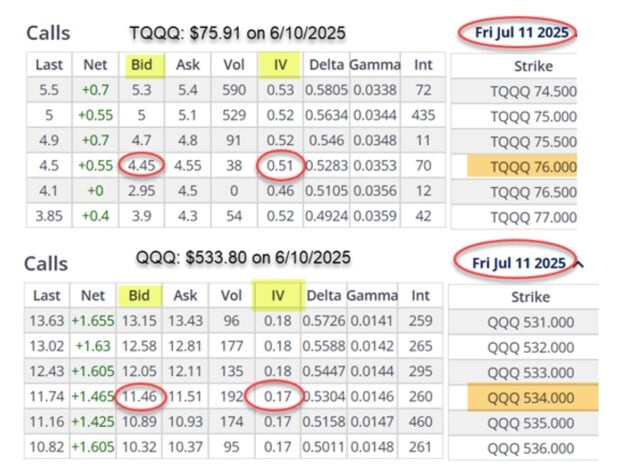
Core Insights - Retail investors are increasingly attracted to leveraged ETFs for enhanced returns when engaging in options strategies like covered calls and cash-secured puts [1][12] - Leveraged ETFs, such as ProShares UltraPro QQQ (TQQQ), aim to amplify the returns of an underlying index, typically by 2x or 3x [3][9] - The article highlights the significant differences in performance and risk between leveraged ETFs and traditional ETFs like Invesco QQQ Trust (QQQ) [6][10] Summary by Category Definition and Functionality - ETFs are securities that track an index or a basket of assets and trade like stocks, providing diversification similar to index funds [2] - Leveraged ETFs utilize financial derivatives to magnify returns, with TQQQ targeting 3x the daily performance of the Nasdaq 100 [3] Performance Comparison - TQQQ exhibits much greater price fluctuations compared to QQQ, leading to higher potential returns and risks [6][10] - Initial calculations show that TQQQ has an expected return of 5.86% over 32 days, annualized to 66.87%, while QQQ has a return of 2.09%, annualized to 23.86% [10][11] Implied Volatility - The implied volatility of TQQQ is significantly higher, at 51%, compared to QQQ's 17%, which aligns with the expected higher returns from leveraged ETFs [9] Investment Strategy Considerations - Leveraged ETFs may be suitable for investors seeking higher returns and willing to accept increased risk, but they may not be appropriate for those focused on capital preservation [12] - The article suggests that most retail investors should avoid leveraged ETFs when implementing low-risk strategies, although they may be applicable for higher-risk investors [12]
Are Leveraged ETFs to Blame for Selloffs? JPM Says Yes
Yahoo Finance· 2025-10-15 10:05
Core Viewpoint - Leveraged ETFs are being scrutinized for their potential role in exacerbating market volatility, particularly following a significant stock selloff attributed to external factors like tariff threats from President Trump [2][4]. Group 1: Market Impact - JPMorgan analysts indicated that leveraged ETFs contributed to approximately $26 billion in selloffs, worsening the S&P 500's largest one-day loss since April [2]. - The volatility associated with leveraged ETFs is heightened due to their structure, which often involves swaps that can lead to forced buying and selling, increasing market instability [4]. Group 2: Expert Opinions - While some experts acknowledge the risks posed by leveraged ETFs to individual investors, not all agree on their systemic impact, with some suggesting that they do not create widespread issues [3][4]. - Morningstar's research analyst highlighted a pattern of investor amnesia regarding the risks of leveraged ETFs, suggesting that past failures are often forgotten by investors [5]. Group 3: Industry Context - Leveraged ETFs represent only 1% of the total $12 trillion ETF industry in the US, indicating that their overall market presence is relatively small [6]. - The largest 3x leveraged ETF, ProShares UltraPro QQQ (TQQQ), has around $29 billion in assets under management, suggesting limited systemic risk from these products [4].

Oriental Harbor Trims $5.4 Million From TQQQ ETF — But Still Keeps Big Tech Bet Intact
The Motley Fool· 2025-10-14 23:03
Core Insights - Oriental Harbor Investment Master Fund sold 59,274 shares of ProShares UltraPro QQQ for an estimated $5.4 million, reducing its position to approximately 1.2 million shares valued at $124.2 million [1][2][6] Fund Positioning - After the sale, TQQQ represents 9.6% of the fund's reportable assets under management [3][8] - The fund's top holdings include Nvidia, Alphabet, and FNGU, indicating a strong focus on technology-driven strategies [6][7] Performance Metrics - As of the latest market close, TQQQ shares were priced at $101.13, reflecting a 33% increase over the past year, outperforming the S&P 500 by 20 percentage points [3][4][7] - The one-year total return for TQQQ stands at 44%, with a dividend yield of 0.65% [4] Investment Strategy - ProShares UltraPro QQQ aims to deliver daily returns consistent with the Nasdaq-100 Index through the use of financial instruments [5][9] - The fund is non-diversified, concentrating a significant portion of its assets in a limited number of holdings [11][12] Market Context - The trimming of TQQQ position by Oriental Harbor may be a strategic rebalancing move after strong returns, maintaining a high-conviction tilt toward technology growth [10]

TQQQ ETF Amplifies Nasdaq's Big Gains
247Wallst· 2025-10-08 15:26
Core Viewpoint - ProShares UltraPro QQQ (NASDAQ:TQQQ) demonstrates that sophisticated trading knowledge is not a prerequisite for gaining leverage in financial markets [1] Group 1 - ProShares UltraPro QQQ offers a means for investors to access leveraged exposure without requiring advanced trading skills [1]