
Probe Cards

Search documents
FormFactor(FORM) - 2025 Q4 - Earnings Call Transcript
2026-02-04 22:27
Financial Data and Key Metrics Changes - FormFactor's Q4 2025 revenues reached $215.2 million, exceeding the outlook range of $205 million to $215 million, marking a record for both quarterly and annual revenue [24][30] - GAAP gross margins for Q4 were 42.2%, up 240 basis points from 39.8% in Q3, while non-GAAP gross margins were 43.9%, a 290 basis point increase from 41% in Q3 [24][25] - GAAP net income for Q4 was $23.2 million, or $0.29 per diluted share, compared to $15.7 million, or $0.20 per diluted share in Q3 [26] - Free cash flows in Q4 were $34.7 million, up from $19.7 million in Q3, demonstrating improved cash-generating power [27] Business Line Data and Key Metrics Changes - In the DRAM probe card segment, sequential growth was achieved, driven by non-HBM applications like DDR4 and DDR5, with expectations for record growth in HBM applications in Q1 [7][8] - The probe card segment's gross margins improved by 364 basis points to 44.5%, while the systems segment saw a decline of 50 basis points [25] - The systems segment experienced a sequential revenue increase in Q4, driven by customer investments in co-packaged optics and quantum computing, although a seasonal reduction in demand is expected in Q1 [14][15] Market Data and Key Metrics Changes - The demand for DRAM, particularly HBM, is expected to continue growing, with FormFactor positioned to capture market share due to increased test intensity and complexity [6][11] - The foundry and logic probe card market is anticipated to see increased demand in Q1, shifting from traditional drivers to data center applications like network switches [11][12] - The company is also focusing on high-performance compute applications, with ongoing production qualifications in leading-edge GPU applications [14] Company Strategy and Development Direction - FormFactor is committed to improving gross margins and achieving its target model, with a focus on operational effectiveness and financial discipline [18][20] - The company plans to expand its Farmers Branch site to increase capacity at structurally lower costs, which is expected to support further revenue growth and gross margin expansion [5][23] - The strategic acquisition of Keystone Photonics aims to enhance capabilities in co-packaged optics, positioning the company for growth in energy-efficient optical data transmission [15] Management's Comments on Operating Environment and Future Outlook - Management expressed optimism about the robust demand environment for memory and DRAM, driven by customer investments and industry forecasts [37] - The company anticipates continued gross margin improvements, although at a more moderate pace moving forward [22] - Management highlighted the importance of maintaining strong relationships with customers to navigate the dynamic DRAM market and capitalize on growth opportunities [73] Other Important Information - The company expects Q1 revenues of $225 million ±$5 million, with non-GAAP gross margins projected at 45% ±150 basis points [30][31] - The impact of tariffs on gross margins is estimated at around 200 basis points, with ongoing efforts to mitigate these costs through customs drawbacks [31][80] - The company has a share repurchase program with $70.9 million remaining for future repurchases, although cash is currently prioritized for the Farmers Branch ramp-up [30] Q&A Session Summary Question: What has driven the recent gross margin improvements? - Management noted that workforce reductions and improvements in cycle times and yields have been primary drivers of the faster-than-expected gross margin improvements [34][35] Question: How does FormFactor view the growth potential in the DRAM market? - Management indicated that robust demand and favorable pricing dynamics are expected to drive continued growth in the DRAM market, particularly with the transition to HBM4 [36][37] Question: Can FormFactor increase its run rate before the Farmers Branch comes online? - Management confirmed that they are currently operating at a run rate of $225 million per quarter and expect to continue improving output from existing facilities [39][40] Question: What is the expected impact of HBM5 on FormFactor's business? - Management highlighted that HBM5 will likely drive increased test intensity and complexity, presenting significant opportunities for FormFactor as they engage with customers on R&D [43][44] Question: How does FormFactor plan to address the foundry and logic market dynamics? - Management expects growth in the foundry and logic market, driven by share gains and participation in high-performance compute applications [78]

FormFactor(FORM) - 2025 Q4 - Earnings Call Transcript
2026-02-04 22:27
Financial Data and Key Metrics Changes - FormFactor's Q4 2025 revenues reached $215.2 million, exceeding the outlook range of $205 million to $215 million, marking a record for both quarterly and annual revenue [24] - GAAP gross margins for Q4 were 42.2%, up 240 basis points from 39.8% in Q3, while non-GAAP gross margins were 43.9%, a 290 basis point increase from 41% in Q3 [24][25] - GAAP net income for Q4 was $23.2 million, or $0.29 per diluted share, compared to $15.7 million, or $0.20 per diluted share in Q3 [26] - Free cash flows in Q4 were $34.7 million, up from $19.7 million in Q3, demonstrating improved cash-generating power [27] Business Line Data and Key Metrics Changes - In the DRAM probe card segment, sequential growth was achieved, driven by non-HBM applications like DDR4 and DDR5, with expectations for record growth in HBM applications in Q1 [7][8] - The probe card segment's gross margins improved by 364 basis points to 44.5%, while the systems segment saw a decline of 50 basis points [25] - The systems segment experienced a sequential revenue increase in Q4, driven by investments in co-packaged optics and quantum computing, although a seasonal reduction in demand is expected in Q1 [14][15] Market Data and Key Metrics Changes - The demand for DRAM is expected to continue growing, particularly in HBM applications, with significant contributions anticipated from HBM3E and the early stages of HBM4 ramp [8][11] - The foundry and logic probe card market is expected to see increased demand in Q1, primarily driven by data center applications rather than traditional markets [11][12] - The company is gaining market share across all major HBM manufacturers, with expectations for continued growth in this area [50][51] Company Strategy and Development Direction - The company is focused on improving gross margins and operational effectiveness, with a target model gross margin of 47% at an $850 million annual run rate [19][80] - The Farmers Branch site is expected to come online later in 2026, providing increased capacity at structurally lower costs, which will support further revenue growth and gross margin expansion [5][23] - The company is committed to being a key supplier to leading customers in the industry, diversifying its demand profile, and expanding its presence in high-performance compute applications [11][14] Management's Comments on Operating Environment and Future Outlook - Management expressed optimism about the demand environment, citing robust forecasts from major ATE manufacturers and strong customer conversations [37] - The company anticipates continued sequential revenue growth and gross margin improvement in Q1 2026, driven by operational enhancements and increased output [4][30] - Management acknowledged the challenges posed by tariffs but is actively pursuing mitigation strategies, including tariff drawbacks [80] Other Important Information - The company made a strategic acquisition of Keystone Photonics to enhance its optical test capabilities, which is expected to strengthen its leadership in co-packaged optics [15] - The company has not repurchased any shares in Q4, prioritizing cash deployment for the Farmers Branch ramp-up instead [30] Q&A Session Summary Question: What has driven the recent gross margin improvements? - Management noted that workforce reductions and improvements in cycle times and yields were primary drivers of the gross margin performance [34] Question: How does the company view the DRAM market and its growth potential? - Management highlighted strong tailwinds in the DRAM market, particularly from HBM transitions, and expressed confidence in capturing market share [37] Question: Can the company increase its run rate before the Farmers Branch comes online? - Management indicated that they believe they can execute at a run rate of $225 million per quarter and will continue to focus on improving output from existing facilities [40] Question: What is the expected revenue from high-bandwidth memory probe cards? - Management expects HBM revenue to increase significantly in Q1, projecting it to be in the low 50s million range [72] Question: How does the company plan to address tariff impacts? - Management is pursuing tariff drawback strategies to mitigate the financial impact of tariffs, although benefits may take several quarters to materialize [80]
Semiconductor Consumables Probe Cards and Photomask
QYResearch· 2025-12-13 00:06
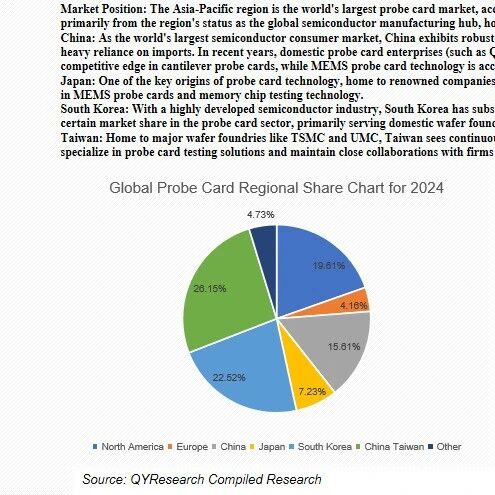
Semiconductor Industry Overview - The global probe card market is projected to reach $2.656 billion in revenue in 2024, with a CAGR of 7.45% from 2025 to 2031 [5] - The global MEMS probe card market is expected to reach $1.987 billion in revenue in 2024, accounting for 74.8% of the total probe card market [8] - The global photomask market is anticipated to reach $6.238 billion in revenue in 2024, with a CAGR of 4.63% from 2025 to 2031 [15] Probe Card Market Rankings - FormFactor leads the global semiconductor probe card market with a revenue of $625.96 million in 2024, representing a 25.72% year-over-year growth and a market share of 23.57% [11] - Technoprobe S.p.A. follows closely with a revenue of $613.51 million in 2024, showing a year-over-year growth of 20.89% and a market share of 23.10% [11] - MPI Corporation experienced significant growth of 54.55%, reaching $223.18 million in revenue in 2024, with a market share of 8.40% [11] Photomask Market Rankings - Photronics is the leading company in the photomask market with a revenue of $866.95 million in 2024, although it shows a decline of 2.82% year-over-year [18] - Toppan ranks second with a revenue of $752.09 million, reflecting a growth of 3.15% [18] - The "Other" category in the photomask market accounts for a significant share, with revenues increasing from $2,526.23 million in 2023 to $2,709.28 million in 2024, a growth of 7.25% [18] Market Growth Projections - The semiconductor industry is expected to see continued growth, with the probe card market and photomask market both showing positive trends in revenue and market share [5][15] - The overall semiconductor consumables market is projected to expand, driven by advancements in technology and increasing demand across various applications [20]

FormFactor(FORM) - 2025 Q3 - Earnings Call Presentation
2025-10-29 20:25
Company Overview - FormFactor has a global presence with approximately 2,250 employees and manufactures over 115 million MEMS probes annually[6] - The company's trailing twelve months (TTM) revenue as of September 27, 2025, was $759 million[6,7] - FormFactor is recognized by industry leaders such as Intel, Samsung, Micron, SK hynix, and TSMC, with these customers accounting for over 10% of revenue in one or more quarters since Q3 FY20[6,7] Financial Performance & Targets - In 2024, FormFactor's revenue was $764 million, with a non-GAAP EPS of $1.15 and free cash flow of $83 million[17] - The company's target model aims for $850 million in revenue, a non-GAAP gross margin of 47%, a non-GAAP operating margin of 22%, and a non-GAAP diluted EPS of $2.00[84] - The target capital expenditure model is projected to be between 3.5% and 4.0% of revenue, equating to $30 million - $35 million[96] Market Position & Growth - FormFactor is the 1 global supplier in both Test Subsystems and Focused Chip Making Equipment categories[21] - The company estimates the advanced probe card market to be $2.6 billion in 2027[76] - FormFactor aims for a 5%+ CAGR in the Engineering Systems market, exceeding the market's 3% CAGR[79] Recent Financial Results - In Q3 2025, FormFactor's revenue was $202.7 million with a gross margin of 41% and a diluted EPS of $0.33[105] - The outlook for Q4 2025 projects revenue of $210 million (±$5 million) with a gross margin of 42% (±1.5%) and diluted EPS of $0.35 (±$0.04)[105]
FormFactor(FORM) - 2025 Q2 - Earnings Call Transcript
2025-07-30 21:27
Financial Data and Key Metrics Changes - The company reported Q2 revenues of $195.8 million, exceeding the high end of the outlook range, with a 14.3% increase from Q1 and a 0.8% decrease year-over-year from Q2 2024 [14][21] - Non-GAAP gross margin for Q2 was 38.5%, at the low end of the range, and decreased from 39.2% in Q1 [16][18] - Non-GAAP operating income for Q2 was $22.8 million, a 35.2% increase from Q1, driven by higher revenues [19] - GAAP net income for Q2 was $9.1 million, or $0.12 per diluted share, compared to $6.4 million, or $0.08 per diluted share in Q1 [20] Business Line Data and Key Metrics Changes - Probe card segment revenues were $162.1 million in Q2, an 18.7% increase from Q1, driven by higher revenues in all markets, particularly Foundry and Logic and DRAM [14][15] - Foundry and Logic revenues increased to $100 million in Q2, a 16.7% increase from Q1, comprising 50.8% of total revenues [15] - DRAM revenues were $57.1 million in Q2, a 16.8% increase from Q1, with HBM revenues rising from $29.5 million in Q1 to $37 million in Q2 [15][16] - Systems segment revenues decreased to $33.7 million in Q2, down from $34.8 million in Q1, comprising 17.2% of total revenues [16] Market Data and Key Metrics Changes - The company continues to strengthen its leadership position in HBM probe cards, with expected growth in both HBM and DRAM overall [9] - The Foundry and Logic probe card market saw seasonal strength in Q2, but a moderate reduction in demand is expected in Q3 [10] - The company was recognized as the number one global supplier in both test subsystems and focused chip-making equipment categories in the annual Tech Insights 2025 Global Customer Satisfaction Survey [11] Company Strategy and Development Direction - The company is focused on advanced packaging and generative AI as key growth drivers, with expectations of semiconductor industry growth to a trillion dollars by the early next decade [5][6] - Strategic investments include a minority equity investment in FICT and the acquisition of a manufacturing facility in Farmers Branch, Texas, aimed at improving competitiveness and profitability [8][13] - The company aims to achieve a target financial model of 47% gross margin on $850 million of annual revenue, acknowledging recent performance has not demonstrated a clear path to that level [13][26] Management's Comments on Operating Environment and Future Outlook - Management acknowledged that recent financial results, particularly gross margins, have not reflected the company's market leadership position, attributing this to product mix shifts and operational cost increases [7] - The company expects Q3 revenues of approximately $200 million, with a higher gross margin of around 40%, despite potential tariff impacts [24][25] - Management emphasized the importance of diversifying customer exposure to mitigate risks associated with individual customer volatility [62] Other Important Information - The company experienced a negative free cash flow of $47.1 million in Q2, primarily due to capital expenditures related to the Farmers Branch facility [21][22] - Total cash and investments at the end of Q2 were $253 million, a decrease of $50 million from Q1, largely due to the facility purchase [22] - The company has entered into a new $150 million revolving credit facility agreement to enhance financial flexibility [23] Q&A Session Summary Question: What is the residual customer ramp-up cost embedded in the Q3 gross margin guide? - Management confirmed no additional ramp-up costs are assumed in Q3 for the HBM customer [29][30] Question: Will the trend of higher sequential DRAM systems and lower sequential logic/foundry persist into Q4? - Management noted that while the PC and mobile markets remain weak, they are focusing on growth in areas driven by generative AI and advanced packaging [31][33] Question: What are the key factors that can help bridge the gross margin gap to target levels? - Management identified volume growth, operational cost reductions, and expanding Foundry and Logic market share as key components to improve gross margins [42][44] Question: What impact will the new Texas facility have on the P&L? - Management indicated that the facility is expected to lower operational costs in the long term, but immediate impacts on the P&L will be assessed as progress is made [48][49] Question: What is the status of the hyperscaler and GPU customer contributions? - Management reported progress in qualifying for GPU testing and noted contributions from hyperscaler custom ASICs in Q2, with expectations for revenue growth in the second half [70][72]
FormFactor(FORM) - 2025 Q2 - Earnings Call Transcript
2025-07-30 21:25
Financial Data and Key Metrics Changes - The company reported Q2 revenues of $195.8 million, exceeding the high end of the outlook range, with a 14.3% increase from Q1 and a 0.8% decrease year-over-year from Q2 2024 [15][16] - Non-GAAP gross margin for Q2 was 38.5%, down from 39.2% in Q1, primarily due to lower margins in the Systems segment and increased manufacturing costs [17][19] - Non-GAAP operating income for Q2 was $22.8 million, a 35.2% increase from Q1, driven by higher revenues despite lower gross margins [21] - GAAP net income for Q2 was $9.1 million, or $0.12 per diluted share, compared to $6.4 million, or $0.08 per diluted share in Q1 [22] Business Line Data and Key Metrics Changes - Probe card segment revenues were $162.1 million in Q2, an 18.7% increase from Q1, with significant growth in Foundry and Logic and DRAM markets [15][16] - Foundry and Logic revenues increased to $100 million in Q2, a 16.7% increase from Q1, representing 50.8% of total company revenues [16] - DRAM revenues were $57.1 million in Q2, up 16.8% from Q1, with HBM revenues increasing from $29.5 million in Q1 to $37 million in Q2 [16][18] - Systems segment revenues decreased to $33.7 million in Q2, down from $34.8 million in Q1, comprising 17.2% of total revenues [17] Market Data and Key Metrics Changes - The company continues to strengthen its leadership position in the HBM probe card market, with expectations of continued growth in both HBM and DRAM [9][10] - The Foundry and Logic probe card market saw seasonal strength in Q2, but a moderate reduction in demand is expected in Q3 [10][11] - The Systems segment is driven by advancements in co-package optics and quantum computing, with pilot production systems running for primary customers [12] Company Strategy and Development Direction - The company is focused on advanced packaging and generative AI as key growth drivers, positioning itself as a leading supplier of probe cards and systems [5][6] - Strategic investments include a minority equity investment in FICT and the acquisition of a manufacturing facility in Texas to enhance competitiveness and lower operational costs [7][8] - The company aims to achieve a target financial model of 47% gross margin on $850 million of annual revenue, acknowledging recent performance has not met this target [13][27] Management's Comments on Operating Environment and Future Outlook - Management acknowledged that recent financial results, particularly gross margins, have not reflected the company's market leadership, attributing this to product mix shifts and operational cost increases [6][27] - The company expects Q3 revenues to be around $200 million, with a higher gross margin of approximately 40%, despite potential tariff impacts [26][27] - Management remains optimistic about long-term growth prospects in the semiconductor industry, projecting significant growth driven by advanced packaging and generative AI [5][79] Other Important Information - The company experienced a negative free cash flow of $47.1 million in Q2, primarily due to capital expenditures related to the Texas facility acquisition [23][24] - Total cash and investments at the end of Q2 were $253 million, a decrease of $50 million from Q1, largely due to the facility purchase [24][25] - The company has entered into a new $150 million revolving credit facility to enhance financial flexibility [25] Q&A Session Summary Question: How much residual customer or HBM product cost is still embedded in the third quarter gross margin guide? - Management confirmed no additional ramp-up costs are assumed in Q3 for the HBM customer [30][31] Question: Do you think the trend of higher sequential DRAM systems and lower sequential logic/foundry could persist in Q4? - Management indicated that while the PC and mobile markets remain weak, they are focusing on growth in areas driven by generative AI and custom ASICs [32][34] Question: What impact will the new facility in Texas have on the P&L over the next few quarters? - Management stated that the facility is expected to lower operational costs in the medium term, but no immediate impact on the P&L is anticipated until it is operational [48][50] Question: What is the expected contribution from hyperscaler and GPU customers in the second half of the year? - Management noted that there has been progress in qualifying for GPU testing and expects revenue contributions from hyperscalers and custom ASICs in the second half [74][75] Question: What are the expected impacts of tariffs on gross margins? - Management acknowledged that tariffs are expected to have a significant impact on gross margins, with ongoing efforts to mitigate these effects [94][95]