RNL技术

Search documents
联想提出RNL技术,通过多维感知等解决AI训练中的难题
Xin Lang Ke Ji· 2025-11-28 11:09
Core Viewpoint - Lenovo's innovative RNL technology addresses long-standing challenges in load balancing for AI training and inference scenarios, particularly in RoCE networks, as recognized by its acceptance at the IEEE CyberSciTech 2025 conference [1][2]. Group 1: Technology Innovation - The RNL technology incorporates a closed-loop system of "multi-dimensional perception + path load balancing + incremental migration," combining algorithmic innovation with practical value [2]. - The multi-dimensional perception mechanism allows real-time awareness of network topology, AI task network demands, and RoCE link load status, providing a data foundation for dynamic scheduling [2]. - Path load balancing optimization utilizes virtual-physical network mapping and path scoring algorithms to intelligently select optimal data transmission paths, maximizing bandwidth utilization [2]. - Incremental flow migration employs a strategy to avoid instantaneous delays during link traffic adjustments, ensuring business continuity [2]. Group 2: Future Plans - Lenovo plans to extend the RNL technology to high-performance storage and HPC scenarios, incorporating deep learning algorithms to enhance congestion prediction capabilities [2]. - The company aims to validate the comprehensive performance of RNL technology in large AI clusters with thousands to tens of thousands of nodes, continuously driving innovation and iteration in AI network technology [2].

联想万全异构智算研发团队论文被IEEE CyberSciTech 2025收录
Huan Qiu Wang· 2025-11-28 09:37
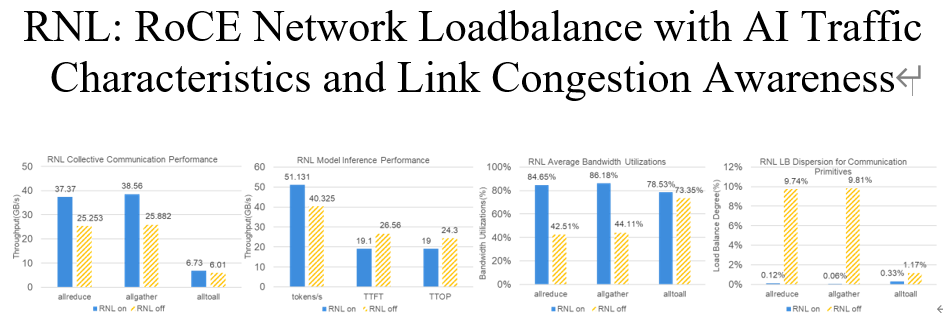
Core Insights - Lenovo's RNL technology addresses long-standing challenges in RoCE network load balancing for AI training and inference scenarios, showcasing innovation in multi-dimensional perception, path load balancing optimization, and incremental flow migration [1][2]. Group 1: RNL Technology Overview - The RNL technology integrates multi-dimensional perception, path load balancing optimization, and incremental flow migration into a closed-loop system, providing both algorithmic innovation and practical value [1]. - The multi-dimensional perception mechanism allows real-time awareness of network topology, AI task network demands, and RoCE link load status, forming a data foundation for dynamic scheduling [1]. - Path load balancing optimization employs virtual-physical network mapping and path scoring algorithms to intelligently select optimal data transmission paths, maximizing bandwidth utilization [1]. Group 2: Performance and Cost Efficiency - RNL technology demonstrates high reliability and dual advantages in enhancing AI business efficiency and reducing total cost of ownership (TCO) [2]. - Performance improvements include a 50% enhancement in communication primitive performance, 85% bandwidth utilization, and a 90% reduction in load balancing discreteness [2]. - In AI inference scenarios, transactions per second (TPS) increased by 26%, time to first byte (TTFT) decreased by 30%, and time per output token (TPOT) reduced by 22%, while overall deployment costs were lowered by 60% [2]. Group 3: Strategic Implications - RNL technology is incorporated into Lenovo's heterogeneous computing platform, reinforcing its technological barriers in the AI heterogeneous computing market and enhancing its industry influence and core competitiveness [4].