Rapid Rewards loyalty program

Search documents
Are Wall Street Analysts Predicting Southwest Airlines Stock Will Climb or Sink?
Yahoo Finance· 2025-11-03 13:28
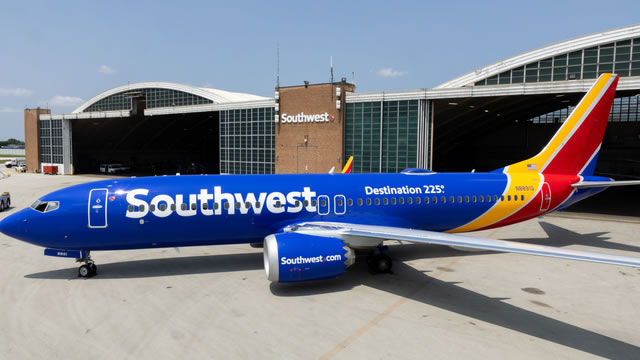
Core Viewpoint - Southwest Airlines Co. has underperformed compared to the broader market and industry benchmarks, with a notable decline in stock value despite some positive earnings surprises. Company Overview - Southwest Airlines, based in Dallas, Texas, is valued at $15.7 billion and offers scheduled air transportation services in the U.S. and near-international markets, along with various in-flight and loyalty services [1]. Stock Performance - Over the past year, LUV's stock has declined by 3.7%, while the S&P 500 Index has increased by 17.7% [2]. - In 2025, LUV's stock fell by 9.9%, contrasting with a 16.3% rise in the S&P 500 on a year-to-date basis [2]. - Compared to the U.S. Global Jets ETF (JETS), which gained about 6.8% over the past year, LUV's performance has been weaker [3]. Recent Financial Results - On October 22, LUV reported Q3 results, with shares closing down more than 6% in the following trading session. The adjusted EPS was $0.11, exceeding Wall Street expectations of $0.01, while revenue was $6.95 billion, slightly missing forecasts of $6.97 billion [4]. Earnings Expectations - For the current fiscal year ending in December, analysts expect LUV's EPS to grow by 13.5% to $1.09 on a diluted basis. The company's earnings surprise history is mixed, beating estimates in three of the last four quarters [5]. Analyst Ratings - Among 21 analysts covering LUV, the consensus rating is "Hold," with four "Strong Buy," one "Moderate Buy," 11 "Holds," one "Moderate Sell," and four "Strong Sells" [5]. - UBS maintained a "Neutral" rating on LUV and lowered the price target to $33, indicating a potential upside of 8.9% from current levels. The mean price target of $33.12 suggests a 9.3% premium, while the highest target of $46 indicates a potential upside of 51.8% [6].

Meet Wall Street's Most Prolific Stock-Split Stock Throughout History -- a Company Whose Shares Have Gained Nearly 337,000% in 52 Years
The Motley Fool· 2025-05-14 07:51
Core Insights - The rise of artificial intelligence (AI) has created a significant $15.7 trillion addressable market, becoming a major trend on Wall Street since late 2022 [1] - Stock splits, particularly forward stock splits, have contributed to the S&P 500 reaching an all-time closing high earlier this year [2] Stock Splits Overview - A stock split is a method used by public companies to adjust their share price and outstanding share count without affecting market capitalization or operational performance [4] - There are two types of stock splits: forward splits, which lower share prices to make them more accessible to investors, and reverse splits, which are generally viewed negatively as they indicate struggling companies [5][6] Recent Trends in Stock Splits - In 2024, several prominent companies, including Nvidia and Broadcom, executed forward stock splits, reflecting a trend among successful businesses [7] - Fastenal has completed its ninth stock split since its IPO in 1987, showcasing a consistent strategy to engage investors [8] Historical Context of Stock Splits - Companies like Coca-Cola, Dollar General, and Home Depot have a long history of stock splits, primarily occurring between the 1970s and early 2000s, before the advent of online brokers that allowed fractional share purchases [9][10] - Home Depot completed all 13 of its stock splits between January 1982 and December 1999, while McDonald's and Dollar General last executed their forward splits in 1999 and 2000, respectively [10] Notable Company: Southwest Airlines - Southwest Airlines has achieved remarkable success with a return of nearly 337,000% since January 1973 and has conducted 14 stock splits since its IPO in June 1971 [14] - The airline has maintained profitability for 47 consecutive years until the COVID-19 pandemic, demonstrating resilience in a challenging industry [15] - Southwest's financial health is strong, with approximately $8.25 billion in cash compared to $6.7 billion in debt, allowing it to navigate economic downturns effectively [16] - The company's operational efficiency and customer loyalty program have contributed to its sustained success and reputation as a prolific stock-split stock [17][18]