Stretch 机器人

Search documents
“机器人永不疲倦”:现代解释了为何其波士顿动力Atlas机器人准备接管工厂,却不愿接管你的家
Xin Lang Cai Jing· 2026-01-26 21:27
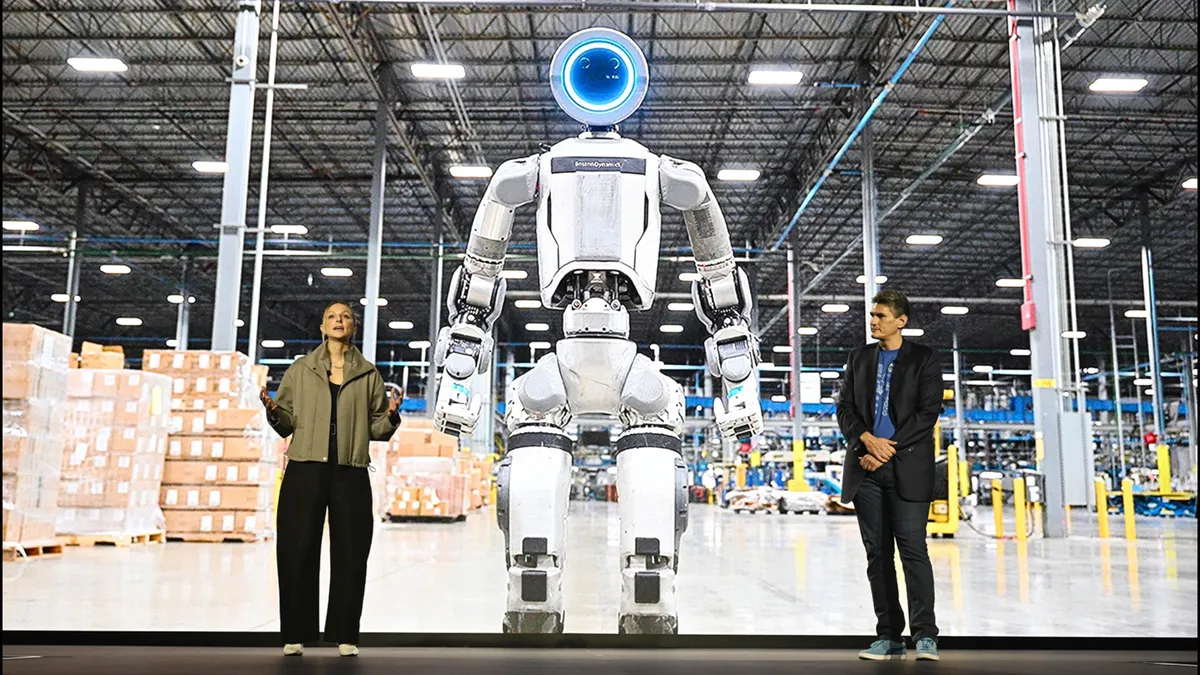
Core Insights - The CES 2026 showcased humanoid robots, with Hyundai's Atlas robot capturing significant attention, shifting perceptions from novelty to serious industrial application [1][4]. Group 1: Product Features and Capabilities - Atlas, developed by Boston Dynamics, weighs 90 kg and stands 1.5 meters tall, with a maximum reach of 2.29 meters [1]. - The robot features 56 degrees of freedom, allowing it to perform tasks such as moving automotive parts without walking, and it can handle delicate items with precision [4]. - Atlas is designed for outdoor use and can autonomously return to a charging dock when its battery is low [4]. Group 2: Production and Deployment Plans - Mass production of Atlas will begin at Hyundai's new Robotics Meta Factory Application Center (RMAC), with an expected cumulative output of 30,000 units by 2030 [2]. - The deployment of Atlas robots in Hyundai's smart factories is set to start in 2028 [2]. Group 3: Market Position and Competitive Advantage - Boston Dynamics, backed by Hyundai Motor Group, believes it has a competitive edge due to its established commercialization path and comprehensive service system [12]. - The company emphasizes the versatility of Atlas, which can perform various tasks, unlike other specialized robots [9]. Group 4: Industry Trends and Future Outlook - The industry is experiencing a competitive race in practical robot development, with players like Tesla and Chinese manufacturer Zoomlion also entering the market [12]. - The CEO of Boston Dynamics predicts that widespread deployment of robots in factories will occur between 2028 and 2030, while consumer market penetration may take until 2035 [16].