
TECNO Camon 40

Search documents
意外!2025中国TOP5手机 苹果全包揽!
是说芯语· 2026-03-19 05:31
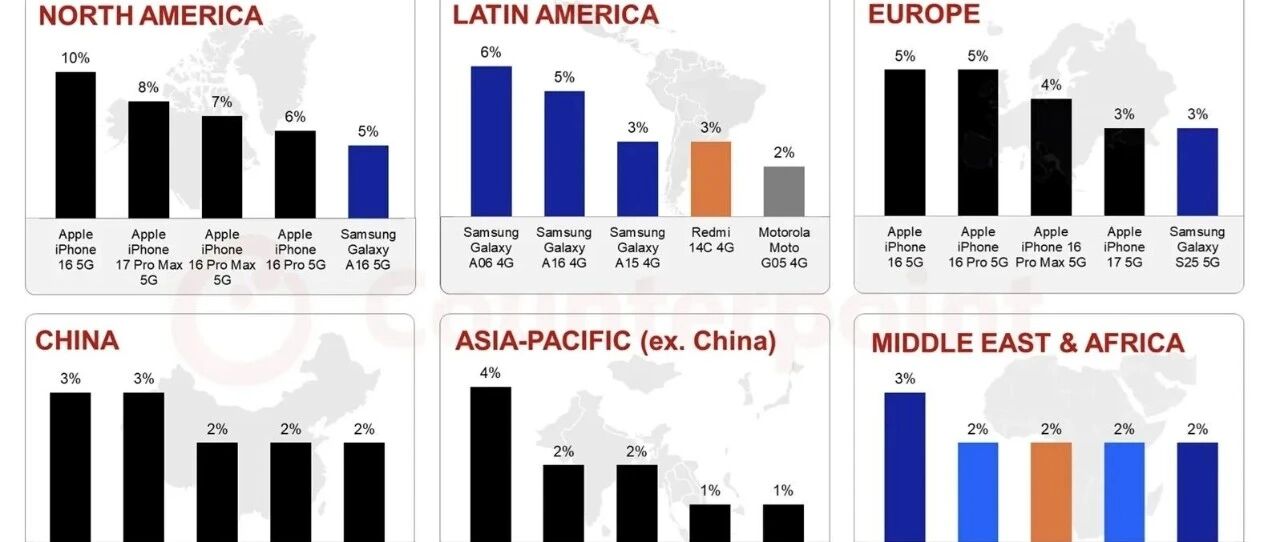
Core Insights - Apple and Samsung dominate the global smartphone shipment rankings in 2025, with both brands holding the top two positions in major markets [1] - The high-end models lead in North America, Europe, and the Asia-Pacific region, while entry to mid-range models are favored in Latin America, the Middle East, and Africa [1] Regional Market Summaries - In North America, Apple occupies four out of the top five positions, with the iPhone 16 5G leading the market, while Samsung's Galaxy A16 5G is the only Android model in the top five, primarily driven by the prepaid market [1] - In China, Apple models occupy all top five positions, with the iPhone 16 Pro Max 5G leading, reflecting a strong preference for high-end models among consumers [1] - The Asia-Pacific region (excluding China) sees growth driven by markets like Japan and India, with the iPhone 16e entering the top five due to strong sales in Japan [2] - In Latin America and the Middle East, the top five models are all 4G smartphones, with Samsung's A series leading in both markets, and Xiaomi's Redmi 14C also making the top five due to its cost-effectiveness [2] - In Europe, the iPhone and Samsung Galaxy S series dominate the top five, indicating a strong preference for high-end models, which account for over 60% of total smartphone shipments in the region [2]


Omdia:第三季度非洲智能手机出货量同比激增24% 达到2280万台
智通财经网· 2025-11-28 01:16
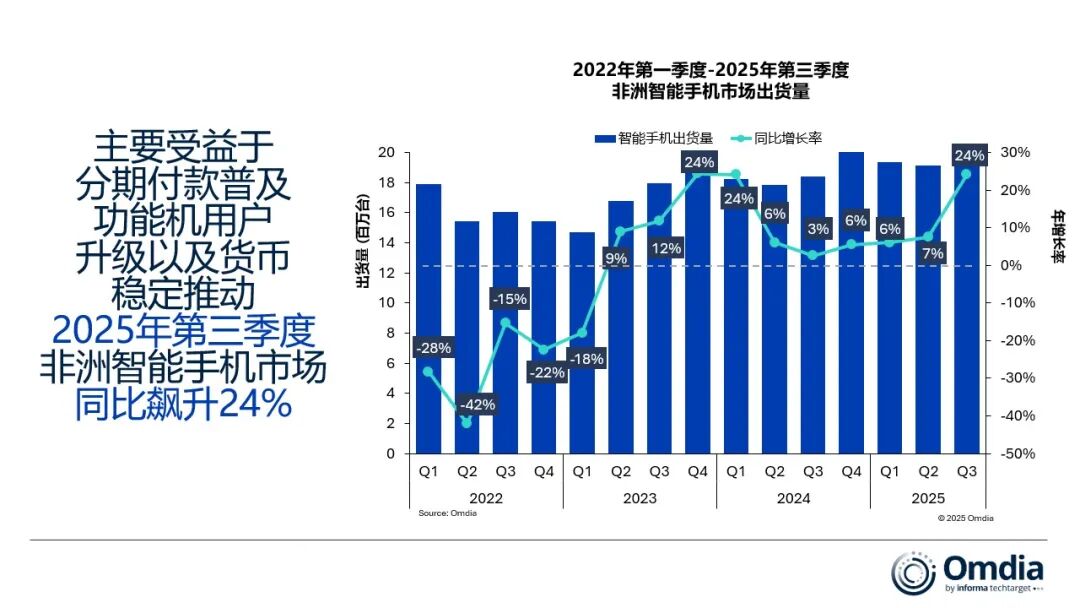
Core Insights - The African smartphone market is experiencing a significant rebound, with Q3 2025 shipments expected to surge by 24% year-on-year, reaching 22.8 million units, following five consecutive quarters of decline [1][6] - Key factors driving this growth include increased market demand, currency stability, enhanced financing usage, and improved retail activities [1] - North Africa and Sub-Saharan Africa are witnessing double-digit growth in smartphone shipments, with Nigeria and Egypt each accounting for 14% of regional shipments, but with differing recovery dynamics [1][2] Market Performance - Nigeria's smartphone shipments are projected to soar by 29% year-on-year, attributed to the stabilization of the Naira and the introduction of affordable models under $150, stimulating retail upgrade demand [1] - Egypt's market is expected to grow by 19%, driven by increased demand for mid-range devices and promotional bundling strategies [1] - South Africa leads the growth with a 31% increase, benefiting from the rise of prepaid models and enhanced retail promotions [2] Product Segmentation - Smartphones priced below $100 are expected to see a remarkable 57% increase, while those above $500 are projected to grow by 52% [4] - Transsion is a key player in the entry-level market, with a 25% year-on-year increase in shipments, supported by strong demand in Algeria, Egypt, Morocco, Nigeria, Kenya, and South Africa [4] - Samsung dominates the high-end market, with strong demand for Galaxy S24 and S24 FE 5G models in South Africa, Senegal, and Algeria [4] Competitive Landscape - Xiaomi is accelerating its long-term strategy in Africa, planning to enter over 15 new markets and has opened its first flagship store in Morocco [4] - OPPO is consolidating its market position in North Africa, focusing on Egypt, while Honor is maintaining steady growth in South Africa through competitive models like Honor 200 Lite [4] Future Outlook - Despite the current growth, the African smartphone market is expected to decline by 6% in 2026 due to rising supply-side pressures, including increased BOM costs and currency depreciation [6] - The low-end 4G market, which constitutes a significant portion of demand, will be particularly affected, leading to higher average selling prices and new payment challenges for consumers [6]


Omdia: 2025年第三季度,非洲智能手机市场出货量同比增长24%,重现双位数增长,传音继续领跑,荣耀仍保持三位数最大增幅
Canalys· 2025-11-28 01:04
Core Insights - Omdia's latest research indicates that smartphone shipments in Africa will surge by 24% year-on-year in Q3 2025, reaching 22.8 million units, marking a rebound after five consecutive quarters of slowdown, driven by increased market demand, currency stability, enhanced financing usage, and improved retail activities [1] Group 1: Regional Performance - North Africa and Sub-Saharan Africa experienced double-digit growth in smartphone shipments, with Nigeria and Egypt each accounting for 14% of regional shipments; Nigeria's market surged by 29% due to stable naira exchange rates and an updated portfolio of models priced below $150, while Egypt saw a 19% increase [1] - South Africa led with a 31% growth, benefiting from the acceleration of prepaid models in the low and mid-range markets, new model launches, and increased retail promotions [2] - Kenya's market grew by 17%, driven by the rising penetration of installment payment plans, which have become a significant driver of smartphone sales [2] Group 2: Market Dynamics - The shipment of smartphones priced below $100 increased by 57%, the fastest growth rate in three quarters, while models above $500 grew by 52%; the entry-level market's rapid growth was primarily driven by Transsion, which saw a 25% year-on-year increase in shipments supported by strong demand in Algeria, Egypt, Morocco, Nigeria, Kenya, and South Africa [5] - Major brands like Samsung dominated the high-end market with strong demand for Galaxy S24 and S24 FE 5G in South Africa, Senegal, and Algeria, although overall market growth remained moderate at 5% due to consumer preference for cost-effective models [5] Group 3: Competitive Landscape - Xiaomi is accelerating its long-term strategy in Africa, planning to enter over 15 new markets in the coming months and has opened its first self-operated flagship store in Morocco; its strong sales in the sub-$150 segment account for half of its shipments [6] - OPPO is consolidating its market position in North Africa with a focus on Egypt, while Honor is maintaining steady growth in South Africa through high-cost-performance models like Honor 200 Lite [6] Group 4: Future Outlook - Omdia forecasts a 6% decline in the African smartphone market by 2026 due to rising supply-side pressures, including increased BOM costs, tight memory supply, and ongoing currency weakness, which will particularly impact the low-end 4G market that constitutes the majority of demand in Africa [8] - These pressures are expected to raise average selling prices, especially in the $80 to $150 range, presenting new payment challenges for consumers; manufacturers will need to strengthen financing partnerships, optimize channel inventory, and localize more effectively to navigate this environment [8]
