UniSplat

Search documents
简历直推 | 驭势科技招聘规划算法工程师!
自动驾驶之心· 2025-11-24 00:03
Core Insights - The article discusses the advancements in autonomous driving technology, particularly focusing on the development and implementation of VLA (Vehicle-Like Action) systems, highlighting the transition from perception-based approaches to VLA-based methodologies [14]. Group 1: VLA Development - The article reflects on the evolution of VLA technology over the past year, noting a shift from academic research to practical applications in the industry, culminating in the announcement of Xiaopeng's VLA 2.0 [14]. - It emphasizes the importance of VLA as a means to enhance the driving experience by mimicking human-like decision-making processes, akin to a "sixth sense" in driving [14]. Group 2: Research and Collaboration - The article mentions collaborative research efforts, such as the paper from The Chinese University of Hong Kong (Shenzhen) and Didi, which proposes a method for efficient reconstruction of dynamic driving scenes [14]. - It highlights the significance of ongoing discussions and knowledge sharing within the autonomous driving community, as seen in the roundtable discussions featuring industry experts [14].

滴滴和港中文最新的前馈3D重建算法UniSplat!史少帅参与~
自动驾驶之心· 2025-11-08 16:03
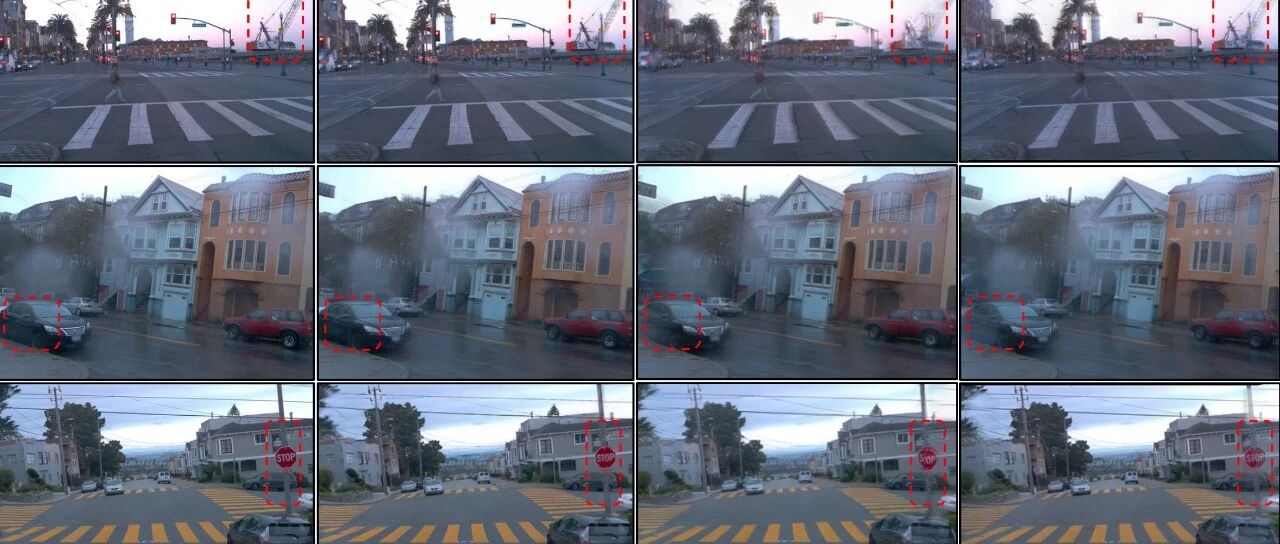
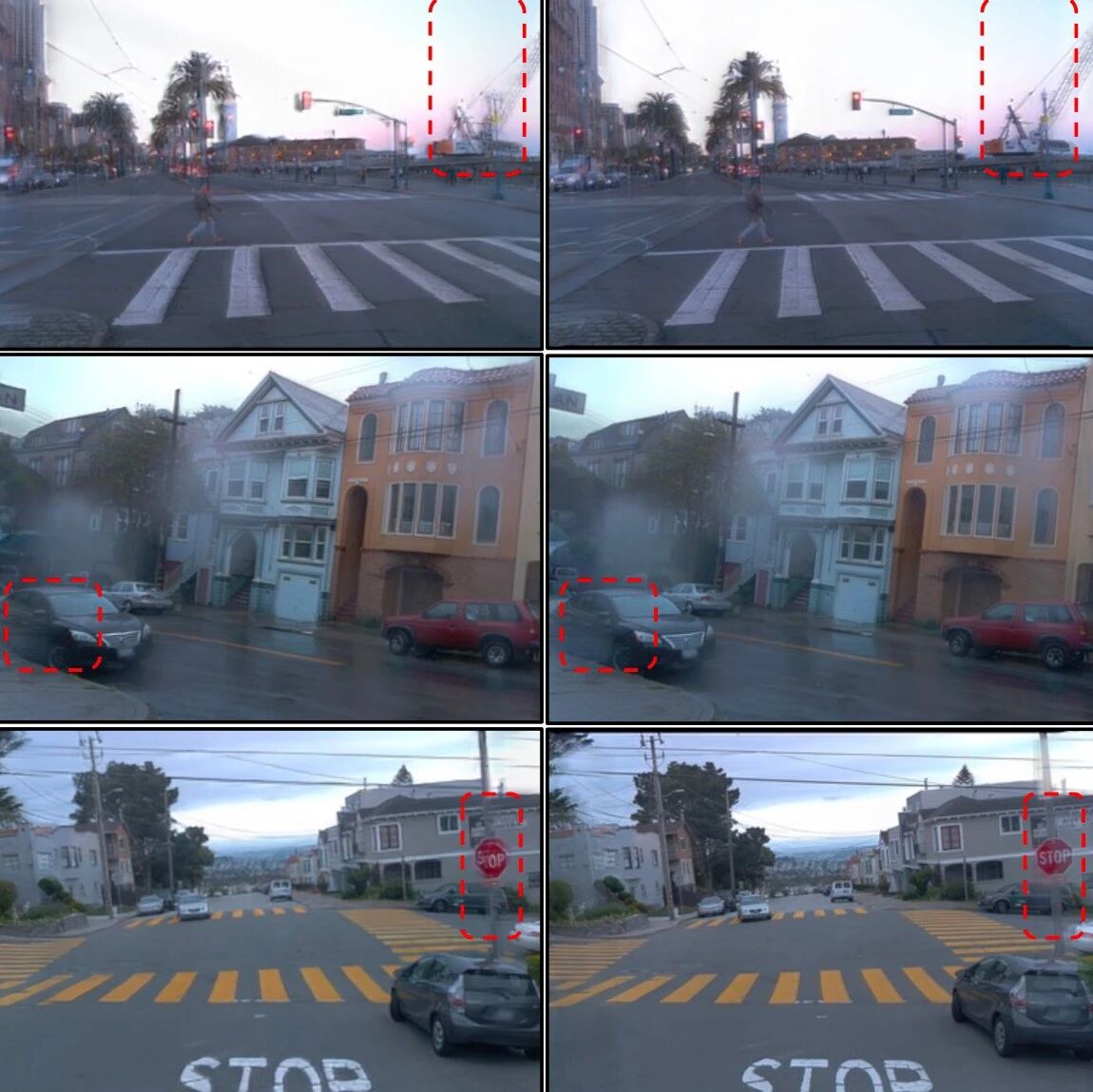
Core Insights - The article discusses the introduction of UniSplat, a novel feed-forward framework for dynamic scene reconstruction in autonomous driving, which addresses challenges in existing methods due to sparse camera views and dynamic environments [6][44]. Group 1: Background and Challenges - Reconstructing 3D scenes from urban driving scenarios is a core capability for autonomous driving systems, supporting tasks like simulation and scene understanding [5]. - Recent advancements in 3D Gaussian splatting have shown impressive rendering efficiency and fidelity, but existing methods often assume significant overlap between input images, limiting their applicability in real-time driving scenarios [5][6]. - The challenges include maintaining a unified latent representation over time, handling partial observations and occlusions, and efficiently generating high-fidelity Gaussian bodies from sparse inputs [5][6]. Group 2: UniSplat Framework - UniSplat is designed to model dynamic scenes using a unified 3D scaffold that integrates multi-view spatial information and multi-frame temporal information [6][9]. - The framework operates in three stages: constructing a 3D scaffold from multi-view images, performing spatio-temporal fusion, and decoding the fused scaffold into Gaussian bodies [6][9]. - The dual-branch decoder strategy enhances detail retention and scene completeness by predicting Gaussian bodies from both sparse point locations and voxel centers [6][9]. Group 3: Experimental Results - Evaluations on the Waymo Open and NuScenes datasets demonstrate that UniSplat achieves state-of-the-art performance in both input view reconstruction and new view synthesis tasks [7][34]. - The model exhibits strong robustness and superior rendering quality when synthesizing views outside the original camera coverage, thanks to its temporal memory mechanism [7][34]. - Comparative results indicate that UniSplat consistently outperforms existing methods, such as MVSplat and DepthSplat, across all metrics [33][34]. Group 4: Conclusion and Future Directions - UniSplat represents a significant advancement in dynamic scene reconstruction and new view synthesis, providing a robust framework for integrating spatio-temporal information from multi-camera video [44]. - The framework's potential applications extend to dynamic scene understanding, interactive 4D content creation, and lifelong world modeling [44].
滴滴和港中文最新的前馈3D重建算法UniSplat!史少帅参与~
自动驾驶之心· 2025-11-08 12:35
Core Viewpoint - The article discusses the introduction of UniSplat, a novel feed-forward framework for dynamic scene reconstruction in autonomous driving, which effectively integrates spatio-temporal information from multi-camera video inputs to enhance the robustness and quality of 3D scene reconstruction [6][44]. Background Review - Reconstructing 3D scenes from urban driving scenarios has become a core capability for autonomous driving systems, supporting critical tasks such as simulation, scene understanding, and long-horizon planning [5]. - Recent advancements in 3D Gaussian splatting technology have shown impressive rendering efficiency and fidelity, but existing methods often assume significant overlap between input images and rely on scene-by-scene optimization, limiting their applicability in real-time driving scenarios [5][6]. UniSplat Overview - UniSplat is designed to address the challenges of robust reconstruction in dynamic driving scenes by constructing a unified 3D Scaffold that integrates multi-view spatial information and multi-frame temporal information [6][9]. - The framework operates in three stages: building a 3D Scaffold from multi-view images, performing spatio-temporal fusion, and decoding the fused Scaffold into Gaussian primitives [6][9]. Experimental Results - Evaluations on the Waymo Open dataset and NuScenes dataset demonstrate that UniSplat achieves state-of-the-art performance in both input view reconstruction and new view synthesis tasks, showcasing strong robustness and superior rendering quality even for views outside the original camera coverage [7][34]. - In the Waymo dataset, UniSplat outperforms existing methods such as MVSplat and DepthSplat across all metrics, achieving a PSNR of 25.37 and an SSIM of 0.765 [34]. - The model effectively distinguishes between dynamic and static elements in scenes, successfully mitigating ghosting artifacts during scene completion [40]. Methodology Details - The 3D Scaffold is constructed by inferring geometric structures using a geometric backbone model and supplementing it with semantic information from a visual backbone model [14][16]. - A dual-branch decoder is employed to generate dynamic-aware Gaussian primitives, enhancing detail retention and scene completeness [23][27]. - The framework incorporates a memory mechanism to accumulate static Gaussian representations over time, facilitating long-term scene completion [29][31]. Conclusion - UniSplat represents a significant advancement in the field of dynamic scene understanding and interactive 4D content creation, providing a robust foundation for future research in lifelong world modeling and autonomous driving applications [44].