Vanguard Growth Index Fund ETF

Search documents
The Vanguard Fund That Can Turn $400 Per Month Into More Than $1.5 Million
Yahoo Finance· 2026-03-24 19:20
Group 1 - Investing $400 per month can lead to a portfolio growth of over $1.5 million in the long term, assuming an average annual return of 10% [2][4][10] - The S&P 500 index has historically averaged a return of 10% per year, which can be leveraged for retirement savings even when starting from $0 [2][8] - Compounding plays a significant role in portfolio growth, with larger balances leading to more substantial growth over time [5] Group 2 - A growth-oriented fund, such as the Vanguard Growth Index Fund ETF, can enhance the likelihood of achieving strong returns by focusing on top growth stocks [6][9] - The Vanguard Growth Index Fund ETF has a low expense ratio of 0.03% and includes holdings in major companies like Nvidia, Tesla, and Eli Lilly, providing diversified exposure [9] - Regular investments in a well-balanced ETF can potentially yield returns that exceed the S&P 500, contributing to significant long-term portfolio value [10]
Apple Stock Is Already A Portfolio Staple — And This ETF Is Turning It Into A Casino Chip
Yahoo Finance· 2026-03-19 10:46
Group 1 - Apple Inc. is a dominant player in global markets, leading to a unique investment scenario where many investors are already heavily invested in the company, yet new ETFs are promoting additional investments in Apple stock through income-generating strategies [1] - Major market funds, including the SPDR S&P 500 ETF Trust and the Vanguard Information Technology ETF, have significant exposure to Apple, with its holdings ranging from 6% to 16% in these portfolios, indicating that most investors are likely already invested in Apple [2] - The YieldMax AAPL Option Income Strategy ETF offers a distinct approach by utilizing synthetic leverage and options techniques, such as covered calls, to generate an impressive distribution yield exceeding 70%, appealing to income-focused retail traders [3] Group 2 - The use of covered call writing in funds like APLY involves a trade-off, as it limits the potential upside of the underlying Apple stock, meaning that while investors can earn income, they forgo the full appreciation of the stock price [4] - APLY has a high expense ratio of 1% and distribution costs that negatively impact its net asset value, resulting in a situation where, despite Apple's stock appreciating around 20% over the past year, APLY's stock price has declined by a similar magnitude [5] - Holding both broad-based ETFs and APLY can lead to unintentional double exposure to Apple, raising concerns about whether these investment products truly offer portfolio diversification or merely concentrate risk in a more complex manner [6]

Inflation Cools, Micron Shines: Tech ETFs Catch Tailwind
Benzinga· 2025-12-18 19:49
Group 1: Market Overview - U.S. tech ETFs experienced a rally due to a cooler-than-expected inflation figure, which dampened Treasury yields [1][2] - The Consumer Price Index (CPI) for November was reported at 2.7% year-over-year, alleviating inflation concerns, while the core inflation rate softened to 2.6%, the lowest since March 2021 [2] - The 10-year Treasury yield moved closer to 4.11%, providing strong support for long-duration growth assets [2] Group 2: Semiconductor Sector Performance - The VanEck Semiconductor ETF (SMH) saw a 2.4% increase, benefiting from strong earnings reported by Micron Technology Inc [3][4] - The iShares Semiconductor ETF (SOXX) advanced by 3%, as easing inflation allowed the Federal Reserve to support growth without reigniting price pressures [4] - Micron's earnings beat reinforced optimism regarding memory pricing and AI-driven demand, lifting the broader chip complex [4] Group 3: Broader Tech Sector Gains - Nasdaq-linked ETFs, including the Invesco QQQ Trust ETF, showed gains due to lower yields, which lifted valuations in megacap tech companies [5] - The Vanguard Growth Index Fund ETF gained traction, reflecting renewed investor appetite for companies with longer-dated cash flows, as inflation effects dampened and bond yields receded [6] Group 4: Investor Sentiment and Risks - Despite the enthusiasm in semiconductor ETFs, there are concerns about valuations having little margin to withstand potential disappointments if inflation figures and earnings trends turn negative [7] - Some investors are pairing tech-intensive ETFs with equal-weight or low volatility strategies to hedge against downside risk [7] - Cooling inflation and reduced yields are currently seen as potent catalysts for tech ETFs, with semiconductors leading the charge [8]



2 Top Vanguard ETFs That Can Turn $350 per Month Into $1 Million in 33 Years
The Motley Fool· 2025-11-09 08:55
Core Insights - The article emphasizes the potential of investing in exchange-traded funds (ETFs) for long-term wealth accumulation, specifically highlighting the possibility of reaching $1 million by investing $350 monthly over 33 years [1][7]. Group 1: Vanguard ETFs - Vanguard ETFs are recommended for long-term investors due to their low fees and good diversification, making them relatively safe options [2]. - The Vanguard Information Technology Index Fund ETF (VGT) and the Vanguard Growth Index Fund ETF (VUG) are identified as top growth-focused funds [2][8]. Group 2: Vanguard Information Technology Index Fund ETF (VGT) - VGT has a low expense ratio of 0.09% and includes a broad mix of 314 tech stocks, covering various sectors such as application software and semiconductors [4]. - Over the past decade, VGT has generated total returns of 681%, averaging a compound annual growth rate (CAGR) of just under 23% [6]. - Even with a conservative long-term return estimate of 10%, a $350 monthly investment in VGT could grow to approximately $1.1 million after 33 years [7]. Group 3: Vanguard Growth Index Fund ETF (VUG) - VUG has a slightly lower management fee of 0.04% and focuses on growth stocks across various industries, with 62% of its 160 holdings in tech [8][9]. - The ETF has achieved total returns of 395% over the past decade, averaging a CAGR of more than 17% [10]. - VUG offers more diversification compared to VGT, which may appeal to investors concerned about potential tech stock volatility [9]. Group 4: Investment Considerations - Both VGT and VUG are considered solid long-term investment options, with expectations that they can generate returns at least on par with the historical performance of the S&P 500 [11]. - The choice between these ETFs may depend on an investor's risk tolerance and preference for tech exposure [12].
ETF flows rise as investors eye opportunities in emerging markets debt
Youtube· 2025-09-19 15:27
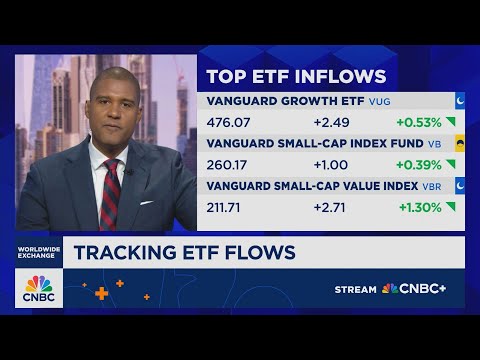
Group 1 - The total ETF flows have exceeded $855 billion year to date, indicating strong investor interest in exchange-traded funds [1] - The Vanguard Growth Index Fund ETF, which focuses on large-cap stocks, experienced the highest inflows this week, followed by the Vanguard Small Cap Fund and the Vanguard Small Cap Value ETF [1] - Small-cap stocks reached a new all-time high, reflecting significant investment in Vanguard products [2] Group 2 - There is substantial capacity for investors to reinvest in the emerging markets debt (EMD) space, which has been underowned for several years [3] - Emerging markets are expected to grow at stronger rates with better fundamental and fiscal dynamics, making them an attractive investment opportunity [3] - The NEMD emerging markets debt hard currency ETF, launched in August, has underperformed compared to the broader market since its inception [3]
ETF flows rise as investors eye opportunities in emerging markets debt
CNBC Television· 2025-09-19 15:27
We're tracking ETF flows that are now over $855 billion year to date. We're also tracking the moves above and below the 30-day moving averages for the popular index funds, the SPY and the triple Q's buying, we're going to show you in a second, surged at the end of the week. This week, the Vanguard Growth Index Fund ETF ticker Bug that focuses on large cap stocks, saw the top inflows, followed by the Vanguard Small Cap Fund, ticker VB, and the the VBR, Vanguard Small Cap Value ETF.Of course, small caps hit a ...
1 Unstoppable Vanguard Fund That Can Turn $50,000 Into $1 Million
The Motley Fool· 2025-07-19 14:00
Core Viewpoint - A simple buy-and-hold investing strategy, particularly in growth stocks through ETFs, can yield significant returns over time with minimal effort [1][2]. Group 1: Investment Strategy - Investing $50,000 in an ETF that tracks growth stocks can potentially double the investment in just over seven years, assuming a long-term average return of 10% [2]. - The Vanguard Growth Index Fund ETF (VUG) is highlighted as a strong option for long-term investment, with the potential to turn a $50,000 investment into over $1 million [3][12]. Group 2: Fund Characteristics - Vanguard funds are known for low fees and excellent diversification, with the Vanguard Growth Index Fund having an expense ratio of 0.04% and a yield of around 0.4% [5]. - The ETF focuses on large growth stocks in the U.S., with technology making up nearly 60% of its holdings, which includes major companies like Apple, Nvidia, and Microsoft [6][7]. Group 3: Growth Potential - The fund could take approximately 32 years to grow a $50,000 investment to over $1 million at a 10% average annual return, with the possibility of reaching this milestone faster if returns exceed 10% [11]. - The potential for significant growth exists due to the strong performance of the stocks within the fund and its low fees, positioning it well for long-term market outperformance [12].