WPS.AI

Search documents
年终盘点:谁会成为中国的"Nano Banana"?
Tai Mei Ti A P P· 2025-12-16 05:46
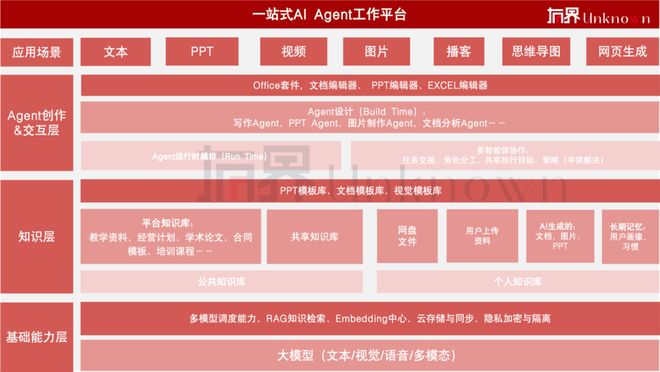
Core Insights - The AI industry is witnessing a significant transformation with the integration of Agents into workflows, marking a shift from traditional tools to more collaborative and intelligent systems [1][18] - Major companies are rapidly developing multi-modal AI tools, creating a competitive landscape where the focus is on comprehensive capabilities rather than isolated functionalities [2][19] - The evaluation of AI Agents is based on three key standards: multi-modal generation capability, knowledge base integration, and human-AI collaboration [5][6] Group 1: Industry Developments - The release of Nano Banana has disrupted the creative tools market by fundamentally changing how designers work, showcasing AI's scalable output capabilities [1] - In the international market, tools like Microsoft Copilot and Google Gemini have established a multi-modal office and creative tool ecosystem, while domestic players like Baidu and Tencent are also making significant strides [2] - The emergence of a competitive landscape is evident as companies strive to define the next generation of creative and office scenarios, with a focus on who will become the "Chinese Nano Banana" [2][19] Group 2: Agent Evaluation Criteria - The evaluation framework for AI Agents includes three levels: the ability to produce complete workflows, form data loops, and continuously accumulate knowledge and memory [2][3] - The first standard is the ability to generate multi-modal content, moving from single-point solutions to comprehensive task management [5][6] - The second standard focuses on the integration of knowledge bases, which allows for the systematic accumulation and application of data across various tasks [5][6] Group 3: Product Comparisons - A comparative analysis of five leading domestic AI Agents reveals a generational divide, with only two companies advancing to the third stage of capability [2][7] - GenFlow3.0 stands out as the only platform with full multi-modal creative capabilities, while others like Quark and WPS are in the second tier, lacking certain functionalities [9][10] - The compatibility of these platforms with Office systems is crucial, with GenFlow3.0 achieving native-level compatibility, enabling seamless integration into existing workflows [11][12] Group 4: Future Directions - The AI application landscape is evolving towards a "淘汰赛" (elimination round) where competition will be based on comprehensive product capabilities rather than just model parameters [18][19] - The ultimate goal for AI Agents is to become partners in the creative process rather than mere tools, emphasizing the need for deep integration into complex work environments [20][21] - The next generation of Agents must focus on reconstructing three core capabilities to transition from being simple tools to long-term collaborative partners in the workplace [21][22]