WisdomTree Japan Hedged Equity ETF (DXJ)

Search documents
Adjusting Your Expectations to Hedge Back to SGD
Investment Moats· 2026-03-17 01:09
Core Insights - The significant outperformance of the WisdomTree Japan Hedged Equity ETF (DXJ) over non-hedged funds is attributed to both currency depreciation and interest rate differentials [1][10]. Interest Rate Dynamics - The returns from DXJ and iShares Currency Hedged MSCI Japan ETF (HEWJ) have been positively impacted by higher carry due to interest rate increases in 2021 and 2022 [2]. - The interest rate differential between the US and Japan has been a critical factor, with US rates significantly higher than Japan's negative rates [5][10]. Currency Forward Contracts - Both DXJ and HEWJ utilize 1-month JPY/USD FX Forward contracts to hedge against currency fluctuations, which helps protect their USD value even if the JPY depreciates [4][6]. - The forward premium in JPY is driven by the interest rate differential, which has implications for the returns of hedged funds [5][10]. Performance Comparison - A table comparing US and Japan's 3-month interest rates shows a consistent interest rate advantage for US rates over Japan from 2018 to 2023, with the differential peaking at 5.79% in October 2023 [7][8]. - The performance difference between HEWJ and EWJ (non-hedged) closely aligns with the interest rate differential, particularly after 2022 when HEWJ's returns exceeded the 3-month rate by 2% [10][12]. Hedging Implications - Hedging is viewed as a strategic bet on the strength of the USD against the JPY, with the absence of hedging representing an implicit risk exposure [14]. - The analysis suggests that hedging strategies can yield different outcomes based on the interest rate environment and currency movements, as seen in the comparison of hedged versus unhedged funds [15][21].

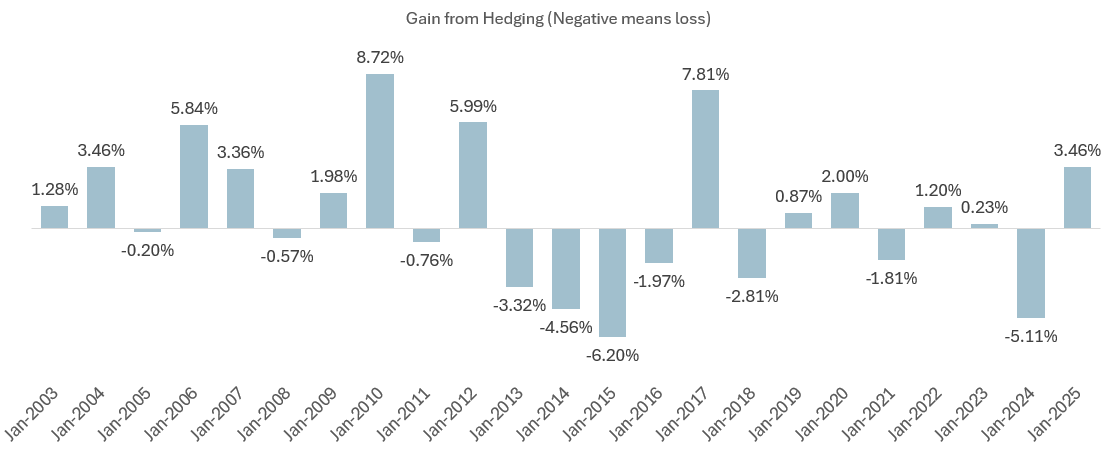
How the Hedged Class of a Japan Fund Result in a 500% Outperformance Over a Non-Hedge One.
Investment Moats· 2026-03-11 00:46
Group 1 - The article discusses concerns about the potential decline of the USD and its implications for investments, particularly in the context of de-dollarization and currency hedging strategies [3][30]. - It highlights the performance comparison between unhedged and hedged equity funds, specifically focusing on the iShares MSCI Japan ETF (EWJ) and the WisdomTree Japan Hedged Equity ETF (DXJ) [8][12]. - The article emphasizes the importance of understanding the difference between being denominated in a currency versus being hedged against currency fluctuations, which can significantly impact investment performance [15][18]. Group 2 - The performance of DXJ has been notably superior to EWJ, with DXJ achieving a 453% return compared to EWJ's 107% since DXJ's inception in 2006, illustrating the benefits of currency hedging in a depreciating currency environment [20]. - The article notes that the Japanese Yen has experienced significant volatility, with a 56% appreciation against the USD from 2006 to 2012, followed by a decline, which affects the performance of both hedged and unhedged funds [24][25]. - It suggests that investors should consider the underlying methodology of funds, as DXJ is designed to favor companies that benefit from a weaker yen, while EWJ is more general in its approach [28].
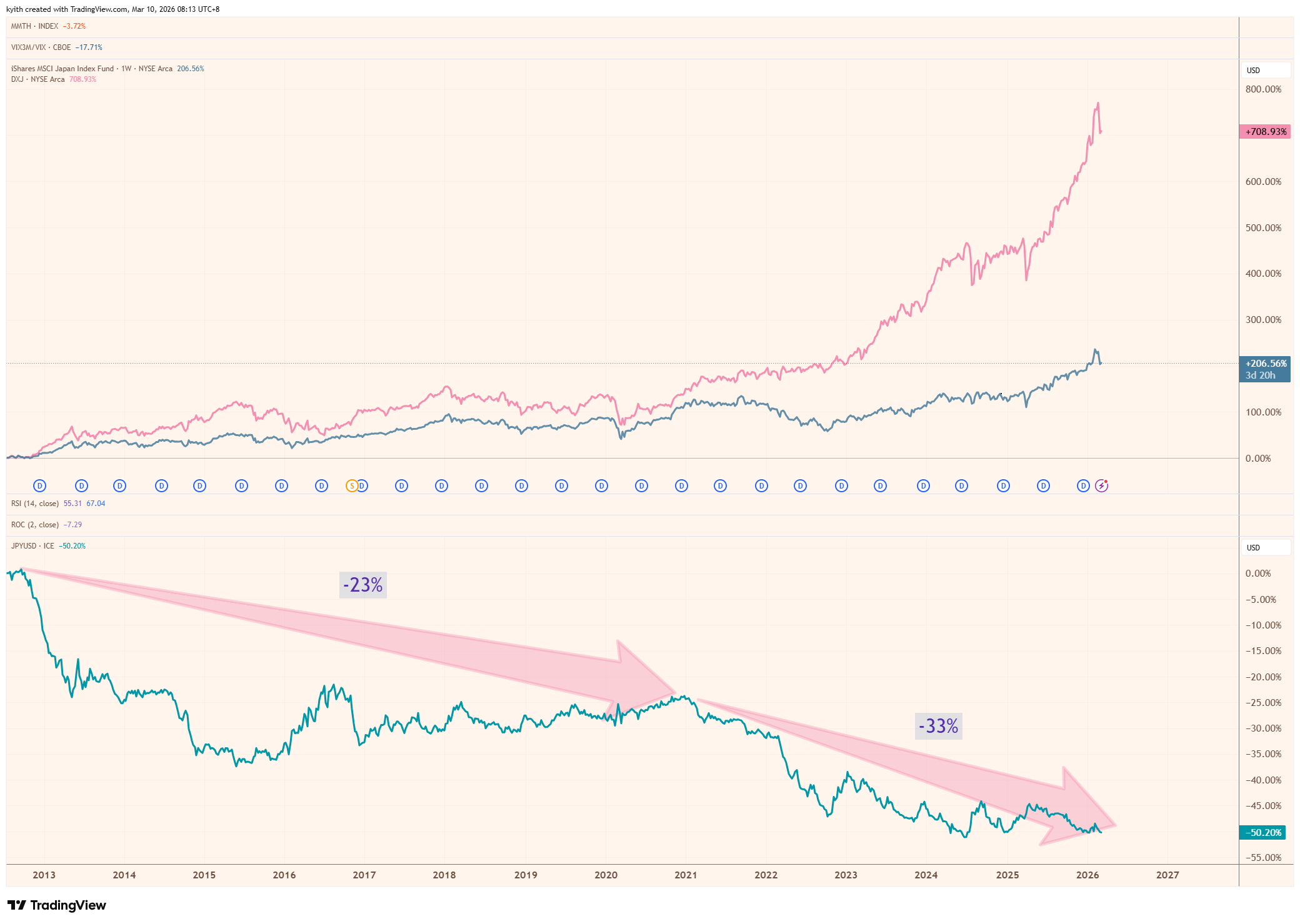
Worried About US Market Volatility? Explore These Japanese ETFs
ZACKS· 2025-11-11 13:26
Core Insights - Japanese equities are becoming an attractive alternative for investors seeking to diversify from the volatility in the U.S. stock market, with Japan's stock market outperforming the U.S. recently [1][2] Market Performance - Foreign investors purchased a net 384 billion yen ($2.5 billion) of Japanese equities in late October 2025, contributing to the Nikkei 225's best monthly gain since 1990, with a 29% increase in dollar terms year to date, compared to the S&P 500's 16% gain [2] - The current enthusiasm for Japanese equities among U.S. investors is at levels not seen since the Abenomics era, indicating strong interest and potential for further investment [2][9] Investment Strategy - Pivoting to Japan's stock market is suggested as a smart move for investors looking for substantial gains and diversification, with Exchange Traded Funds (ETFs) recommended as a more accessible option compared to individual stock picking [3][4] Valuation Metrics - The Nikkei is trading at approximately 32% lower valuation compared to the S&P 500, with a trailing 12-month Price/Earnings ratio of 19.25x versus 28.41x, indicating that Japanese equities are relatively inexpensive [6] - The Japanese market is benefiting from improved corporate governance and a focus on shareholder returns, which are expected to support future growth [7] Future Growth Potential - Factors such as moderating inflation, improved trade sentiment from the US-Japan deal, AI-related growth, and steady inflow of foreign funds are anticipated to boost Japan's equity market [7] - Despite recent volatility in the U.S. market, the Japanese stock market presents a less frothy investment environment, making it an appealing option for diversification [8] ETFs to Consider - iShares MSCI Japan ETF (EWJ) has net assets of $15.92 billion, offering exposure to 180 large and mid-sized companies, with a year-to-date surge of 25.7% [11] - WisdomTree Japan Hedged Equity ETF (DXJ) has net assets of $4.64 million, focusing on 431 dividend-paying companies, with a year-to-date increase of 25.8% [12] - iShares MSCI Japan Value ETF (EWJV) has net assets of $515.75 million, targeting 115 large and mid-cap stocks with lower valuations, achieving a year-to-date rise of 28.4% [13]


Is WisdomTree Japan Hedged Equity ETF (DXJ) a Strong ETF Right Now?
ZACKS· 2025-08-07 11:21
Core Insights - The WisdomTree Japan Hedged Equity ETF (DXJ) debuted on June 16, 2006, and offers broad exposure to the Asia-Pacific (Developed) ETFs category [1] - The ETF industry has been traditionally dominated by market capitalization weighted indexes, but smart beta strategies are gaining traction among investors seeking to outperform the market [2][3] - The WisdomTree Japan Hedged Equity ETF has amassed over $3.65 billion in assets, making it one of the larger ETFs in its category [5] Fund Details - The fund is sponsored by WisdomTree and aims to match the performance of the WisdomTree Japan Hedged Equity Index, which provides exposure to Japanese equity markets while neutralizing currency fluctuations [5] - The ETF has an annual operating expense ratio of 0.48% and a 12-month trailing dividend yield of 3.61% [6] - The fund's holdings are primarily in U.S. dollars, accounting for approximately 99.07% of total assets, with top holdings including Mitsubishi Ufj Financial Group and Toyota Motor Corp [7] Performance Metrics - Year-to-date, the WisdomTree Japan Hedged Equity ETF has increased by approximately 10.64%, and it has risen about 35.91% over the last 12 months as of August 7, 2025 [8] - The ETF has a beta of 0.43 and a standard deviation of 19.49% over the trailing three-year period, indicating a medium risk profile [9] Alternatives - Other ETFs in the space include JPMorgan BetaBuilders Japan ETF (BBJP) with $13.44 billion in assets and iShares MSCI Japan ETF (EWJ) with $15.62 billion in assets, offering lower expense ratios [11] - Investors may consider traditional market cap weighted ETFs for potentially cheaper and lower-risk options [11]