BLT(688333)

Search documents
机器人+商业航天双buff,又一个科技赛道悄悄起风了
3 6 Ke· 2025-12-17 09:53
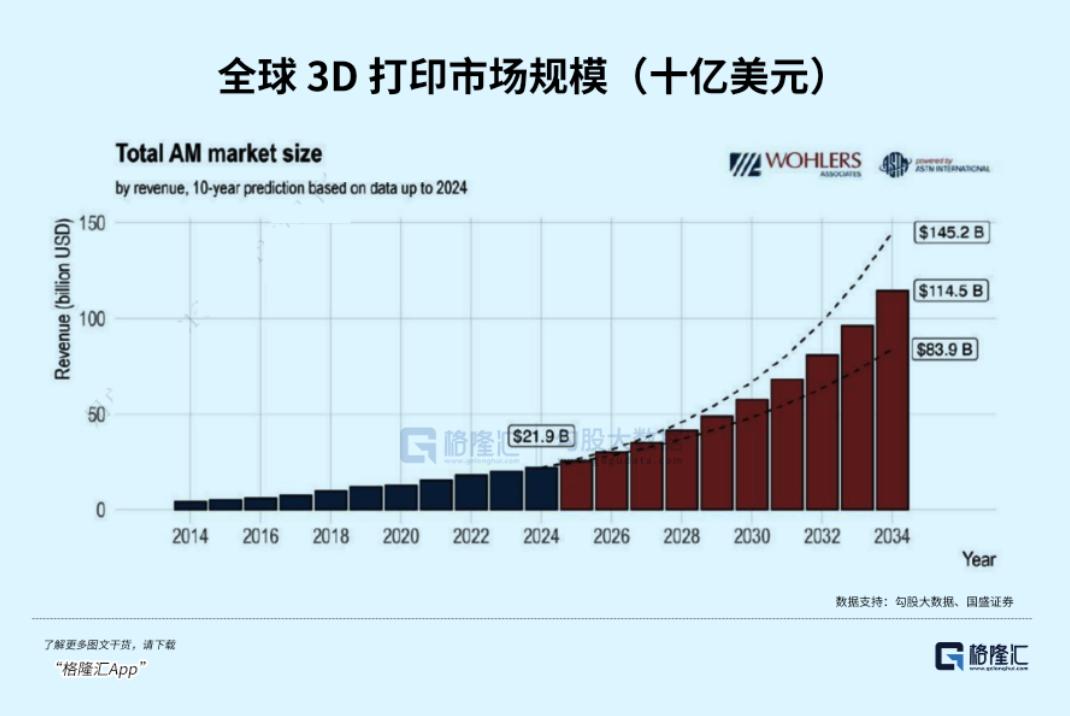
Core Insights - The 3D printing technology has transitioned from experimental stages to becoming a core productivity driver in high-end manufacturing, evidenced by successful applications in aerospace and robotics [1] - The global 3D printing market is projected to reach $21.9 billion in 2024 and is expected to grow to $114.5 billion by 2034, indicating a significant expansion phase [2] - Chinese manufacturers dominate the entry-level equipment market with over 90% market share, supported by rapid technological advancements and cost advantages [4] Market Growth - The 3D printing industry has entered a phase of large-scale expansion, with a notable increase in domestic exports, reaching 3.77 million units valued at 8.9 billion yuan in 2024 [4] - The export volume is expected to exceed 5 million units in 2025, with a potential for export value to surpass 10 billion yuan for the first time [4] Technological Advancements - Significant improvements in SLM metal printing precision and carbon fiber 3D printing have enhanced capabilities for aerospace and automotive applications [5] - AI modeling technology and advancements in consumer-grade 3D printing have made the technology more accessible, reducing operational complexity and costs [5] Application Expansion - The demand for 3D printing in humanoid robotics and commercial aerospace is rapidly increasing, with 3D printing reducing the number of parts in rocket engines by 80% and costs by 90% [6] - The consumer market is also experiencing a surge, with sales of 3D printed toys and custom home goods tripling during major shopping events [8] Investment Opportunities - The industry is poised for growth in 2025, driven by increased orders and capital investment, with three main investment lines identified: core equipment, core materials, and emerging applications [9] - Key players in industrial-grade 3D printing, such as Platinum and Huazhu, are well-positioned to benefit from the growing demand [9] - The domestic production of core materials, such as titanium alloy powders, is becoming increasingly competitive, with significant cost advantages over imports [10] Conclusion - The evolution of 3D printing technology from concept to reality has established it as a core production force, with Chinese companies leading in both consumer and industrial markets [12] - The structural opportunities in the industry, driven by exports and domestic production, warrant close attention from investors [12]


机器人+商业航天双buff,又一个科技赛道悄悄起风了!
Ge Long Hui· 2025-12-17 09:51
Core Insights - The 3D printing technology has transitioned from experimental stages to becoming a core productivity driver in high-end manufacturing, evidenced by successful applications in aerospace and robotics [2] - The global 3D printing market is projected to reach $21.9 billion in 2024 and is expected to grow to $114.5 billion by 2034, indicating a significant expansion phase [2] Market Growth and Domestic Manufacturers - The global 3D printing industry has moved beyond small-scale growth and is now in a phase of large-scale expansion, with Chinese manufacturers capturing over 90% of the entry-level equipment market due to high cost-performance ratios [4] - In 2024, China exported 3.7777 million 3D printing devices worth 8.9 billion yuan, with projections indicating that exports could exceed 5 million units and 10 billion yuan in 2025 [4] Domestic Production and Technological Advancements - The domestic production rate for metal 3D printing equipment has increased from less than 30% five years ago to 60%, while the local supply chain coverage for non-metal materials exceeds 85% [5] - Companies like Plater and Huazhu High-Tech are producing competitive metal 3D printers at prices 30% lower than their Western counterparts, successfully entering supply chains in aerospace and new energy vehicles [6] Technological Improvements and Application Expansion - Significant technological advancements have been made in industrial-grade 3D printing, with SLM metal printing achieving precision of 0.01 mm, suitable for aerospace engine components [7] - The efficiency of 3D printing has improved fivefold over the past three years, with entry-level device prices dropping by 60%, making the technology accessible to consumers and small businesses [7] Application Scenarios and Market Drivers - The demand for 3D printing in humanoid robotics and commercial aerospace is rapidly increasing, with 3D printing reducing the number of parts in rocket engines by 80% and cutting costs by 90% [8] - During the 618 shopping festival, sales of 3D printed toys and customized home goods surged over threefold, indicating a strong awakening of consumer demand [10] Investment Opportunities - The year 2025 is anticipated to be pivotal for 3D printing, with three main investment lines identified: core equipment, core materials, and emerging applications [10] - In the core equipment sector, companies like Plater and Huazhu High-Tech are positioned to benefit from industrial and consumer demand growth [11] - The core materials sector is expected to see further domestic production increases, with companies like Zhonghang Mite and Yuyuan Powder Materials offering competitive products [12] - Emerging applications in humanoid robotics and commercial aerospace are likely to experience significant growth, with companies like LZ Group and Yinbang Co. poised to capitalize on these trends [13]

机器人+商业航天双buff,又一个科技赛道悄悄起风了!
格隆汇APP· 2025-12-17 09:48
Core Insights - The article emphasizes the rapid growth and transformation of the 3D printing industry, highlighting its transition from experimental technology to a core productivity driver in high-end manufacturing [5][6][23]. - The global 3D printing market is projected to reach $21.9 billion in 2024, with expectations to grow to $114.5 billion by 2034 [6]. Market Expansion and Domestic Manufacturers - Chinese manufacturers dominate the entry-level 3D printing equipment market, capturing over 90% of the share due to high cost-performance and rapid technological iteration [10]. - In 2024, China exported 3.7777 million 3D printing devices worth 8.9 billion yuan, with projections for 2025 to exceed 5 million units and 10 billion yuan in export value [10][11]. - The domestic production rate for metal 3D printing equipment has increased from under 30% five years ago to 60%, while non-metal material supply chain coverage exceeds 85% [11]. Technological Advancements and Application Scenarios - Key technological breakthroughs in industrial-grade 3D printing have achieved precision levels of 0.01 mm, meeting aerospace manufacturing requirements [13]. - The cost of titanium alloy powder, a core material for metal printing, has halved from 600 yuan/kg in 2023 to below 300 yuan/kg [14]. - 3D printing is significantly reducing costs and production times in commercial aerospace, with SpaceX's Raptor engine comprising 85% 3D printed components, leading to a 90% cost reduction and a production cycle cut from 6 months to 1 month [14]. Investment Opportunities - The article identifies three main investment lines for 3D printing: 1. **Core Equipment Line**: Benefiting from industrial and consumer demand growth, with companies like Platinum and Huashu High-Tech leading the market [19]. 2. **Core Materials Line**: Focusing on domestic production advantages, with companies like Zhonghang Mite and Youyan Powder Materials providing competitive pricing [20]. 3. **Emerging Applications Line**: Companies in humanoid robotics and commercial aerospace are positioned to benefit directly from increased demand [22]. Conclusion - The 3D printing industry is at a pivotal moment, transitioning from concept to reality, with significant opportunities for investment as domestic companies lead in both consumer and industrial markets [23].

国防军工行业2026年投资策略:“全球化、AI+”,高质量发展兼顾价值与成长
GF SECURITIES· 2025-12-15 14:50
Core Insights - The report emphasizes the importance of "globalization and AI+" in advancing high-quality development in the defense and military industry, highlighting the need for modernization and efficiency improvements in military systems [5][30][34] - The investment strategy focuses on balancing value and growth, with traditional sectors entering an S-curve evolution phase while new demands and replacements coexist [5][30] Section Summaries 1. Current Development Stage from the S-Curve Perspective - The defense and military industry is in a growth phase, with traditional sectors experiencing rapid development during the previous five-year plan, but not yet entering a slowdown [16][26] - The S-curve model indicates that the industry lifecycle includes multiple product lifecycles, with the current focus on extending product lifespans through innovation [23][24] 2. S-Curve Cycle Expansion - Global military trade remains robust, emphasizing the importance of lifecycle management from equipment to services [9][18] - The report anticipates that the demand for large aircraft and low-altitude economic activities will accelerate due to supportive policies [9][28] 3. S-Curve Cycle Evolution - Supply chain reforms are crucial for reducing costs and complexity, enhancing the focus on maintenance and repair services [9][33] - The integration of unmanned systems and intelligent technologies is expected to drive significant advancements in military capabilities [9][51] 4. New Cycle of the S-Curve: Emerging Industries - The report identifies commercial aerospace, AI, controllable nuclear fusion, quantum information, and deep-sea technology as key areas for future growth [9][57][65] - The acceleration of technological advancements and policy support is expected to unlock new market opportunities in these sectors [9][58] 5. Investment Recommendations - The report recommends focusing on companies that align with the evolving S-curve, particularly those involved in supply chain reform, maintenance, and unmanned systems [5][30] - Specific companies highlighted for investment include 航发动力, 中航高科, and 国睿科技, among others, which are positioned to benefit from these trends [6][9]


商业航天深度报告(火箭篇):卫星应用需求释放,火箭供给有望突破
ZHESHANG SECURITIES· 2025-12-14 11:56
Investment Rating - The report rates the industry as "Positive" [1] Core Insights - The demand for satellite applications is expected to release, leading to a breakthrough in rocket supply [1] - The construction of low Earth orbit (LEO) satellite constellations is progressing slower than anticipated, resulting in a rapid increase in rocket launch demand [5][19] - The cost of rocket launch capacity is continuously decreasing, and the industry capacity is expanding [4][32] Summary by Sections 1. Low Earth Satellite Communication: Multi-Scenario Applications Leading Industry Growth - Satellite internet is a new type of network that provides broadband internet access globally through a certain number of satellites, enhancing military communication networks and expanding service coverage for ground users [5][10] - The construction of low Earth satellite constellations is facing "frequency occupation and orbit preservation" pressures, with significant demand in China [5][21] 2. Rocket Sector: Demand Explosion, Supply Breakthrough, Moving Towards High Frequency and Low-Cost Commercial Closure - The number of planned satellite launches in China is expected to reach approximately 16,000 over the next five years, leading to a rapid increase in rocket launch frequency from 54 times in 2025 to 860 times in 2030, with a CAGR of 74% [24][25] - By 2029, the demand for space computing in China is projected to correspond to 6,800 rocket launches, with a global total of 15,000 launches [27] - The national team is continuously expanding capacity, and private rocket companies are expected to see concentrated test launches by the end of this year [29][32] 3. Key Industry Chain Targets - The report highlights several key suppliers and potential main manufacturers in the rocket industry, including: - Hangyang Co., Ltd. as a liquid oxygen fuel supplier [38] - Plater Technology as a 3D printing parts supplier for rockets [38] - Aerospace Power as the only listed platform of the Sixth Academy of Aerospace Science and Technology [38]


3D 打印行业报告:飞入寻常百姓家,行业扩张奇点时刻降临
Orient Securities· 2025-12-13 07:11
Investment Rating - The report maintains a "Positive" outlook on the 3D printing industry, indicating a low current penetration rate and potential for rapid growth driven by the expansion of demand for customized products and the popularization of the 3D farm model [7]. Core Insights - The 3D printing industry is entering a "singularity moment," where growth is driven not just by technological breakthroughs but also by a paradigm shift in industrial manufacturing and a surge in consumer demand for personalized products. Key drivers include agile manufacturing advantages in industrial-grade 3D printing, the ability to produce complex shapes, and the democratization of technology in consumer-grade 3D printing [9][13]. - The global 3D printing market is projected to reach $21.9 billion in 2024, with a year-on-year growth of 9.31%. In China, the market is expected to reach 42.3 billion yuan, with a significant portion of revenue coming from equipment and services [9][69]. Summary by Sections Investment Suggestions and Targets - The report suggests that the 3D printing industry is poised for rapid growth due to low current penetration rates and expanding demand. Key investment targets include: - Consumer-grade 3D printing service operator Huina Technology (300609, not rated) - Industrial-grade metal printing equipment manufacturers Plater (688333, not rated) and Huashu High-Tech (688433, not rated) - 3D printing material suppliers Jialian Technology (301193, not rated) and Youyan Powder Materials (688456, not rated) [4][21]. Industry Overview - 3D printing technology is characterized by its flexibility and high production capacity, allowing for the creation of complex structures with minimal waste. The technology has evolved from traditional subtractive manufacturing to additive manufacturing, enabling significant design freedom and reduced production cycles [22][24]. - The main materials used in 3D printing include plastics and metal powders, with various technological routes such as FDM, SLS, and SLA being commercially viable [31][36]. Market Outlook - The global 3D printing market is experiencing a golden development period, with both consumer and industrial segments expected to expand. The U.S. leads the market, while the Asia-Pacific region is catching up rapidly. The market for 3D printing materials is projected to grow by 35.21% in 2024, with significant growth also seen in 3D bioprinting and metal additive manufacturing [58][62]. - In China, the 3D printing market is expected to reach 42.3 billion yuan in 2024, with a strong focus on equipment and services, which together account for 76% of the market [69][70]. Key Players - The report highlights the differentiation among leading companies in the industrial-grade 3D printing sector, with notable players like Plater and Huashu High-Tech excelling in metal 3D printing. In the consumer-grade sector, Huina Technology is building a supply-demand ecosystem through a combination of scale farms and offline stores [9][20][21].



卫星互联网板块再度领涨,卫星ETF易方达(563530)标的指数涨超1%,“千帆星座”在轨测试达标
Mei Ri Jing Ji Xin Wen· 2025-12-05 09:30
Core Insights - The satellite internet and commercial aerospace sectors are experiencing a rebound, with the China Satellite Industry Index rising by 1.3% as of 11:00 AM, driven by significant gains in stocks such as Platinum (up over 10%), Guangku Technology (up over 7%), and Aopu Optoelectronics (up over 5%) [1] Group 1: Market Performance - The China Satellite Industry Index has shown a positive trend, indicating strong market interest and investment potential in the satellite sector [1] - Key stocks within the index have demonstrated substantial price increases, reflecting investor confidence and market momentum [1] Group 2: Industry Developments - The "Thousand Sails Constellation" communication project has successfully met its expected performance metrics, with international application testing underway, including successful demonstrations in Kazakhstan [1] - The commercial rocket launch market in China has significant growth potential compared to global standards, with increasing demand driven by the expansion of large satellite constellations [1] Group 3: Investment Opportunities - The China Satellite Industry Index includes 50 companies across satellite manufacturing, launching, and application sectors, providing comprehensive coverage of the industry chain [1] - The E Fund Satellite ETF (563530) tracks this index, offering investors a streamlined way to capitalize on opportunities within the satellite industry [1]



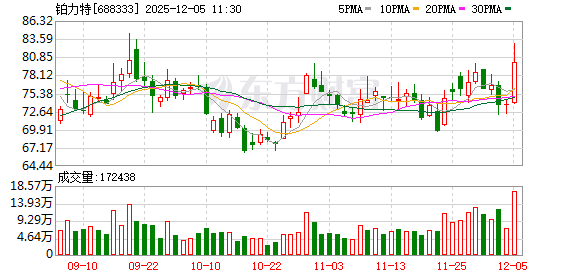
铂力特成交额创2025年3月10日以来新高
Zheng Quan Shi Bao Wang· 2025-12-05 03:49
Core Insights - The trading volume of Plutotech reached 1.276 billion RMB, marking the highest level since March 10, 2025 [2] - The latest stock price increased by 10.61%, with a turnover rate of 5.86% [2] - The previous trading day recorded a total trading volume of 543 million RMB [2] Company Overview - Xi'an Plutotech Additive Technology Co., Ltd. was established on July 6, 2011, with a registered capital of 274.322174 million RMB [2]
政策、技术、生态共振,商业航天万亿级市场蓄势待发,通用航空ETF基金(561660)盘中涨超1.2%
Xin Lang Cai Jing· 2025-12-05 02:25
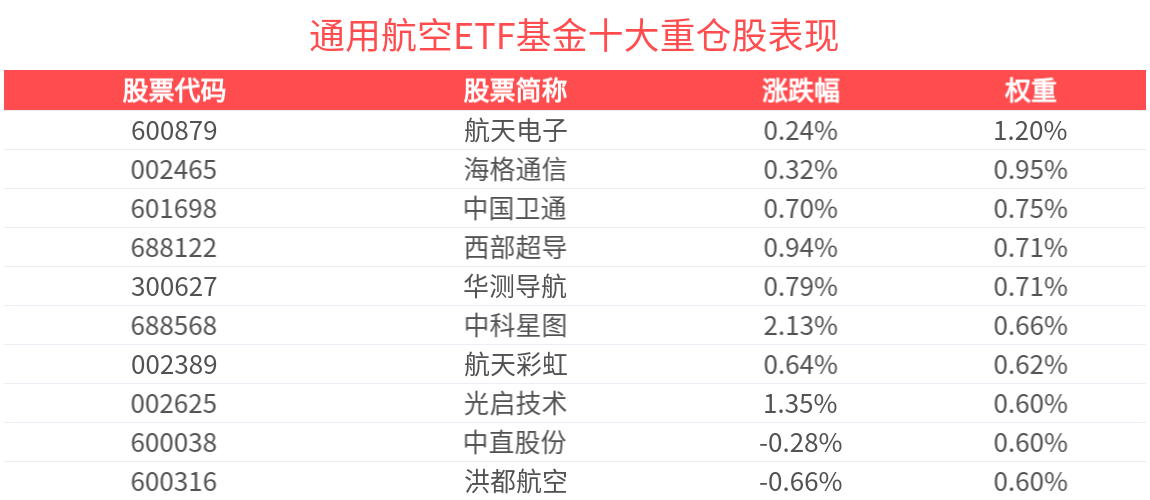
Core Insights - The commercial aerospace market in China is poised for significant growth, driven by technological breakthroughs and policy support, with a potential market size reaching trillions [1] - The 2025 Commercial Aerospace Forum showcased advancements in various segments of the industry, including rocket launches and satellite management, indicating a robust development trajectory [1] Industry Overview - The commercial aerospace sector is experiencing a dual inflection point characterized by technological advancements and market expansion [1] - The opening of national major aerospace projects to commercial entities and the acceleration of in-orbit service capabilities are key factors contributing to this growth [1] Market Performance - As of December 4, 2025, the Zhongzheng General Aviation Theme Index (931855) rose by 1.08%, with notable increases in constituent stocks such as Plittech (up 12.17%) and Guanglian Aviation (up 9.04%) [1] - The General Aviation ETF Fund (561660) also saw a 1.10% increase, reflecting positive market sentiment towards the sector [1] Key Stocks - The top ten weighted stocks in the Zhongzheng General Aviation Theme Index account for 40.68% of the index, highlighting the concentration of market influence among these companies [2] - Notable stocks include Aerospace Electronics (600879) and Haige Communication (002465), which are among the top performers in the index [2][3]





卫星产业ETF(159218)盘中20日新高!铂力特、航宇微、中科星图领衔
Sou Hu Cai Jing· 2025-12-05 02:12
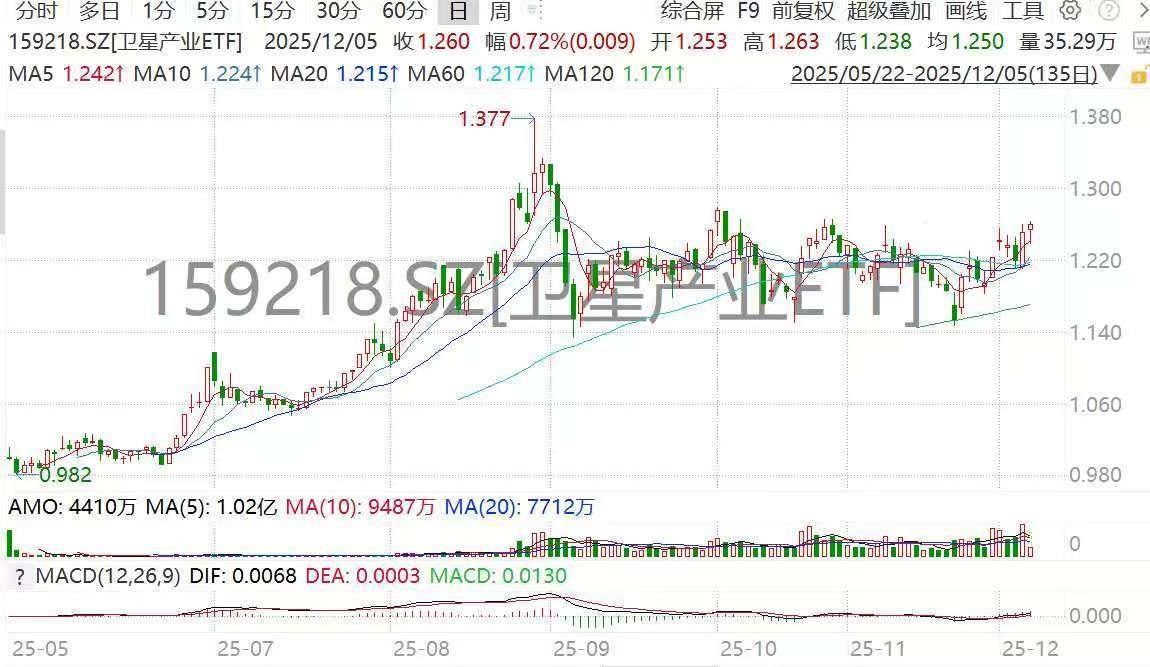
Core Insights - The satellite industry is experiencing a resurgence, with the satellite industry ETF (159218) rising by 0.72% and reaching a peak increase of 0.96%, indicating strong market interest and trading activity [1] - Key players such as Plutotech, Aerospace Micro, and Zhongke Xingtou are leading the charge in this growth [1] - The trading volume has increased significantly, with a turnover rate of 6.53% and a transaction value exceeding 44 million [1] Domestic Developments - The successful maiden flight of the reusable "Zhuque-3" rocket marks a significant milestone for the domestic satellite industry, enhancing the ecosystem of industry chain cooperation [1] - This achievement is expected to catalyze further advancements and investments within the sector [1] International Context - SpaceX's "Starlink" service launching in South Korea highlights the intensifying global competition in the satellite internet market [1] - The competitive pressure from international players is driving the acceleration of satellite internet infrastructure development in China [1] Growth Opportunities - The combination of policy support and competition from "Starlink" is creating clear growth opportunities for the entire satellite industry chain in China [1]