
BOC HONG KONG(BHKLY)

Search documents
中银香港(02388) - 截至2025年8月31日的股份发行人的证券变动月报表
2025-09-01 09:30
股份發行人及根據《上市規則》第十九B章上市的香港預託證券發行人的證券變動月報表 | 截至月份: | 2025年8月31日 | 狀態: 新提交 | | --- | --- | --- | | 致:香港交易及結算所有限公司 | | | | 公司名稱: | 中銀香港(控股)有限公司 | | | 呈交日期: | 2025年9月1日 | | | I. 法定/註冊股本變動 不適用 | | | | 備註: | | | | 本公司可發行的股份數目上限為20,000,000,000股普通股股份及其股本並無股份面值。 | | | FF301 第 1 頁 共 10 頁 v 1.1.1 FF301 II. 已發行股份及/或庫存股份變動 | 1. 股份分類 | 普通股 | | 股份類別 | 不適用 | | 於香港聯交所上市 (註1) | 是 | | | --- | --- | --- | --- | --- | --- | --- | --- | --- | | 證券代號 (如上市) | 02388 | | 說明 | | | | | | | 多櫃檯證券代號 | 82388 | RMB 說明 | | | | | | | | | | 已發 ...
美银证券:升中银香港至37.66港元 评级“买入”
Zhi Tong Cai Jing· 2025-09-01 08:29
美银证券发布研报称,中银香港(02388)上半年净利润同比升10.5%至222亿港元,拨备前利润同比升 16.5%至317亿港元,均胜预期。尽管中银香港希望稳步提高全年派息率,上半年每股股息同比增长 1.8%至0.58港元,派息率下降至27.7%。美银证券将中银香港今年每股盈利预测上调10%,2026年至 2027年每股盈利预测大致稳定,其目标价由33.1港元上调至37.66港元,其评级为"买入"。 ...
美银证券:升中银香港(02388)至37.66港元 评级“买入”
智通财经网· 2025-09-01 08:21
Core Viewpoint - Bank of America Securities reports that Bank of China Hong Kong (02388) achieved a 10.5% year-on-year increase in net profit to HKD 22.2 billion in the first half of the year, exceeding expectations [1] Financial Performance - Pre-provision profit rose by 16.5% year-on-year to HKD 31.7 billion, also surpassing forecasts [1] - The interim dividend per share increased by 1.8% year-on-year to HKD 0.58, while the payout ratio decreased to 27.7% [1] Earnings Forecast and Target Price - Bank of America Securities raised the earnings per share forecast for Bank of China Hong Kong by 10% for this year [1] - Earnings per share forecasts for 2026 to 2027 are expected to remain stable [1] - The target price for the stock was increased from HKD 33.1 to HKD 37.66, maintaining a "Buy" rating [1]
大行评级|摩根大通:上调中银香港目标价至38.4港元 维持“中性”评级
Ge Long Hui· 2025-09-01 06:45
Core Viewpoint - Morgan Stanley's report indicates that Bank of China Hong Kong's performance in the first half of the year exceeded the bank's expectations, but was generally in line with market expectations, supported by robust growth in pre-tax operating profit [1] Summary by Category - **Earnings Forecast** - The bank raised its earnings forecast by 20% to reflect more resilient profit margins and trading income [1] - **Rating and Target Price** - The bank maintained a "neutral" rating and adjusted the target price from HKD 37.7 to HKD 38.4 [1]
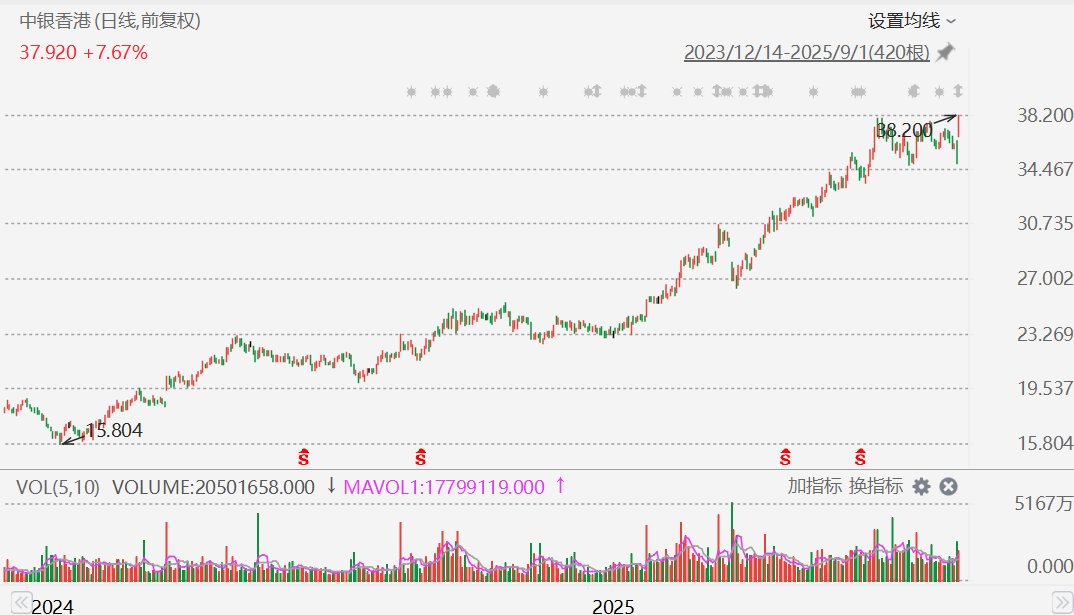
港股异动丨中银香港大涨超8%创历史新高,计划申请稳定币发行人牌照
Ge Long Hui· 2025-09-01 03:49
Group 1 - The core viewpoint of the article highlights that Bank of China Hong Kong (2388.HK) has seen a significant stock price increase, rising over 8% to reach a historical high of 38.2 HKD, with a market capitalization exceeding 400 billion HKD [1] - The bank plans to apply for a stablecoin issuer license, aiming to be among the first approved issuers, following the establishment of a joint venture led by Standard Chartered Hong Kong that has expressed interest in applying for a license [1] - The deadline for the first batch of applications for stablecoin licenses is set for the end of September [1] Group 2 - Although Bank of China is not one of the three sandbox institutions for stablecoin issuance, it has established a dedicated team to advance related developments [1] - There is external optimism regarding the potential development of a stablecoin linked to offshore RMB, which is why the bank places significant importance on the development of stablecoins [1]

港股异动 | 中银香港(02388)绩后涨超6% 中期股东应占溢利221.2亿港元 净交易性收益按年上升
Zhi Tong Cai Jing· 2025-09-01 01:45
Core Viewpoint - Bank of China Hong Kong reported a strong performance for the first half of 2025, with significant increases in net operating income and profit attributable to shareholders, leading to a rise in stock price by over 6% following the earnings announcement [1][2]. Financial Performance - For the first half of 2025, the net operating income before impairment provisions was HKD 40.022 billion, an increase of 13.26% year-on-year [1]. - The profit attributable to shareholders was HKD 22.12 billion, reflecting a year-on-year increase of 10.54% [1]. - Basic earnings per share were HKD 2.0952, with an interim dividend proposed at HKD 0.58 per share [1]. Revenue Breakdown - Net interest income, after accounting for foreign exchange swap contracts, rose to HKD 28.929 billion, a year-on-year increase of 0.4%, driven by growth in average interest-earning assets [2]. - Average interest-earning assets increased by HKD 203.871 billion or 5.7% year-on-year [2]. - The net service fee and commission income increased year-on-year, benefiting from improved market conditions in investment, with notable growth in insurance, securities brokerage, and fund business commissions [1]. Profitability Metrics - The net trading income also saw a year-on-year increase, which helped offset the rise in operating expenses, impairment provisions, and net losses from fair value adjustments of investment properties [1]. - The total profit for the period was HKD 22.796 billion, an increase of HKD 2.333 billion or 11.4% year-on-year [1]. Interest Margin - The net interest margin, after including foreign exchange swap contracts, was 1.54%, a decrease of 7 basis points year-on-year, primarily due to lower market interest rates compared to the same period last year [2]. - The company has strengthened deposit pricing and term management to optimize the deposit structure, which has partially mitigated the impact of declining market interest rates [2].
中银香港绩后涨超6% 中期股东应占溢利221.2亿港元 净交易性收益按年上升
Zhi Tong Cai Jing· 2025-09-01 01:45
Core Viewpoint - Bank of China Hong Kong (02388) reported a strong performance for the first half of 2025, with significant increases in net operating income and profit attributable to shareholders, leading to a rise in stock price by over 6% following the earnings announcement [1][2]. Financial Performance - The net operating income before impairment provisions for the first half of 2025 was HKD 40.022 billion, representing a year-on-year increase of 13.26% [1]. - Profit attributable to shareholders reached HKD 22.12 billion, up 10.54% year-on-year, with basic earnings per share at HKD 2.0952 [1]. - The interim dividend proposed is HKD 0.58 per share [1]. Revenue Breakdown - Net interest income, after accounting for foreign exchange swap contracts, increased to HKD 28.929 billion, a year-on-year rise of 0.4%, driven by growth in average interest-earning assets [2]. - Average interest-earning assets grew by HKD 203.871 billion or 5.7% year-on-year [2]. - The net service fee and commission income increased year-on-year, benefiting from improved market conditions in investment, with notable growth in insurance, securities brokerage, and fund business commissions [1]. Profitability Metrics - The net trading income also saw a year-on-year increase, which helped offset the rise in operating expenses, impairment provisions, and net losses from fair value adjustments of investment properties [1]. - The total profit for the period was HKD 22.796 billion, an increase of HKD 2.333 billion or 11.4% year-on-year [1]. Interest Margin - The net interest margin, after including foreign exchange swap contracts, was 1.54%, down 7 basis points year-on-year, primarily due to lower market interest rates compared to the same period last year [2]. - The group has strengthened deposit pricing and term management to optimize the deposit structure, which has partially mitigated the impact of declining market interest rates [2].
中银香港上半年股东应占溢利同比升10.5%
Zhong Guo Xin Wen Wang· 2025-08-30 05:40
Core Viewpoint - Bank of China (Hong Kong) Limited reported a net profit attributable to shareholders of HKD 22.152 billion for the first half of 2025, representing a year-on-year increase of 10.5% [1][3] Financial Performance - The operating environment in Hong Kong improved, and the capital market rebounded, leading to an increase in intermediary business income for Bank of China (Hong Kong) [3] - Commission income from insurance, securities brokerage, and fund businesses grew year-on-year [3] - The impaired loan ratio was 1.02%, which is better than the market average, indicating robust asset quality [3] Business Development - Bank of China (Hong Kong) enhanced the application of Renminbi in trade and capital markets to meet the offshore financing needs of corporate clients, with Renminbi customer loans increasing by 16% compared to the end of last year [3] - The Renminbi clearing volume at the Manila and Phnom Penh branches recorded stable growth [3] Future Outlook - The company plans to continue promoting global development, focusing on expanding its business in Southeast Asia, as well as enhancing connectivity and Renminbi business [3]
中银香港(02388) - 2025 Q2 - 业绩电话会
2025-08-29 10:02
Financial Data and Key Metrics Changes - Profit attributable to equity holders increased by 10.5% to HKD 22.2 billion, with ROE rising by 0.53 percentage points to 12.92% [3][4][76] - After-tax profit grew by 11.4% year on year to HKD 22.8 billion [15] - Customer deposits increased by 5.6% to HKD 2,880 billion, with CASA deposits surging by 31.7% [17][18] - NPL ratio decreased by three basis points to 1.02%, outperforming the market average [20] Business Line Data and Key Metrics Changes - BOC Life's standard new premiums grew by 30%, ranking second in the market for the first quarter [5][79] - Assets under custody increased by 19% [4][79] - Fee income from investment and insurance business grew significantly by 95%, resulting in a 25.8% growth in net fee income [19][50] - The number of cross-border high-end customers grew by 44%, and new high-end personal banking customers increased by 35% [4][78] Market Data and Key Metrics Changes - In Southeast Asia, deposits and loans increased by 10.5% and 8.4% respectively, with income rising by 9.3% year on year [9][82] - RMB loans grew by 16%, with a 90% increase in the underwriting volume of offshore RMB public bonds [10][82] - The average LCR and NSFR stood at 208% and 140% respectively, indicating solid liquidity [20] Company Strategy and Development Direction - The company aims to deepen the development of private banking, asset management, and custodian business while enhancing its role as a regional headquarters for Southeast Asian operations [22][23] - The focus will be on balancing quality, profitability, and scale, diversifying income sources, and maintaining consistent risk management [23] - The company is committed to digital transformation and enhancing its capabilities in AI applications [12][70] Management's Comments on Operating Environment and Future Outlook - The banking sector faces a challenging operating environment due to uncertain global economic conditions and local market interest rates [3][22] - The company expects continued pressure on banking operations but sees opportunities arising from industrial chain optimization and the robust development of AI and digital assets [22][23] - Management anticipates that interest rates will remain uncertain, impacting NIM and net interest income [32] Other Important Information - The Board declared a second interim dividend of HKD 0.29 per share, with total DPS for the first half amounting to HKD 0.58 [4][76] - The company has been recognized for its ESG and CSR efforts, receiving various accolades from renowned institutions [13][14] Q&A Session All Questions and Answers Question: Outlook for NIM and dividend policy - Management noted that HIBOR has fluctuated, impacting NIM, which was 1.54%, down seven basis points year on year, and expects pressure on NIM going forward [29][30][32] - Regarding dividends, the company aims to balance long-term shareholder returns with operational results, maintaining a dividend payout ratio within a specified range [33][34][35] Question: Loan growth expectations and Southeast Asia strategy - Loan demand has increased by a single digit, with expectations for steady growth in the second half, supported by policy and market conditions [38][39][40] - The Southeast Asian market is a key focus, with strategies to enhance contributions to overall revenue and strengthen regional risk management capabilities [41][42][43] Question: Fee income sustainability and asset quality - Non-interest income increased significantly, with expectations for continued growth driven by strong market conditions and customer needs [49][50] - Asset quality remains stable, with a focus on managing risks associated with the property market and maintaining healthy coverage ratios [53][54][56]
中银香港(02388) - 2025 Q2 - 业绩电话会
2025-08-29 10:00
Financial Data and Key Metrics Changes - Profit attributable to equity holders increased by 10.5% to HKD 22.2 billion, with ROE rising by 0.53 percentage points to 12.92% [4][81] - Total customer deposits grew by 5.6% to HKD 2,880 billion, with CASA deposits surging by 31.7% [16] - After-tax profit grew by 11.4% year on year to HKD 22.8 billion [15] - Operating expenses increased by 2.3% to HKD 8.3 billion, while cash to income ratio improved by 2.2 percentage points to 20.8% [19] Business Line Data and Key Metrics Changes - BOC Life's standard new premiums grew by 30%, ranking second in the market for the first quarter [6][83] - Assets under custody increased by 19% [5][82] - Fee income from investment and insurance business grew significantly by 95%, resulting in a 25.8% growth in net fee income [19][52] - The number of cross-border high-end customers grew by 44%, and new high-end personal banking customers increased by 35% [5][82] Market Data and Key Metrics Changes - The NPL ratio of Southeast Asian entities was 2.7%, down eight basis points from the end of last year [9][86] - RMB loans grew by 16%, with a 90% increase in the underwriting volume of offshore RMB public bonds [10][86] - The average LCR and NSFR stood at 208% and 140% respectively, indicating solid liquidity [20] Company Strategy and Development Direction - The company aims to deepen the development of private banking, asset management, and custodian business while enhancing its role as a regional headquarters for Southeast Asian operations [22] - The strategic focus includes leveraging innovative technologies and strengthening talent development to support the next five-year plan [22] - The company is committed to balancing quality, profitability, and scale while diversifying income sources and maintaining consistent risk management [22] Management's Comments on Operating Environment and Future Outlook - The management noted that the banking sector faces a challenging operating environment due to uncertain global economic conditions and local market interest rates [4] - The outlook for the second half anticipates continued pressure on banking operations due to cyclical and structural adjustments in Hong Kong's economy [22] - New opportunities are expected from industrial chain optimization and the robust development of AI and digital assets [22] Other Important Information - The company launched the dual currency BOC GoCard and grew BOC Pay plus mainland transaction volumes by 40% year on year [7][84] - The company actively participated in offshore RMB market development and supported the issuance of green bonds and infrastructure bonds [10][88] - The company established an AI committee to coordinate AI-related applications and risk management [12][76] Q&A Session Summary Question: Outlook on NIM and HIBOR's impact - Management indicated that HIBOR has fluctuated, and while the NIM was 1.54%, it is expected to face pressure due to lower interest rates [29][32] Question: Dividend policy and share repurchases - Management confirmed a second interim dividend of HKD 0.29 per share, with a focus on long-term shareholder returns and potential share repurchases [33][34] Question: Loan growth expectations for the second half - Management noted steady loan demand growth, with expectations for recovery in loan demand despite global economic challenges [39][41] Question: Fee income sustainability - Management expects continued strong momentum in fee income driven by investment insurance and cross-border consumption [52][55] Question: Asset quality and property market outlook - Management reported stable asset quality with a focus on risk management, particularly in the property sector, which remains under pressure [56][59]