Chevron(CVX)

Search documents
Chevron after the boom: what dividend investors should expect next
Investing· 2026-01-07 09:40
Group 1 - Chevron Corp is actively involved in the oil market, with a focus on both Brent and WTI crude oil futures [1] - Brent Oil Futures have shown significant price fluctuations, impacting the overall market dynamics [1] - Crude Oil WTI Futures are also experiencing volatility, which is crucial for investors to monitor [1] Group 2 - Canadian Natural Resources Ltd is highlighted as a key player in the oil industry, contributing to the competitive landscape [1] - The analysis emphasizes the importance of understanding market trends in oil prices for investment strategies [1] - Overall market conditions are influenced by various factors, including geopolitical events and supply-demand dynamics [1]


The Caracas Catalyst: Big Oil’s $100 Billion Opportunity
Investing· 2026-01-07 08:32
Core Viewpoint - The article provides a comprehensive market analysis focusing on major players in the oil and gas sector, specifically Chevron Corp, Halliburton Company, and Slb NV, along with insights on Crude Oil WTI Futures [1] Group 1: Company Analysis - Chevron Corp is highlighted for its strong financial performance, with significant revenue growth attributed to rising oil prices and increased production levels [1] - Halliburton Company is noted for its strategic investments in technology and services that enhance operational efficiency, contributing to its competitive edge in the market [1] - Slb NV is recognized for its innovative solutions in the energy sector, which are expected to drive future growth and profitability [1] Group 2: Market Trends - The analysis indicates a bullish trend in Crude Oil WTI Futures, driven by supply constraints and increasing global demand, which could impact pricing strategies for the companies involved [1] - The overall oil market is experiencing volatility, influenced by geopolitical factors and economic recovery post-pandemic, which presents both opportunities and challenges for industry players [1]


美国称已和委内瑞拉达成20亿美元石油交易,“或转移运往中国的原油”
Sou Hu Cai Jing· 2026-01-07 08:25
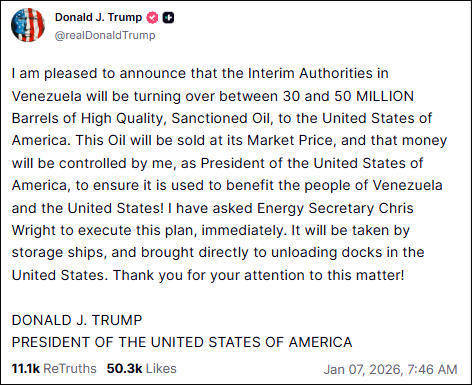
【文/观察者网 柳白】 掳走委内瑞拉总统马杜罗后,美国总统特朗普迫不及待盘算着,该如何收割这个南美国家的石油资源。 此后更传出,特朗普政府勒令委内瑞拉中断与中国等国经济往来的消息。 特朗普当地时间1月6日宣布,根据美委两国已达成的协议,委内瑞拉将向美国出口总值近20亿美元的原 油。 路透社援引知情人士的话称,这项标志性协议在执行初期,可能需要转移原本销往中国的原油供应。此 举有助于避免委内瑞拉进一步削减石油产量,同时加强美国的能源供应,但尚不清楚委内瑞拉能否从此 次石油供应中获得收益。 "我荣幸地宣布,委内瑞拉临时权力机构将向美国移交3000万至5000万桶受制裁的高品质原油。"特朗普 6日在"真相社交"平台上写道。 "这批原油将按市场价出售,所得款项将由我作为美利坚合众国总统控制,确保资金用于造福委内瑞拉 与美国两国人民!" 特朗普说,他已下令美国能源部长克里斯·赖特立即落实这项石油转移计划,原油将由油船装载,直接 运往美国码头卸货。 消息公布后,美国原油价格下跌超1.5%。市场预计,此举将增加委内瑞拉对美国的石油出口量。 委内瑞拉一直在以比布伦特原油价格低约22美元/桶的价格,出售其旗舰原油品种梅雷原油, ...
雪佛龙:1月委原油出口或超上月,11艘油轮赴美
Sou Hu Cai Jing· 2026-01-07 06:57
【1月7日初步数据:雪佛龙本月委内瑞拉原油出口或超上月】初步数据显示,1月雪佛龙出口的委内瑞 拉原油势将超过上月。至少11艘油轮计划驶抵委内瑞拉政府控制的何塞港和巴霍格兰德港。 船舶动态 表明,雪佛龙租用的11艘油轮中,一艘已完成装载,两艘正停靠在码头。 所有原油都将运往美国炼油 厂,涉及Valero EnergyCorp、Phillips 66和Marathon Petroleum Corp等。 本文由 AI算法生成,仅作参考,不涉投资建议,使用风险自担 ...
Why the US Is Targeting Venezuela, and What it Means for Markets
Investing· 2026-01-07 06:53
Group 1 - The article provides a market analysis focusing on major oil companies including Chevron Corp, Exxon Mobil Corp, and ConocoPhillips, as well as Crude Oil WTI Futures [1] - It highlights the performance trends and market dynamics affecting these companies and the crude oil market [1] - The analysis aims to identify potential investment opportunities and risks within the oil sector [1] Group 2 - Chevron Corp's recent financial performance and strategic initiatives are discussed, indicating its position in the market [1] - Exxon Mobil Corp's operational efficiency and production levels are analyzed, showcasing its competitive edge [1] - ConocoPhillips' exploration and production strategies are examined, reflecting its growth potential in the current market environment [1]


传雪佛龙(CVX.US)联手私募股权Quantum Energy Partners 收购卢克石油国际资产
Zhi Tong Cai Jing· 2026-01-07 06:41
去年10月,美国政府宣布对俄罗斯两家最大的石油生产商——俄罗斯石油公司(Rosneft PJSC)和卢克石 油——实施制裁,理由是这两家公司为俄罗斯提供资金支持。自制裁生效以来,卢克石油的国际资产面 临的运营阻碍日益增多——该公司国际资产的石油产量约占其全球总产量的0.5%。 国际大宗商品贸易巨头贡沃尔(Gunvor)此前计划收购卢克石油的国际资产,但遭到美国财政部的尖锐批 评,称其为克里姆林宫的"傀儡"。对此,贡沃尔回应称,美国财政部对该公司的描述"存在根本性误 解,且与事实严重不符"。该公司补充称:"我们期待有机会澄清这一明显的误解。在此期间,贡沃尔决 定撤回收购卢克石油国际资产的提议。" 值得一提的是,除了雪佛龙和Quantum Energy Partners之外,全球范围内还有其他企业正考虑竞购卢克 石油的国际资产,包括埃克森美孚(XOM.US)、阿布扎比国际控股公司、沙特阿拉伯Midad Energy和凯 雷集团。 据报道,雪佛龙(CVX.US)和专注于能源领域的私募股权Quantum Energy Partners将联手收购受美国制裁 的俄罗斯石油企业卢克石油(Lukoil PJSC)的国际资产。 ...
“唐罗主义”变现?雪佛龙急调11艘油轮,正将委内瑞拉原油掠回美国
Hua Er Jie Jian Wen· 2026-01-07 06:31
Core Viewpoint - The Trump administration is transforming geopolitical influence into actual energy benefits, accelerating the flow of Venezuelan oil resources to the U.S. under the framework of "Trump Doctrine" [1][7]. Group 1: U.S. Energy Strategy - The U.S. is reshaping the energy landscape in the Western Hemisphere through direct intervention, transitioning from sanctions to resource redistribution led by the U.S. [1][7]. - On January 6, President Trump announced that the Venezuelan interim government would transfer 30 to 50 million barrels of oil to the U.S. [1]. - Chevron has chartered 11 oil tankers, with one already loaded and two docked, marking the highest number of charters since October of the previous year [1][8]. Group 2: Market Impact - International crude oil prices fell following the announcement, as the market perceived a reduced risk of further collapse in Venezuelan oil production and an expected increase in exports to the U.S. [1]. - Wall Street analysts are cautiously optimistic, suggesting that the situation in Venezuela could exert short-term downward pressure on oil prices [9]. Group 3: Supply Projections - UBS analysts predict that if restrictions are lifted, Venezuelan oil production could rebound from approximately 850,000 barrels per day to between 1 million and 1.3 million barrels per day [9]. - Goldman Sachs maintains a Brent crude price forecast of $56 per barrel for 2026, but notes that increased Venezuelan production could lower prices to $54 per barrel [11]. Group 4: Structural Challenges - Despite short-term export increases, analysts warn of significant structural challenges to the full recovery of Venezuela's oil industry, which may take up to 10 years and require substantial capital investment [12]. - The Venezuelan oil infrastructure has been severely damaged due to years of underinvestment, complicating recovery efforts [12]. - The U.S. strengthening its control over the Western Hemisphere may impact the "shadow fleet" used to evade sanctions, which constitutes about 10% of the global fleet for transporting sanctioned oil [12].
Chevron, Quantum team up in bid for Lukoil's $22B international assets: report
Invezz· 2026-01-07 06:16
Chevron and private equity group Quantum Energy Partners are teaming up on a bid to acquire the international assets of sanctioned Russian oil producer Lukoil, Financial Times reported, citing people ... ...
The Trump Market: Where Policy Meets Punditry, and Everyone Needs a Tums
Stock Market News· 2026-01-07 06:00
Group 1: Greenland Acquisition - The U.S. acquisition of Greenland is viewed as a "national security priority" by Trump, with discussions on options including purchase or military utilization [3] - Danish Prime Minister Mette Frederiksen confirmed that "Greenland is not for sale," a sentiment shared by 85% of the local population, leading to volatility in European markets [4] - Companies like Critical Metals Corp. (CRML), which holds rare earth assets in Greenland, saw shares rally over 23% recently and a 251% increase over the past six months, driven by speculative trading [5] Group 2: Venezuelan Oil Deals - Trump announced that Venezuela would export up to $2 billion worth of oil to the U.S., aiming to divert supplies from China and support the Venezuelan economy [6] - U.S. crude prices fell more than 1.5% following the announcement, indicating market concerns about global oversupply [7] - Shares of U.S. oil companies, particularly Chevron, surged in pre-market trading, with Chevron's shares climbing as much as 10%, while other companies like ConocoPhillips and Exxon Mobil also benefited [8] Group 3: Tariff Impacts - Trump's tariffs have consistently caused market volatility, with significant drops in major indices following tariff announcements, such as a 878-point drop in the Dow Jones in October 2025 [11] - Indian markets reacted negatively to tariff threats, with the information technology stock index falling about 2.5% [12] - Analysts project that potential tariffs on BRICS nations could lead to a 90% reduction in U.S.-BRICS trade volumes, impacting GDP growth and inflation [13] Group 4: Market Resilience - Despite ongoing volatility, the S&P 500's total return climbed 19.4% since Election Day 2024, with a nearly 35% surge after hitting a low in April 2025 [14] - The market has shown resilience, often shrugging off geopolitical shocks unless they threaten broader supply chains, indicating a complex relationship between headlines and market performance [15] - The current market environment is characterized by unpredictability, where a single social media post can significantly impact market dynamics [16]


Geopolitical Tensions Escalate as China Threatens Rare Earth Curbs on Japan; Chinese Equities Soar; Chevron Eyes Lukoil Assets; X Faces EU Disconnection Threat
Stock Market News· 2026-01-07 05:08
Economic Relations - China has imposed an immediate ban on the export of dual-use items to Japan and is considering stricter controls on rare earth elements, a move seen as retaliation against Japan's comments on Taiwan [2][8] - Japanese manufacturers, especially in the electric vehicle and defense sectors, are highly vulnerable due to their reliance on China for heavy rare earths, with potential losses estimated at ¥660 billion ($4.2 billion) for a three-month disruption and ¥2.6 trillion ($16.4 billion) for a year-long restriction [3][8] Market Performance - Chinese equity markets have started 2026 with strong momentum, as the Shanghai Composite Index surged 1.40% to close at 4,023.42 points, marking its highest level in nearly a decade [4][8] - The rally is primarily driven by technology sectors, with semiconductors up 5.60% and AI stocks gaining between 3.20% and 3.7%, with analysts predicting further growth of 10-20% for Chinese equities in the coming years [5][8] Energy Sector Developments - Chevron and Quantum Energy Partners are among the bidders for Lukoil's international assets, valued at approximately $22 billion, as Lukoil divests under U.S. sanctions [6][8] Regulatory Challenges - Social media platform X, owned by Elon Musk, has been fined €120 million by the European Commission for multiple breaches of the Digital Services Act, marking a significant regulatory challenge [7][8]