
Raymond James Financial(RJF)

Search documents
Raymond James Financial Declares Quarterly Dividend on Common Stock
Globenewswire· 2026-02-19 21:20
St. Petersburg, Fla., Feb. 19, 2026 (GLOBE NEWSWIRE) -- On February 19, 2026, the Raymond James Financial, Inc. (NYSE: RJF) Board of Directors declared a quarterly cash dividend on shares of its common stock of $0.54 per share, payable April 15, 2026 to shareholders of record on April 1, 2026. About Raymond James Financial, Inc. Raymond James Financial, Inc. (NYSE: RJF) is a leading diversified financial services company providing private client group, capital markets, asset management, banking and other s ...



Raymond James Recruits Another Big Ex-Commonwealth Team
Barrons· 2026-02-18 18:13
Raymond James Recruits Another Big Ex-Commonwealth Team - Barron'sSkip to Main ContentThis copy is for your personal, non-commercial use only. Distribution and use of this material are governed by our Subscriber Agreement and by copyright law. For non-personal use or to order multiple copies, please contact Dow Jones Reprints at 1-800-843-0008 or visit www.djreprints.com.---# Raymond James Recruits Another Big Ex-Commonwealth Team## The firm's latest recruits managed approximately $682 million in client ass ...

Raymond James Stock: Is Wall Street Bullish or Bearish?
Yahoo Finance· 2026-02-18 12:04
Valued at a market cap of $31.3 billion, Saint Petersburg, Florida-based Raymond James Financial, Inc. (RJF) is a diversified financial services company that provides private client group, capital markets, asset management, banking, and other services to individuals, corporations, and municipalities in the United States and internationally. The company's shares have underperformed the broader market over the past year and in 2026. RJF stock has declined 1.1% over the past 52 weeks and 1.6% on a YTD basis ...
新“次贷危机”?美国PE的“软件业贷款敞口”比财报显示的更大
Hua Er Jie Jian Wen· 2026-02-14 02:51
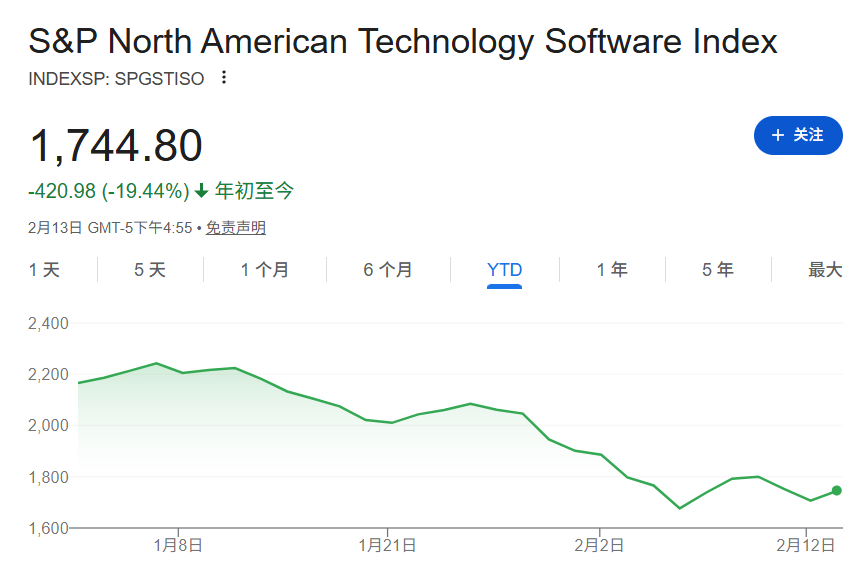
Core Insights - The private credit industry's actual loan exposure to the software sector may significantly exceed disclosed levels, with at least 250 investments worth over $9 billion not classified as software loans despite being defined as such by other lenders or sponsors [1][2] - The software sector has become the largest single industry exposure for Business Development Companies (BDCs), accounting for approximately 20% of all loans held by BDCs, compared to 13% in the broader leveraged loan market [2][6] - The classification inconsistencies among BDCs complicate the assessment of risk exposure, especially as AI technologies threaten traditional software business models [1][7] Group 1: Classification Issues - A review of disclosures from major BDCs revealed that software companies are often categorized under different industry classifications, leading to a lack of clarity regarding their actual exposure [3][4] - For instance, companies like Pricefx and Kaseya, which identify as software firms, have been classified as "business services" and "professional retail" respectively by their lenders, highlighting the discrepancies in classification standards [3][4] - This inconsistency extends even within the same company, as seen with Blue Owl Capital, where the same firms are classified differently across various funds [5] Group 2: Market Risks and Concerns - The influx of private equity funds into the software sector has been significant, with approximately 30% of private equity capital flowing into this industry over the past decade, and software accounting for 40% of all sponsor-backed private credit [6] - Recent advancements in AI technology have raised concerns about the future of software businesses, with the S&P North American Software Index dropping over 20% this year, indicating heightened market anxiety [7][10] - Analysts warn that the ongoing AI revolution is fundamentally altering the software industry, rendering historical classification guidelines obsolete and increasing scrutiny on private credit managers [10]


AI Shockwave: SCHW, LPLA & Others Slide on Disruption Fear
ZACKS· 2026-02-12 18:16
Core Insights - Artificial intelligence (AI) is transitioning from a growth driver for technology stocks to a disruptor in traditional financial services, impacting market expectations for wealth management firms globally [1] - Major wealth management and brokerage stocks have experienced significant declines as investors assess the implications of new AI tools that automate tasks previously performed by human advisors [1] Stock Performance - The Charles Schwab Corp. (SCHW) has decreased by 10.9%, LPL Financial Holdings Inc. (LPLA) by 13.8%, and Raymond James Financial Inc. (RJF) by 8.8% in recent trading days [2] - Other firms such as Lazard and Stifel Financial have also seen declines of nearly 4% and 4.9%, respectively, while banks with substantial wealth management exposure, including JPMorgan Chase (JPM), Bank of America (BAC), and Wells Fargo, have dropped more than 4% [2] Trigger for Stock Selloff - The stock market reaction was initiated by the launch of an AI-powered tax planning tool by U.S. fintech startup Altruist, which is integrated into its Hazel platform [3] - This tool can process client data to generate personalized tax strategies and financial insights that previously required extensive manual work from advisors [3] Investor Concerns - Investors view the AI tool as a potential threat to traditional revenue streams in wealth advisory, particularly in fee-based services like tax planning and portfolio strategy [4] - The ability to commoditize and scale complex financial advice rapidly raises concerns about the erosion of fee margins and business models for existing firms [4] Shift in Market Focus - The market's focus has shifted from beneficiaries of the AI boom to those who might be displaced by it, affecting asset management and private capital firms [5][6] - Executives from firms like Blackstone and Apollo Global Management have attempted to reassure stakeholders that AI is unlikely to undermine their businesses, but skepticism remains prevalent [6] Reassessment of Risks - The initial optimism surrounding AI is evolving into a reassessment of risks, as investors consider the potential for AI to compress margins and alter business models [7] - The recent selloff in wealth management stocks signifies a turning point in how investors perceive AI risk within financial services [8] Implications for Wealth Management - The declines in shares of firms like Schwab, LPL Financial, and Raymond James reflect fears that AI could diminish advisory fees and disrupt established operating models [8][9] - While it is too early to label AI as an existential threat to human-led wealth advice, the rapid advancement of tools like Altruist's Hazel platform necessitates a reevaluation of defensible areas within the value chain [10] - Success for incumbents will likely hinge on the effective integration of AI into client service, compliance, and portfolio construction, where trust and judgment remain essential [10]



Why Altruist’s New AI Tax Tool Spooked Investors in Schwab, LPL, Raymond James
Yahoo Finance· 2026-02-12 05:01
Core Insights - The launch of Altruist's AI-powered tool, Hazel, has negatively impacted the stock prices of major wealth management firms, indicating market sensitivity to AI developments [2][6] - Experts suggest that the market reaction may be an overreaction, and the true impact of AI tools on wealth management firms will depend on their adoption rates [2][5] Group 1: AI Tool Launch and Market Reaction - Altruist introduced Hazel, an AI tool that creates tax strategies based on client documents, leading to stock declines for firms like LPL Financial and Charles Schwab [2][6] - The stock prices of LPL Financial and Charles Schwab fell by 5.7% and 4%, respectively, with other firms like Stifel Financial and Piper Sandler also experiencing declines [6] Group 2: Industry Expert Opinions - Bill Harris, CEO of Evergreen Wealth, emphasized that Hazel is part of a broader trend of AI tools that will transform the wealth management industry [3][4] - Kyle Mostransky, CEO of Mostransky & Associates, argued that while AI can optimize financial calculations, the human element remains crucial for interpreting financial decisions [5] - Harris noted that the introduction of AI tools could lead to a reduction in fees for human financial advisors, which currently average around 1% of assets [5]


Raymond James Financial, Inc. (RJF) Presents at Bank of America Financial Services Conference 2026 Transcript
Seeking Alpha· 2026-02-11 17:44
To ensure this doesn’t happen in the future, please enable Javascript and cookies in your browser.If you have an ad-blocker enabled you may be blocked from proceeding. Please disable your ad-blocker and refresh. ...

Raymond James Financial (NYSE:RJF) 2026 Conference Transcript
2026-02-11 16:32
Summary of Raymond James Financial Conference Call Company Overview - **Company**: Raymond James Financial (NYSE:RJF) - **Core Businesses**: Wealth management, capital markets, and asset management - **Client Assets**: Approximately $1.7 trillion in client assets with over $30 billion in net new assets in the last year [3][5] Macro Environment - **Market Context**: Entering the fourth year of a bull market, with expectations for increased IPOs and M&A activity as the Fed cuts rates [5] - **Economic Indicators**: - Unemployment near historical lows - Inflation under control - Strong consumer sentiment - Projected earnings growth for S&P 500 at 12% to 15% [6] Strategic Priorities - **Cultural Values**: Emphasis on client-first approach, long-term decision-making, integrity, and advisor independence [7][9] - **Investment in Technology**: Over $1 billion annually to enhance advisor capabilities and client relationships [20] - **Value Proposition**: "The Power of Personal" focusing on human relationships in a technology-driven environment [10] Competitive Landscape - **Recruitment Success**: Record recruitment year with advisors producing over $400 million, a 21% increase from the previous year [12] - **Long-term Strategy**: Focus on culture and platform rather than upfront financial incentives for advisors [13][14] Financial Performance and Guidance - **Operating Metrics**: - Adjusted operating margin target of about 20% - Compensation ratio target of 65% or lower [15] - **Loan Growth**: 13% growth in loans, primarily driven by securities-based lending [34] - **Credit Quality**: Strong credit quality with no early signs of stress in the portfolio [35] Capital Markets and M&A Activity - **M&A Outlook**: Increased activity expected as private equity firms look to sell long-held investments; optimistic about the pipeline despite a soft first fiscal quarter [44][46] - **Product Gaps**: Opportunities identified in depository and biotech sectors for market share growth [47][48] Capital Allocation Strategy - **Prioritization Framework**: 1. Organic growth through advisor recruitment 2. Strategic acquisitions that align culturally and strategically 3. Ongoing dividends targeting 20%-30% of earnings 4. Share buybacks as a last priority [50][52] Asset Management Insights - **Internal vs. External Sales**: Majority of assets sold externally, but internal sales to wealth management channels are significant [39] - **Focus on Relationships**: Emphasis on deep personal relationships with clients as a key driver for asset management success [42][43] Conclusion - **Overall Sentiment**: Optimistic outlook for the US economy and Raymond James's growth trajectory, with a strong focus on maintaining cultural values and investing in technology to enhance advisor-client relationships [6][11]
Raymond James: Excellent Buy-The-Dip Opportunity
Seeking Alpha· 2026-02-11 15:35
Group 1 - iREIT+HOYA Capital focuses on income-producing asset classes that provide sustainable portfolio income, diversification, and inflation hedging [1][2] - The investment group targets dividend yields up to 10% and offers research on REITs, ETFs, closed-end funds, preferreds, and dividend champions [2] - The current earnings season presents opportunities to capitalize on market reactions, particularly for companies with reliable business models like Raymond James Financial, Inc. (RJF) [2] Group 2 - The investment approach emphasizes defensive stocks with a medium- to long-term horizon, aiming for high-yield and dividend growth [2] - The service provides a free two-week trial for potential investors to explore top ideas within its income-focused portfolios [1]

瑞杰金融公布2026财年业绩预期及战略投资计划
Jing Ji Guan Cha Wang· 2026-02-11 14:51
Core Viewpoint - RJF disclosed several key insights during the Q3 FY2025 earnings call, including Q1 FY2026 performance expectations, strategic investments and integration plans, medium to long-term business expansion directions, and internal trading dynamics [1] Performance Overview - The company expects a 6.5% quarter-over-quarter growth in asset management and related management fees for Q1 FY2026, while maintaining an adjusted pre-tax profit margin target of over 20% [2] Strategic Initiatives - The company plans to increase investments in artificial intelligence and technology, expand the recruitment of financial advisors, and advance the acquisition and integration of Greensledge, a boutique investment bank in the structured credit sector [3] Future Development - The company will focus on diversified business synergies, including the expansion of private investment alternatives, and leverage the low interest rate environment to drive growth in securities-backed lending [4] Company Status - On December 2, 2025, the company disclosed that several executives sold shares, indicating a need to monitor corporate governance dynamics [5]