
Sony Group(SONY)

Search documents
Lenskart’s Year Of Big Wins
Inc42 Media· 2025-12-07 05:30
Core Insights - Lenskart is transitioning from a basic D2C eyewear brand to a tech-focused company, aiming to enhance its market position and product offerings [2][4] - The company is ramping up domestic manufacturing in India, with plans to shift most operations from China, supported by a new facility in Telangana [3][22] - Lenskart is launching AI-powered smart glasses, B by Lenskart, featuring advanced technology and integration with third-party developers, which could lead to recurring revenue streams [6][9][7] Financial Performance - Lenskart reported a net profit of INR 297 Cr in FY25, a significant improvement from a loss of INR 10 Cr in FY24, although this was largely driven by other income [31][32] - Revenue increased from INR 3,789 Cr in FY23 to INR 6,651 Cr in FY25, but operational profitability remains a concern due to high expenses [32][33] - The company's IPO was met with a muted market debut, with shares trading below the issue price shortly after listing [34][35] Market Position and Strategy - The smart eyewear market is experiencing rapid growth, with shipments increasing over 1,000% in the past year, presenting an opportunity for Lenskart [11] - Lenskart's strategy includes appealing to younger consumers through innovative features and affordability, while facing competition from other tech companies [9][17] - The company is focusing on vertical integration and reducing reliance on foreign manufacturing, which may help mitigate risks associated with currency fluctuations [22][19] Future Outlook - 2026 is expected to be a critical year for Lenskart, as it needs to demonstrate sustainable growth and improved margins following its IPO [37] - The company faces challenges in maintaining profitability and managing rising operational costs, which could impact its long-term viability [24][33] - Analysts suggest that Lenskart must achieve consistent profitability over the next few quarters to validate its business model and growth strategy [31][36]



Stop calling it recovery! Business needs a different word
Jamaica· 2025-12-07 05:05
Core Insights - The article argues that the concept of "recovery" is misleading for businesses in Jamaica, as it implies returning to a pre-existing, flawed business model rather than transforming for future resilience [2][5][6] - It emphasizes the need for a new vision, specifically "Vision 2050 Jamaica," which focuses on transformation rather than restoration [3][12][14] Group 1: Recovery vs. Transformation - The term "recovery" suggests a return to a viable business model, which is a misconception; many businesses had vulnerabilities before the disaster [5][6] - The article cites examples like Sony and Indonesia, which chose transformation over recovery, leading to more resilient outcomes [8][10] Group 2: Vision 2050 Jamaica - The current Vision 2030 Jamaica project is nearing its end, and a new plan is needed that focuses on resilience and transformation rather than recovery [13][14] - The proposed Vision 2050 should define what a resilient country looks like and guide current decision-making towards that future [14]

浦东引领区建设五周年:以开放之姿筑先锋之路
Zhong Guo Xin Wen Wang· 2025-12-06 15:22
Core Insights - The article highlights the significant role of Pudong in China's modernization and reform, showcasing its achievements in facilitating enterprises' internationalization and innovation [1][3]. Group 1: Internationalization Support - Pudong has established a comprehensive service platform, the "Pudong New Area Enterprise Going Global Comprehensive Service Center," which supports companies in their overseas investments, exemplified by Shanghai Yanzaki Circuit Board Co., Ltd.'s successful establishment of a factory in Thailand with a total investment of 95 million yuan for phase one and 100 million yuan for phase two [1][2]. - The service center has created a network of 11 governing units and over 90 strategic partners across various professional fields, providing a full range of services from market research to risk warning [2]. Group 2: Innovation Ecosystem - Pudong's innovation ecosystem has been bolstered by the establishment of the Global Open Innovation (GOI) network, which now includes over 100 members, including major international companies like Bayer and Pfizer, supporting more than 6,000 enterprises [2][3]. - The region has become a hub for biopharmaceutical innovation, attracting startups and multinational corporations, thus positioning itself as a critical player in the global drug development landscape [3]. Group 3: Economic Development - Pudong's development strategy emphasizes a dual approach of "going out" and "bringing in," creating a synergistic effect that enhances both local and international business operations [2][3]. - The region has transitioned from a factor-driven model to an institutional and ecological model of openness, achieving breakthroughs in various sectors, including new retail supply chains and biopharmaceuticals [3][4].


Critics Choice Awards: “KPop Demon Hunters” receives two nominations as the dream run continues for Netflix animated film; check nominations, date and time of the awards
The Economic Times· 2025-12-06 10:04
Core Insights - "KPop Demon Hunters" has received multiple nominations, including Best Animated Feature and Best Song for its hit song "Golden" [2][6] - The film has won Best Animated Film at the New York Film Critics Circle Awards and is also nominated for five Grammy Awards [2][6] Awards and Nominations - The film is nominated for Best Animated Feature at the 2025 Critics' Choice Awards alongside titles like "Arco" and "Zootopia 2" [6] - The song "Golden" is competing against other notable songs for Best Song, including "Drive" from "F1" and "Clothed by the Sun" from "The Testament of Ann Lee" [6] Film Background - "KPop Demon Hunters" was released on June 20, 2025, and is available for streaming on Netflix [6] - The film is produced in collaboration with Sony Pictures Animation and directed by Maggie Kang and Chris Appelhans [6] - The narrative explores themes of Korean culture and features a character named Rumi who struggles with her dual identity while facing a rival boy-band made up of demons [5][6]

败退中国,一代日本神机坠落!
Xin Lang Cai Jing· 2025-12-05 23:24
Core Viewpoint - Sony Mobile has quietly exited the Chinese market, marking the end of its presence without any formal announcement or farewell [5][10][11]. Group 1: Market Exit - Sony's official WeChat account has entered the cancellation process, signaling the end of its mobile business in China [5]. - The number of employees involved in Sony's mobile division has drastically decreased from over 600 to single digits [11]. - Sony's market share in China's smartphone sector fell below 0.1% in 2023, relegating it to the "others" category [11]. Group 2: Historical Context - Sony Ericsson was once a leading player in the mobile phone market, known for popular models like K750i and W800, achieving a peak sales of 103 million units in 2007 [12][14]. - The launch of the iPhone in 2007 marked a turning point, as Sony failed to adapt to the changing landscape of mobile technology [14][16]. - After the rebranding to Sony Mobile in 2012, the company struggled to maintain its market position, with global market share dropping to 2% by 2014 [16]. Group 3: Competitive Landscape - Sony's focus on hardware and industrial design did not resonate with Chinese consumers, who preferred features like localized software and high cost-performance ratios [18]. - The rise of domestic brands such as Huawei, Xiaomi, and OPPO further marginalized Sony in the competitive smartphone market [18]. - Sony's inability to create a robust ecosystem or match the R&D capabilities of competitors contributed to its decline [18]. Group 4: Broader Implications - The exit of Sony Mobile reflects a larger trend of Japanese companies struggling in the Chinese market, contrasting with the rapid growth of Chinese consumer electronics [19][25]. - The decline of Sony Mobile symbolizes the end of an era for niche premium brands in the face of evolving consumer preferences and technological advancements [24].

突发!又一日本知名品牌败退中国
Xin Lang Cai Jing· 2025-12-05 15:24
Core Viewpoint - Sony Mobile has quietly exited the Chinese market, marking the end of its presence without any formal announcement or farewell [5][12][11]. Group 1: Market Performance - Sony Mobile's market share in China has dwindled to less than 0.1% in 2023, relegating it to the "others" category [12]. - The official WeChat account of Sony Xperia entered the cancellation process in early November, signaling the closure of its operations in China [5][12]. - The last update on Sony's official Weibo account was nine months ago, and the Chinese website has removed the mobile product category entirely [8][12]. Group 2: Historical Context - Sony Ericsson was once a leading player in the mobile phone market, achieving a peak sales figure of 103 million units in 2007, second only to Nokia and Samsung [17]. - The launch of the Xperia series in 2008 marked a shift, but subsequent models struggled due to delayed releases and quality issues [18][21]. - By 2014, Sony's global market share had plummeted to just 2%, unable to compete with emerging brands like Xiaomi and Huawei [23]. Group 3: Competitive Landscape - The rise of domestic brands offering high cost-performance ratios has overshadowed Sony's offerings, which failed to adapt to changing consumer preferences [28]. - Sony's focus on industrial design and high-end features did not resonate with Chinese consumers, who preferred more practical and localized options [27][28]. - The competitive landscape has shifted dramatically, with brands like Apple, Samsung, Huawei, Xiaomi, OPPO, and Vivo dominating the market [28]. Group 4: Broader Implications - The exit of Sony Mobile reflects a broader trend of Japanese companies struggling in the Chinese market, where local brands have gained significant ground [29]. - The decline of Sony Mobile symbolizes the end of an era for niche brands in the face of mass-market competition [35].

Nintendo’s 98% staff retention rate means the average employee has been there 15 years
Fortune· 2025-12-05 09:47
Company Retention and Knowledge Transfer - Nintendo has an impressive employee retention rate of 98%, with Japanese employees averaging 15 years at the company, significantly higher than the average tenure in Japan (11 years) and the U.S. (4 years) [1] - The long tenure of employees allows for the transfer of institutional knowledge, with key figures like Shuntaro Furakawa and Shigeru Miyamoto having decades of experience at Nintendo [2] Innovation and Adaptability - Despite the risk of becoming stagnant due to reliance on institutional knowledge, Nintendo successfully combines this knowledge with fresh ideas, allowing for a continuous pipeline of innovative games [3] - The company has faced its share of failures but maintains a competitive position in the video game industry against larger rivals like Sony and Microsoft [3] Positive Employee Sentiment - Former employees of Nintendo express positive sentiments about their experiences, highlighting the opportunity to work with talented designers and learn valuable lessons in game design [4] - This goodwill may stem from Nintendo's stable work environment, which contrasts with the industry's typical volatility [4] Unique Business Approach - Nintendo continues to create games in a manner distinct from its competitors, emphasizing its unique approach to game development [5]


当 Xbox 招牌游戏登陆索尼平台,微软为何选择与对手共享游戏? | 声动早咖啡
声动活泼· 2025-12-05 09:08
Core Viewpoint - Microsoft is shifting its strategy by allowing its flagship game "Halo" to be available on competitor Sony's PlayStation platform, indicating a departure from traditional exclusive game strategies in the gaming industry [4][11]. Group 1: Market Dynamics - As of May 2023, Xbox has sold 43 million units less than Sony's PS5, highlighting a significant market share disparity where Microsoft holds 30% and Sony commands 70% globally [5][6]. - In specific regions like Europe and Japan, the market share gap is even more pronounced, with Microsoft's share in Japan being only 4% [5][6]. Group 2: Financial Pressures - Microsoft's gaming division has faced pressure to achieve a 30% profit margin, while the average profit margin in the gaming industry ranges from 17% to 22% [6]. - The Xbox division reported a profit margin of only 12% for the first nine months of the 2022 fiscal year, prompting cost-cutting measures and strategic adjustments [6]. Group 3: Strategic Shifts - Microsoft is increasingly promoting its Xbox Game Pass subscription service, which allows players to access a wide range of games for a monthly fee, similar to streaming services like Netflix [8]. - The company has invested hundreds of billions in acquiring successful game studios, including a record $69 billion for Activision Blizzard, to enhance its Game Pass offerings [8]. Group 4: Consumer Behavior - There is a concern that users may subscribe to services like Game Pass for only a short period, undermining traditional game sales where consumers pay $60 to $70 for ownership [9]. - Following the acquisition of Activision Blizzard, Microsoft reportedly lost over $300 million in sales from the "Call of Duty" series due to its inclusion in Game Pass [9]. Group 5: Industry Evolution - The hardware architecture of gaming consoles is becoming increasingly similar to mid-range PCs, suggesting that traditional gaming consoles may soon become obsolete [10]. - Microsoft is marketing its Game Pass service as a cross-platform solution, indicating a shift in focus from hardware to software and service delivery [10]. Group 6: Community Reactions - The decision to allow "Halo" on PlayStation has sparked backlash among Xbox fans, as the game is seen as a cornerstone of the Xbox identity [11].


腾讯与索尼达成临时协议,荒野起源有了新进展
3 6 Ke· 2025-12-05 03:54
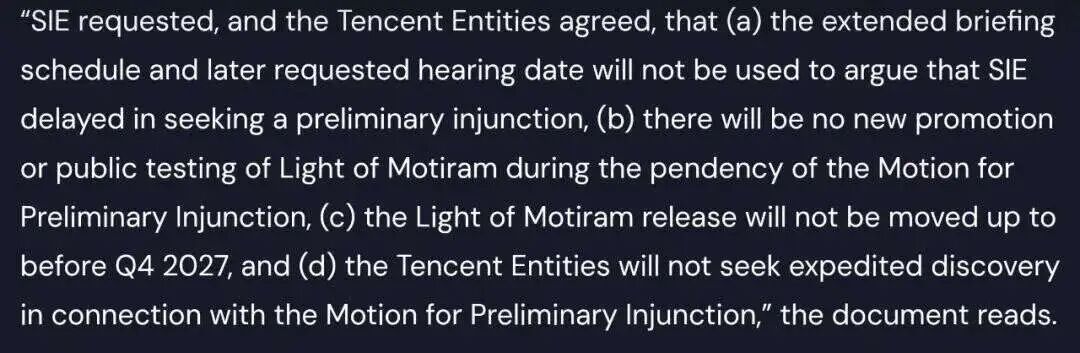
Core Viewpoint - Tencent and Sony have reached a temporary agreement regarding the copyright dispute over "Light of Motiram," also known as "荒野起源" (Wilderness Origin), which has led to the suspension of all marketing and public testing activities for the game until at least Q4 2027 [1][10][12]. Group 1: Legal Dispute - The legal conflict between Tencent and Sony centers around allegations of copyright infringement, with Sony accusing Tencent of copying elements from the "Horizon" series, including character design and gameplay mechanics [13][21]. - Sony filed a lawsuit against Tencent on July 25, 2025, demanding the cessation of alleged infringement and compensation [13][21]. - The timeline of the dispute shows a progression from initial collaboration discussions to a formal lawsuit, highlighting the complexities of their relationship [26][30]. Group 2: Project Development Challenges - "Wilderness Origin" has faced significant development challenges since its inception in 2020, with multiple demos being discarded before settling on the current project direction [5]. - The game received its domestic version approval in February 2024 and was globally revealed in November of the same year, but has since encountered delays due to the ongoing legal issues [5][10]. - Initial public tests received positive feedback, but the lack of long-term operational plans has posed additional challenges for the development team [6][10]. Group 3: Competitive Landscape - While engaged in legal battles with Tencent, Sony is advancing its collaboration with NCSoft to develop "Horizon: Steel Frontiers," a free-to-play MMO set in the "Horizon" universe, which directly competes with Tencent's "Wilderness Origin" [4][26]. - The announcement of "Horizon: Steel Frontiers" has intensified competitive pressure on Tencent, as both games target similar audiences and gameplay styles [4][26].

Sony Group Corporation (SONY) is a Buy amid Robust Operating Profit Growth and Buyback Program
Yahoo Finance· 2025-12-05 03:10
Core Viewpoint - Sony Group Corporation is recognized as a strong investment opportunity in the augmented reality sector, with a consensus Moderate Buy rating and a price target increase to $34.75 from $30.25 due to robust operating profit growth and a significant share buyback program [1][2][3]. Financial Performance - In the second quarter, Sony reported revenue of $20.14 billion, with operating profit rising 10% year-over-year to $2.76 billion [3]. - The company announced a share buyback program valued at $648 million, reflecting confidence in its financial health [3]. - Sony expects its full-year operating profit to increase by 8% from previous forecasts and has raised its annual revenue projection by 3% [4]. Business Segments and Growth Drivers - Growth is anticipated to be driven by the imaging and sensing solutions segment, as well as the music segment [4]. - Sony is positioned as an augmented reality enabler, developing technologies such as Micro-OLED and OLED microdisplays, which are essential for AR/VR headsets and smart glasses [5]. - The company introduced an XR head-mounted display featuring 4K OLED microdisplays in 2024 and joined the AR Alliance, highlighting its commitment to the augmented reality ecosystem [5].