
Stanley Black & Decker(SWK)

Search documents
Stanley Black Gears Up to Report Q2 Earnings: What's in Store?
ZACKS· 2025-07-25 15:21
Core Viewpoint - Stanley Black & Decker, Inc. is expected to report a decline in both revenues and adjusted earnings for the second quarter of 2025, with revenues projected at $3.99 billion, down 0.9% year-over-year, and adjusted earnings expected to fall 65.1% to 38 cents per share [1][9]. Revenue Performance - The consensus estimate for Stanley Black's second-quarter revenues is $3.99 billion, indicating a decline of 0.9% from the previous year [1][9]. - The Tools & Outdoor segment is anticipated to see a revenue increase of 1.6% year-over-year to $3.58 billion, driven by strong demand in the DEWALT business and other key brands [3][9]. - Conversely, the Industrial segment is expected to experience a revenue decline of 10.3% year-over-year to $444.9 million, impacted by softness in the automotive market and the divestiture of the infrastructure business [5][9]. Earnings Performance - The adjusted earnings consensus estimate is set at 38 cents per share, reflecting a significant decline of 65.1% from the same quarter last year [1][9]. - The company has a history of earnings surprises, having outperformed consensus estimates in the last four quarters with an average surprise of 18.4% [2]. Cost and Margin Analysis - Stanley Black's cost-reduction initiatives are expected to support its bottom line, with an anticipated EBITDA margin of 6%, representing a 70 basis points year-over-year expansion [4]. - Selling, general, and administrative (SG&A) expenses are projected to rise by 10.8% year-over-year to $887.3 million, which may pressure the company's overall profitability [6]. Foreign Exchange Impact - The company's operations are subject to foreign exchange headwinds, with a stronger U.S. dollar likely negatively affecting its overseas business [6].


Stanley Black & Decker Announces 3rd Quarter 2025 Dividend
Prnewswire· 2025-07-24 20:10
Core Viewpoint - Stanley Black & Decker has announced a $0.01 increase in its quarterly cash dividend to $0.83 per share, reflecting the company's commitment to enhancing shareholder value and confidence in its long-term growth strategy [1][2]. Company Overview - Founded in 1843 and headquartered in the USA, Stanley Black & Decker is a global leader in Tools and Outdoor products, employing approximately 48,000 people and producing a wide range of innovative tools and solutions for builders, tradespeople, and DIY enthusiasts [2]. Dividend Details - The approved quarterly cash dividend of $0.83 per share will be payable on September 16, 2025, to shareholders of record as of September 2, 2025 [1].

Stanley Black & Decker (SWK) Expected to Beat Earnings Estimates: What to Know Ahead of Q2 Release
ZACKS· 2025-07-22 15:07
Core Viewpoint - The market anticipates a year-over-year decline in earnings for Stanley Black & Decker due to lower revenues, with actual results being crucial for stock price movement [1][2]. Earnings Expectations - The upcoming earnings report is expected to show earnings of $0.38 per share, reflecting a decline of 65.1% year-over-year, with revenues projected at $3.99 billion, down 0.9% from the previous year [3]. Estimate Revisions - The consensus EPS estimate has been revised 3.5% higher in the last 30 days, indicating a collective reassessment by analysts [4]. Earnings Surprise Prediction - The Zacks Earnings ESP model suggests that the Most Accurate Estimate for Stanley Black & Decker is higher than the consensus estimate, resulting in an Earnings ESP of +18.80%, indicating a likely earnings beat [11]. Historical Performance - In the last reported quarter, Stanley Black & Decker exceeded the expected earnings of $0.68 per share by delivering $0.75, achieving a surprise of +10.29%. The company has beaten consensus EPS estimates in the last four quarters [12][13]. Investment Considerations - While the potential for an earnings beat exists, other factors may influence stock performance, making it essential to consider the broader context beyond just earnings results [14][16].


Maria Ford Appointed to Forbes Business Development Council
Prnewswire· 2025-07-14 12:00
Core Insights - Maria Ford, President of U.S. Commercial & Industrial Sales at DEWALT, has joined the Forbes Business Development Council to share insights on the construction industry and empower the next generation of tradespeople [1][7] Company Overview - DEWALT is a brand under Stanley Black & Decker, recognized as a leader in total jobsite solutions, providing tools and technologies designed to enhance safety and productivity on construction sites [9] Leadership and Advocacy - Ford has a strong background in the industry, having started her career at Stanley Black & Decker in 1998 and progressively taking on more responsibilities in sales and marketing [5] - She is a vocal advocate for skilled trades, actively inspiring future workers through speeches, op-eds, and media engagements [4] Financial Impact - Ford oversees DEWALT's U.S. Commercial & Industrial Sales division, which generates $2 billion in revenue, focusing on empowering professionals through advanced tools and technology solutions [6]


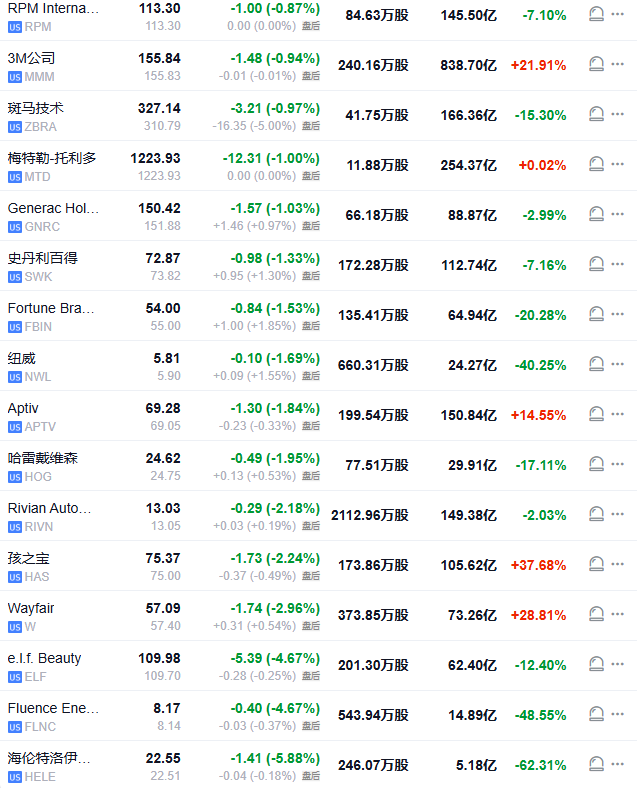
周五,“特朗普关税输家”成分股普跌,海伦特洛伊收跌5.88%,Fluence Energy跌4.67%,孩之宝跌2.24%,“特斯拉劲敌”Rivian跌2.18%,史丹利百得跌1.33%,3M跌0.94%。




news flash· 2025-07-11 23:03
Group 1 - The stocks of companies identified as "losers from Trump's tariffs" experienced a decline, with notable drops including Helen of Troy down 5.88%, Fluence Energy down 4.67%, and Hasbro down 2.24% [1] - Rivian, labeled as a "Tesla competitor," fell by 2.18%, while Stanley Black & Decker and 3M also saw declines of 1.33% and 0.94% respectively [1] Group 2 - RPM International's stock price was reported at $113.30, with a decrease of $1.00 or 0.87%, and a trading volume of 840,000 shares [2] - 3M's stock closed at $155.84, down $1.48 or 0.94%, with a trading volume of 2.4 million shares and a market capitalization of $83.87 billion, reflecting a 21.91% increase [2] - Zebra Technologies saw a stock price of $327.14, down $3.21 or 0.97%, with a market cap of $16.64 billion, down 15.30% [2] - Generac Holdings' stock was at $150.42, down $1.57 or 1.03%, with a market cap of $8.88 billion, down 2.99% [2] - Hasbro's stock price was $75.37, down $1.73 or 2.24%, with a market cap of $10.56 billion, up 37.68% [2] - Fluence Energy's stock closed at $8.17, down $0.40 or 4.67%, with a market cap of $1.49 billion, down 48.55% [2] - Helen of Troy's stock was reported at $22.55, down $1.41 or 5.88%, with a market cap of $518 million, down 62.31% [2]
Why Stanley Black & Decker Stock Popped Today
The Motley Fool· 2025-07-08 20:30
Core Viewpoint - Analyst Nigel Coe from Wolfe Research upgraded Stanley Black & Decker from "underperform" to "peer perform," indicating a potential stabilization in the stock's performance [1][3] Group 1: Market Analysis - Coe suggests that the demand for Stanley's products is likely at a low point, or "trough," and anticipates a rebound, particularly if the Federal Reserve cuts interest rates [3] - The company is currently experiencing its third consecutive year of declining sales, but there is a consensus among analysts that earnings will grow this year and continue to grow for at least the next couple of years [4] Group 2: Financial Performance - Long-term growth rate projections for Stanley Black & Decker are estimated at a respectable 11% annualized [4] - The company reported strong free cash flow of $765 million over the past year, which is twice the reported GAAP earnings [4] - At a valuation of 14 times free cash flow and a dividend yield of 4.7%, Stanley's stock appears to be undervalued [5]

Residential Pros Feel Confident in the Outlook for New Jobs, With Most Homeowners Expecting to Maintain Their Project Plans in 2025, According to Newly Released Data From STANLEY®
Prnewswire· 2025-07-08 12:06
Core Insights - The STANLEY® Pro's Perspective: Job Satisfaction Report indicates a positive outlook among residential professionals for 2025, despite challenges such as rising material costs and labor shortages [2][3][4] Industry Overview - A survey of 500 small repair and remodeling company owners and managers in the U.S. reveals that 89% feel confident about new job opportunities in 2025, with 69% reporting that clients are increasing project sizes [2][4][10] - The survey highlights that 93% of residential pros' clients are interested in high-end design projects, with top priorities including blending painted and finished wood surfaces (44%) and painted wood cabinetry in bold colors (39%) [7][10] Project Priorities - The most prioritized projects for clients in 2025 are kitchen and bathroom remodels, with 81% focusing on kitchen renovations and 79% on bathroom updates [8][10] - Other significant areas of focus include basements (64%) and living rooms (48%) [9][10] Job Satisfaction - A high level of job satisfaction is reported, with 85% of residential pros expressing fulfillment in their work and 82% feeling that financial benefits justify their efforts [13][14] - The survey indicates that 64% of clients show appreciation through referrals, and 81% of pros believe their autonomy is crucial for job satisfaction [11][14] Economic Context - Despite concerns regarding material (36%) and labor costs (30%), the overall sentiment remains optimistic among residential professionals [5][10]

Stanley Black & Decker(SWK) - 2025 Q1 - Quarterly Results
2025-06-30 10:46
Financial Performance - Net sales for Q1 2025 were $3,744.6 million, a decrease of 3.2% from $3,869.5 million in Q1 2024[2] - Gross profit increased to $1,120.8 million, representing 29.9% of net sales, compared to 28.6% in the previous year[2] - Net earnings for Q1 2025 were $90.4 million, significantly up from $19.5 million in Q1 2024, resulting in diluted earnings per share of $0.60[2] - Non-GAAP net earnings for Q1 2025 were $114.4 million, with a diluted earnings per share of $0.75 after adjustments[9] - Net earnings for Q1 2025 were $90.4 million, a significant increase from $19.5 million in Q1 2024, representing a growth of 362.3%[13] - Adjusted EBITDA for Q1 2025 was $361.8 million, up from $342.6 million in Q1 2024, reflecting an increase of 5.7%[13] Segment Performance - The Tools & Outdoor segment reported net sales of $3,280.9 million, slightly down from $3,284.6 million in Q1 2024, while segment profit increased to $289.2 million[8] - The Engineered Fastening segment saw a decline in net sales to $463.7 million from $584.9 million, with segment profit dropping to $39.0 million[8] - GAAP revenue growth for Stanley Black & Decker was -3% in Q1 2025, with organic growth at 1% after adjusting for currency and acquisitions[17] - The Engineered Fastening segment experienced a decline of 21% in GAAP revenue growth, with organic growth at -1%[17] Cash Flow and Dividends - Free cash flow before dividends for Q1 2025 was $(485.0) million, slightly improved from $(496.7) million in Q1 2024[6] - The company declared a dividend of $0.82 per share, up from $0.81 in the previous year[2] Assets and Liabilities - Total current assets rose to $7,009.1 million as of March 29, 2025, compared to $6,377.7 million at the end of 2024[4] - Total liabilities increased to $13,654.1 million from $12,528.5 million, with short-term borrowings of $1,135.2 million reported[4] Expenses and Charges - Selling, general and administrative expenses were $22.0 million in Q1 2025, up from $20.1 million in Q1 2024, reflecting an increase of 9.5%[15] - Interest expense decreased to $77.2 million in Q1 2025 from $87.9 million in Q1 2024, a reduction of 12.8%[13] - The company incurred a restructuring charge of $1.2 million in Q1 2025, compared to $15.0 million in Q1 2024, indicating a decrease of 92%[15] Other Financial Metrics - Non-GAAP adjustments before income taxes totaled $31.5 million in Q1 2025, down from $71.5 million in Q1 2024, indicating a reduction of 56%[15] - Supply Chain Transformation Costs in Q1 2025 amounted to $16.7 million, compared to $14.4 million in Q1 2024, showing an increase of 15.9%[15] - The company reported a gross profit of $16.7 million in Q1 2025, compared to $14.4 million in Q1 2024, marking a growth of 15.9%[15]
Stanley Black & Decker Announces Leadership Transition Plan
Prnewswire· 2025-06-30 10:30
Leadership Transition - Stanley Black & Decker has appointed Christopher Nelson as the new President and CEO, effective October 1, 2025, succeeding Donald Allan, Jr. who has been CEO since July 2022 [1][5] - Donald Allan will transition to the role of Executive Chair of the Board, while Andrea Ayers will become Lead Independent Director [2][5] - This leadership change is part of a comprehensive succession planning process undertaken by the Board [1] Executive Background - Christopher Nelson has over 25 years of executive leadership experience and has been with Stanley Black & Decker since 2023 as COO and President of Tools & Outdoor [6] - Prior to joining Stanley Black & Decker, Nelson held leadership roles at Carrier, the U.S. Army, Johnson & Johnson, and McKinsey & Company [6] Company Performance Expectations - Stanley Black & Decker anticipates that its Second Quarter GAAP and Adjusted EPS performance will exceed its 2025 Planning Assumptions from the Q1 2025 earnings call [4][5]

Stanley Black & Decker(SWK) - 2024 FY - Earnings Call Presentation
2025-06-25 13:29
Investor Presentation V e r s i o n 2 . 2 0 . 2 0 2 4 Contents | SWK Overview | Pages 4 – | 13 | | --- | --- | --- | | Tools & Outdoor | Pages 14 – | 24 | | Industrial | Pages 25 – | 29 | | Appendix | Pages 30 – | 37 | Contacts Dennis Lange Vice President, Investor Relations 860-827-3833 dennis.lange@sbdinc.com Christina Francis Director, Investor Relations 860-438-3470 christina.francis@sbdinc.com Christopher Capela Director, Investor Relations 860-827-5556 christopher.capela@sbdinc.com 1000 Stanley Drive ...