Swiss Re

Search documents
9 Billionen US-Dollar Vermögenswerte für ADGM, während Abu Dhabi Finance Week globale Kapitalströme neu definiert
Prnewswire· 2025-12-19 04:43
Core Insights - Abu Dhabi Global Market (ADGM) is entering its second decade with the announcement of 11 new significant global financial institutions, representing managed assets exceeding $9 trillion, marking a substantial increase from $635 billion last year and $450 billion in 2023 [1][3][5] Group 1: Growth and Expansion - The announcements made during the Abu Dhabi Finance Week (ADFW) highlight the growing influence of Abu Dhabi as the "Capital of Capital" and position ADFW as a global platform for capital flows through leading institutions and a premier regulatory ecosystem at ADGM [2][5] - The strong increase in managed assets at ADGM solidifies its position as the fastest-growing international financial center in the region and one of the most dynamic globally, indicating a shift in Abu Dhabi's role within the global financial system [3][5] Group 2: Institutional Presence - Notable institutions such as Cantor Fitzgerald, BBVA, UBS Group, KKR, and others have announced their presence in ADGM, marking a strong start for the next growth decade [4][5] - The commitments from these global firms reflect long-term confidence in Abu Dhabi's regulatory clarity and the capacity of ADGM to support increasingly sophisticated financial activities [6] Group 3: Digital Assets and Innovation - Binance received a formal global license from the Financial Services Regulatory Authority (FSRA) of ADGM, becoming the first cryptocurrency exchange to operate under a comprehensive regulatory framework in Abu Dhabi, marking a significant milestone for the digital asset industry [6][7] - Other fintech and digital asset companies, including iCapital and Galaxy Digital, are also expanding their operations in ADGM, indicating a growing ecosystem for digital finance [8] Group 4: Strategic Collaborations - RIQ, owned by IHC, plans to collaborate with Swiss Re to develop risk, data, and AI-driven reinsurance solutions from its base in ADGM, showcasing the center's appeal for innovative financial solutions [9] - JPMorgan is expanding its payment and treasury business from ADGM, enabling the company to offer a wide range of solutions, including liquidity management and multi-currency payment functions [10]


Apollo Expands Asset-Level Risk Reviews to Reflect Impact of Extreme Weather
Insurance Journal· 2025-12-18 16:51
Core Insights - Apollo Global Management Inc. is enhancing its risk review process to account for the impact of extreme weather on asset valuations, reflecting a growing concern over the damage caused by floods, storms, and wildfires [1][3] - The firm is expanding its top-down analyses to include more granular, company-level risk assessments before closing deals, as climate-driven disruptions are increasingly affecting operating costs, supply chains, and insurance markets [2][5] Group 1: Risk Assessment and Management - Apollo is implementing deeper analyses of "acute and chronic climate hazards," focusing on loan-level mapping in mortgage portfolios and evaluating exposure to drought, flood, heat, and wildfire in hard-asset sectors [5] - The integration of technology and data availability is allowing Apollo to refine its approach to measuring physical and transition risks, making these assessments a standard part of every deal across all asset classes [5] Group 2: Industry Trends and Responses - The awareness of extreme weather's potential to alter asset values is increasing, with firms like KKR & Co. introducing new credit climate risk models to assess physical risks for new and existing issuers [6][7] - Investors are beginning to recognize the need to assess climate risks similarly to other financial risks, as these can significantly impact cash flows and costs [9][10] Group 3: Market Impact and Future Considerations - A report by MSCI highlighted that 55% of companies in a $2 trillion analysis already face severe physical hazards, affecting sectors such as real estate, insurance, and utilities, leading to higher premiums and lower asset values [10] - The realization that physical risks are already impacting portfolios is prompting investors to adjust their strategies, with a focus on long-term asset holding and the potential for both risks and opportunities in the evolving market landscape [9][11]


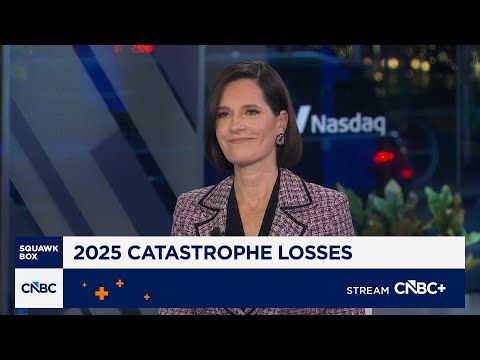
Insured losses from global catastrophes reaches $107B in 2025
CNBC Television· 2025-12-16 13:24
Catastrophes in the US are driving those losses. Contesta Brew is at the table this morning. She joins us with an exclusive first look at catastrophe costs in 2025.>> Good morning, guys. Nice to see you. Yeah, $ 107 billion.That is the estimate from Swiss Restitute for insured losses from catastrophes around the globe this year. 83% of those losses happened in the United States with the LA wildfires becoming the most expensive wildfire event in history. Severe convective storms with wind, hail, and tornadoe ...
Swiss Re AG (SSREY) Discusses Strategic Outlook and Mindset for Achieving Market Leadership - Slideshow (OTCMKTS:SSREY) 2025-12-05
Seeking Alpha· 2025-12-05 13:39
Group 1 - The article does not provide any specific content related to a company or industry [1]


Swiss Re (OTCPK:SSRE.F) Update / Briefing Transcript
2025-12-05 11:02
Summary of Swiss Re Management Dialogue Event Company Overview - **Company**: Swiss Re - **Industry**: Reinsurance Key Messages and Insights 1. **Market Conditions**: The current market is challenging, but there is a positive outlook based on strength and resilience [2][10][12] 2. **Growth Strategy**: Swiss Re aims to grow its franchise at the right time and is focused on cycle management and margins rather than chasing growth for its own sake [5][6][12] 3. **Mindset of Leadership**: The company emphasizes a mindset of humility and recognizes the need for change to maintain its market leadership [3][4][12] 4. **Data and Technology**: Swiss Re has built a solid data and tech foundation over the past eight years, positioning itself as AI-ready with a state-of-the-art platform [6][7][54] 5. **Performance Metrics**: The company has consistently beaten consensus estimates for 21 consecutive quarters, indicating strong underlying portfolio quality [8][10] 6. **Financial Targets**: Swiss Re targets a net income of over $4.4 billion for 2025 and $4.5 billion for 2026, with a return on equity (ROE) of approximately 20% [10][11] 7. **Cost Management**: A cost reduction target of $300 million by 2027 is set, with $100 million expected to be achieved this year [10][20] 8. **Share Buyback Program**: A sustainable annual share buyback program starting at $500 million is planned for 2026, subject to meeting 2025 targets [11][12] Business Unit Insights 1. **Life and Health Reinsurance**: The company has completed a review of its life and health portfolios, setting a strong foundation for future growth [9][46] 2. **P&C Reinsurance**: The P&C business has seen favorable conditions, particularly in Q2 and Q3, with a focus on managing claims and expenses [10][19] 3. **Portfolio Adjustments**: Swiss Re has shifted its portfolio towards shorter-tail risks and reduced its exposure to U.S. casualty markets [41][42] Risk Management and Governance 1. **Risk Expertise**: Swiss Re has developed around 200 proprietary catastrophe models, enhancing its risk management capabilities [17][18] 2. **Client Feedback**: The company has received positive feedback from clients, with a Net Promoter Score (NPS) of 50, indicating strong client relationships [17][18] 3. **Regulatory Engagement**: Swiss Re is actively engaging with regulators to ensure compliance and alignment with industry standards [58] Future Outlook 1. **Market Growth**: The overall insurance market is expected to grow by 4%-5%, with Swiss Re positioned to capitalize on this growth [47][48] 2. **Innovation and AI**: The company is focusing on integrating AI into its core processes, aiming to improve efficiency and decision-making [60][61] 3. **Strategic Focus**: Swiss Re is committed to strengthening its core business units while exploring innovative solutions and maintaining a strong capital position [35][39] Additional Considerations 1. **Cultural Aspects**: The company emphasizes the importance of culture and employee engagement in driving its strategic initiatives [27][28] 2. **Talent Management**: Swiss Re is investing in workforce planning and development to attract and retain talent in a competitive labor market [26][27] This summary encapsulates the key points discussed during the Swiss Re Management Dialogue event, highlighting the company's strategic direction, financial targets, and commitment to innovation and risk management.
Swiss Re (OTCPK:SSRE.F) Earnings Call Presentation
2025-12-05 10:00
Strategy and Targets - Swiss Re aims for a Group net income of USD 4.5 billion in 2026[4] - Swiss Re plans to initiate a sustainable annual share buyback of USD 0.5 billion starting in 2026[4] - The company is on track to reduce its operating cost run-rate by approximately USD 300 million by 2027[4, 13, 100] Business Unit Performance and Targets - L&H Reinsurance has increased its net income target to USD 1.7 billion for 2026[4, 95] - Corporate Solutions has maintained an average quarterly combined ratio of 90.6% since 2021[77] - P&C Reinsurance has increased loss assumptions by +10% since 2022[80] Data, Tech & AI - Swiss Re has a data platform with approximately 11,500 users across the Group[49] - The company's data corpus includes 8 million submissions, 24 million contracts, 44 million claims, and 17 million accounting documents[51] Capital Management - The Group SST ratio was 268% as of October 1, 2025[9] - Swiss Re expects to generate a dividend per share growth of ≥7% for the FY 2024-2026 period[74, 111]
FSB adds three Swiss insurers and one Dutch insurer to resolution plan list
Yahoo Finance· 2025-11-26 10:35
Group 1 - The Financial Stability Board (FSB) has added Zurich Insurance, Swiss Re, and Swiss Life to its list of insurers required to prepare resolution plans in case of insolvency, increasing the total from 13 to 17 insurers [1] - The aim of these resolution plans is to better equip companies and regulators to manage potential emergencies or collapses, following the advocacy for such plans after the 2007-09 financial crisis [2] - The insurance sector initially opposed the move, arguing that the risk of contagion is lower for insurers compared to banks [3] Group 2 - The FSB set its work programme for 2026 during a plenary session in Saudi Arabia, ahead of the G20 leaders' meeting, with the US chairing the G20 next year [4] - The plenary reviewed recent regulatory changes in major economies and identified the rapid growth and complexity of private credit markets as a priority for 2025 [5] - Ongoing monitoring of crypto-assets and stablecoins was called for by the FSB, highlighting concerns regarding risks and regulatory challenges for multi-jurisdiction issuers [6]
Swiss Re Says Low Natural-Catastrophe Losses Lift Results
WSJ· 2025-11-14 06:49
Core Insights - The company's net profit increased to $4 billion for the first nine months of the year, up from $2.2 billion in the same period last year, indicating a significant recovery from prior challenges related to U.S. liability reserves [1] Financial Performance - Net profit for the first nine months of the year: $4 billion [1] - Net profit for the same period last year: $2.2 billion [1] - The increase in net profit reflects a recovery from previous financial impacts [1]

UK’s Reeves to Meet Insurance CEOs in Pre-Budget Growth Pitch
Insurance Journal· 2025-11-05 07:43
Core Viewpoint - UK Chancellor of the Exchequer Rachel Reeves is engaging with top insurance CEOs to promote investment in the London market ahead of a challenging budget on November 26 [1][3]. Group 1: Meeting Details - The meeting will include prominent figures such as Lloyds of London Chair Charles Roxburgh, Swiss Re AG CEO Andreas Berger, and Hiscox Ltd CEO Aki Hussain, focusing on investment opportunities in the London market [2][4]. - Other attendees will include Allianz UK CEO Colm Homes, Beazley Plc CEO Adrian Cox, and Aviva's CEO of UK & Ireland General Insurance Jason Storah [4]. Group 2: Economic Context - Reeves is preparing for a budget that is expected to include tax hikes and spending cuts aimed at stabilizing Britain's public finances, following criticism of previous tax increases impacting UK businesses [3]. - The Chancellor emphasizes her commitment to economic growth as a top priority, indicating that her discussions with insurers are part of broader efforts to stimulate the British economy [3].

Catastrophe Bonds’ Huge Market Gains Put Reinsurers on Backfoot
Insurance Journal· 2025-10-21 10:36
Core Insights - The rise of catastrophe bonds is impacting the market share of reinsurers, with primary insurers increasingly relying on these bonds instead of traditional reinsurance [1][2] - The market for catastrophe bonds has grown significantly, with estimates indicating a growth of over 50% to $55 billion since 2023 [3] - Reinsurers are experiencing pressure on their rates due to the shift towards capital markets for risk transfer, leading to price corrections and diminished market dominance [6] Market Dynamics - Primary insurers now sponsor 58% of all catastrophe bonds, up from 48% two years ago, indicating a shift in reliance from reinsurers [1] - Reinsurers remain dominant but are losing market share to alternative investment managers seeking higher returns [2] - The increasing reliance on capital markets coincides with rising costs from natural catastrophes, with industry losses expected to exceed $150 billion this year [3] Catastrophe Bonds Performance - Catastrophe bonds can yield significant returns if no catastrophic event occurs, as evidenced by the Swiss Re Global Cat Bond Performance Index, which gained about 10% this year [4][5] - The issuance of catastrophe bonds has reached record levels, with projections for continued growth into 2025 [5] Reinsurers' Response - Some reinsurers are adapting by increasing their involvement in the catastrophe bond market, both as issuers and investment managers [7] - Swiss Re emphasizes the importance of capital market instruments as complementary to traditional reinsurance, aiming to provide effective risk transfer solutions [8]