Charles Schwab

Search documents
Is Schwab Fundamental International Equity ETF (FNDF) a Strong ETF Right Now?
ZACKS· 2025-08-22 11:21
Group 1: Core Insights - The Schwab Fundamental International Equity ETF (FNDF) is a smart beta ETF that provides broad exposure to the Foreign Large Value ETF category, having debuted on 08/13/2013 [1] - FNDF is managed by Charles Schwab and has accumulated over $17.26 billion in assets, making it the largest ETF in its category [5] - The fund aims to replicate the performance of the Russell RAFI Developed ex US Large Co. Index (Net) before fees and expenses [5] Group 2: Cost and Performance - FNDF has an annual operating expense ratio of 0.25%, positioning it as one of the cheaper options in the ETF space [6] - The fund has a 12-month trailing dividend yield of 2.91% [6] - As of 08/22/2025, FNDF has increased by approximately 27.41% year-to-date and 18.74% over the past year, with a trading range between $32.25 and $42.27 in the last 52 weeks [9] Group 3: Holdings and Risk - FNDF's top holdings include Shell Plc (2.28% of total assets), Samsung Electronics Ltd, and Totalenergies (TTE), with the top 10 holdings accounting for about 11.8% of total assets [7][8] - The fund has a beta of 0.78 and a standard deviation of 15.58% over the trailing three-year period, indicating a medium risk profile [10] - FNDF consists of approximately 947 holdings, effectively diversifying company-specific risk [10] Group 4: Alternatives - Other ETFs in the Foreign Large Value segment include iShares International Select Dividend ETF (IDV) and Vanguard International High Dividend Yield ETF (VYMI), with assets of $5.79 billion and $11.85 billion respectively [12] - IDV has an expense ratio of 0.49%, while VYMI has a lower expense ratio of 0.17% [12]


Should Schwab U.S. Large-Cap Growth ETF (SCHG) Be on Your Investing Radar?
ZACKS· 2025-08-21 11:20
Core Viewpoint - The Schwab U.S. Large-Cap Growth ETF (SCHG) is a passively managed fund that provides broad exposure to the Large Cap Growth segment of the U.S. equity market, with assets exceeding $46.57 billion, making it one of the largest ETFs in this category [1]. Group 1: Fund Overview - SCHG was launched on December 11, 2009, and is sponsored by Charles Schwab [1]. - The ETF has an annual operating expense ratio of 0.04%, making it one of the least expensive options in the market [4]. - It has a 12-month trailing dividend yield of 0.38% [4]. Group 2: Market Characteristics - Large cap companies typically have a market capitalization above $10 billion and are considered more stable with predictable cash flows [2]. - Growth stocks, which SCHG focuses on, have higher than average sales and earnings growth rates but also come with higher valuations and risks [3]. Group 3: Sector Exposure and Holdings - The ETF has a significant allocation to the Information Technology sector, comprising about 49.3% of the portfolio [5]. - Nvidia Corp (NVDA) is the largest holding at approximately 11.69% of total assets, followed by Microsoft Corp (MSFT) and Apple Inc (AAPL) [6]. - The top 10 holdings account for about 57.74% of total assets under management [6]. Group 4: Performance Metrics - SCHG aims to match the performance of the Dow Jones U.S. Large-Cap Growth Total Stock Market Index [7]. - The ETF has increased by about 8.27% year-to-date and approximately 18.33% over the past year, with a trading range between $22.27 and $30.75 in the last 52 weeks [8]. - It has a beta of 1.16 and a standard deviation of 21.44% over the trailing three-year period, indicating medium risk [8]. Group 5: Competitive Landscape - SCHG holds a Zacks ETF Rank of 2 (Buy), indicating strong potential based on expected returns, expense ratio, and momentum [10]. - Other similar ETFs include the Vanguard Growth ETF (VUG) and Invesco QQQ (QQQ), with VUG having $182.44 billion in assets and QQQ at $364.63 billion [11]. Group 6: Investment Trends - Passively managed ETFs are gaining popularity among both institutional and retail investors due to their low cost, transparency, flexibility, and tax efficiency, making them suitable for long-term investment strategies [12].




Schwab Witnesses Rise in July 2025 Client Assets: What's Behind it?
ZACKS· 2025-08-18 15:35
Core Insights - Charles Schwab (SCHW) reported a significant increase in client assets, reaching $10.96 trillion in July 2025, which is a 15% increase from July 2024 and a 2% increase from June 2025 [1][8] - The company continues to benefit from market volatility, strong asset gathering, and increased client engagement, despite lowering fees on some products [2] - Schwab's total client assets have shown a compound annual growth rate (CAGR) of 20.1% over the past five years, driven by acquisitions and market appreciation [3] Financial Performance - Core net new assets increased by 62% year-over-year to $46.9 billion, with a 10% increase from June 2025 [1][8] - The Zacks Consensus Estimate for Schwab's 2025 revenues is projected at $23.41 billion, indicating a year-over-year growth of 19.4% [4] - Trading revenues have risen year-over-year in the first half of 2025, reflecting the increase in average client assets [2] Client Activity - Schwab opened 377,000 new brokerage accounts in July 2025, a 15% increase from the previous year [7][8] - Active brokerage accounts totaled 37.7 million, up 5% year-over-year [7] - Average interest-earning assets were $418.6 billion, with average margin balances increasing by 17% year-over-year [6] Competitive Landscape - Schwab's close competitor, Robinhood, reported increases in Daily Average Revenue Trades (DARTs) across various categories, indicating a competitive market environment [9][10] - Interactive Brokers also reported a year-over-year rise in client DARTs, suggesting a robust trading backdrop [10][11] Valuation and Estimates - Schwab's shares have increased by 29.9% year-to-date, outperforming the industry average of 20.8% [12] - The forward price-to-earnings (P/E) ratio for Schwab is 18.72, which is above the industry average [13] - Earnings estimates for 2025 and 2026 indicate year-over-year growth of 42.5% and 17.3%, respectively, with upward revisions in estimates over the past 30 days [15]


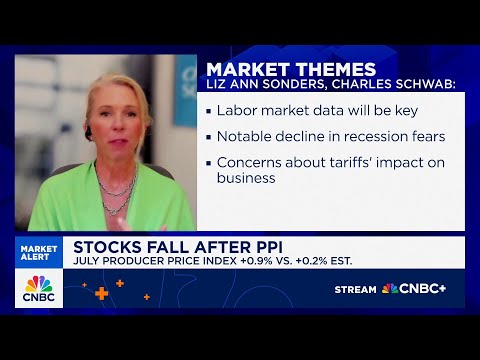
Charles Schwab's Liz Ann Sonders: Labor market data will be key
CNBC Television· 2025-08-14 15:13
Inflation & Pricing Pressure - PPI数据值得信任,细节与整体同样重要,需深入挖掘[1][2] - 生产者价格可能更多地传递到消费者价格[3] - 部分公司表示,即使未直接受关税影响,也可能提高价格[4][5] - 关税的影响不太可能是一次性的,公司将决定利润率的承担比例和价格转嫁比例[6] Market Performance & Strategy - 市场对关税采取乐观态度,但指数层面的表现主要由大型股驱动[7][8] - 标普500指数中,跑赢指数的股票占比约为三分之一,表明存在轮动[9] - Russell 2000指数与美联储政策预期短期相关[9] - 建议关注高质量的小型股,避免低质量股票,以应对市场回调或波动[14][15] Small Cap Concerns - Russell 2000指数中有40%的公司不盈利或现金流不足以支付债务利息[12][14] - 摆脱低质量反弹,倾向于更高质量的股票[15]
Schwab Gains 31.9% YTD: Should You Buy the Stock Right Now?
ZACKS· 2025-08-12 16:16
Core Insights - The Charles Schwab Corporation (SCHW) shares have increased by 31.9% year-to-date, outperforming the S&P 500 Index's 8.5% growth and the industry's 20.4% rise, but lagging behind peers Robinhood Markets (HOOD) and Interactive Brokers (IBKR) [1][8] Performance Overview - Schwab has benefited from increased market volatility, leading to a year-over-year rise in trading revenues in the first half of 2025 due to higher client trading volume [3] - The company's performance has been supported by strong asset gathering, sustained client engagement, equity market appreciation, and effective expense management [4] Growth Factors - Improving Net Interest Margin (NIM): NIM increased to 2.59% in the first half of 2025 from 2.03% in the prior year, aided by a reduction in high-cost bank supplemental funding, which fell 70% to $27.7 billion from a peak of $97.1 billion in May 2023 [5][6][10] - Client assets have surged, with total managed investing solutions revenues growing at a compound annual growth rate (CAGR) of 12.2% from 2019 to 2024, and total client assets growing at a CAGR of 20.1% during the same period [11][12] - Strategic acquisitions, including TD Ameritrade, have strengthened Schwab's market position and diversified revenue streams [13] Revenue and Earnings Estimates - The Zacks Consensus Estimate for Schwab's 2025 revenues is $23.41 billion, indicating a year-over-year increase of 19.4% [14] - Earnings estimates for 2025 and 2026 have been revised upward by 4.6% and 4.7%, respectively, with projected earnings of $4.59 per share for 2025, reflecting a growth rate of 41.2% [16] Valuation and Returns - Schwab's current trailing 12-month price/book (P/B) ratio is 4.40, above the industry average of 2.08, but lower than Robinhood's 12.51 and Interactive Brokers' 6.04 [19][22] - The company has a return on equity (ROE) of 19.3%, exceeding the industry average of 11.89%, indicating effective utilization of shareholder funds [23] Shareholder Returns - Schwab has consistently increased capital distributions, including an 8% hike in the quarterly dividend to 27 cents per share in January 2025 and a $20 billion share repurchase plan announced in July 2025 [26]
Should Schwab U.S. Dividend Equity ETF (SCHD) Be on Your Investing Radar?
ZACKS· 2025-08-11 11:21
Core Viewpoint - The Schwab U.S. Dividend Equity ETF (SCHD) is a leading investment option for exposure to the Large Cap Value segment of the U.S. equity market, with significant assets and low expense ratios, making it attractive for long-term investors [1][4][10]. Group 1: ETF Overview - SCHD is a passively managed ETF launched on October 20, 2011, and is sponsored by Charles Schwab, with assets exceeding $69.99 billion [1]. - The ETF aims to match the performance of the Dow Jones U.S. Dividend 100 Index, which focuses on high dividend yielding stocks with a strong record of dividend payments [7]. Group 2: Investment Characteristics - Large cap companies, defined as those with market capitalizations above $10 billion, are generally more stable and exhibit predictable cash flows compared to mid and small cap companies [2]. - Value stocks, which typically have lower price-to-earnings and price-to-book ratios, have historically outperformed growth stocks in long-term performance, although growth stocks may excel in strong bull markets [3]. Group 3: Costs and Performance - SCHD has an annual operating expense ratio of 0.06%, positioning it among the least expensive ETFs in its category, and it offers a 12-month trailing dividend yield of 3.81% [4]. - As of August 11, 2025, SCHD has gained approximately 0.25% year-to-date and 4.36% over the past year, with a trading range between $24.32 and $29.53 in the last 52 weeks [8]. Group 4: Sector Exposure and Holdings - The ETF has a significant allocation to the Consumer Staples sector, comprising about 19.8% of the portfolio, followed by Energy and Healthcare [5]. - Texas Instruments Inc (TXN) is the largest holding at approximately 4.33% of total assets, with the top 10 holdings accounting for about 40.3% of total assets under management [6]. Group 5: Alternatives and Market Position - SCHD holds a Zacks ETF Rank of 2 (Buy), indicating strong expected returns based on various factors, making it a compelling choice for investors interested in the Large Cap Value segment [10]. - Other comparable ETFs include the Vanguard High Dividend Yield ETF (VYM) and the Vanguard Value ETF (VTV), with VYM having $62.20 billion in assets and VTV at $139.70 billion, both with competitive expense ratios [11].
Charles Schwab(SCHW) - 2025 Q2 - Quarterly Report
2025-08-08 20:19
Part I - Financial Information [Item 1. Condensed Consolidated Financial Statements (Unaudited)](index=36&type=section&id=Item%201.%20Condensed%20Consolidated%20Financial%20Statements%20(Unaudited)) This section presents the unaudited condensed consolidated financial statements for The Charles Schwab Corporation [Condensed Consolidated Statements of Income](index=36&type=section&id=Condensed%20Consolidated%20Statements%20of%20Income) The company reported significant year-over-year growth in net income for both the second quarter and first six months of 2025 Key Income Statement Figures (Unaudited) | Metric | Three Months Ended June 30, 2025 | Three Months Ended June 30, 2024 | Six Months Ended June 30, 2025 | Six Months Ended June 30, 2024 | | :--- | :--- | :--- | :--- | :--- | | **Total net revenues** | $5,851 million | $4,690 million | $11,450 million | $9,430 million | | **Net interest revenue** | $2,822 million | $2,158 million | $5,528 million | $4,391 million | | **Total expenses excluding interest** | $3,048 million | $2,943 million | $6,192 million | $5,885 million | | **Net Income** | $2,126 million | $1,332 million | $4,035 million | $2,694 million | | **Diluted Earnings Per Share** | $1.08 | $0.66 | $2.07 | $1.34 | [Condensed Consolidated Statements of Comprehensive Income](index=37&type=section&id=Condensed%20Consolidated%20Statements%20of%20Comprehensive%20Income) Comprehensive income for Q2 2025 increased significantly due to higher net income and positive changes in other comprehensive income Comprehensive Income Summary (Unaudited) | Metric | Three Months Ended June 30, 2025 | Six Months Ended June 30, 2025 | | :--- | :--- | :--- | | **Net Income** | $2,126 million | $4,035 million | | **Other comprehensive income (loss), net of tax** | $1,030 million | $2,257 million | | **Comprehensive Income** | $3,156 million | $6,292 million | [Condensed Consolidated Balance Sheets](index=38&type=section&id=Condensed%20Consolidated%20Balance%20Sheets) Total assets decreased due to reduced bank deposits and borrowings, while stockholders' equity increased from retained earnings and improved AOCI Key Balance Sheet Figures (Unaudited) | Metric | June 30, 2025 | December 31, 2024 | | :--- | :--- | :--- | | **Total assets** | $458,936 million | $479,843 million | | **Available for sale securities** | $67,612 million | $82,994 million | | **Held to maturity securities** | $139,684 million | $146,453 million | | **Bank loans — net** | $50,405 million | $45,215 million | | **Total liabilities** | $409,485 million | $431,468 million | | **Bank deposits** | $233,058 million | $259,121 million | | **Total stockholders' equity** | $49,451 million | $48,375 million | [Condensed Consolidated Statements of Stockholders' Equity](index=39&type=section&id=Condensed%20Consolidated%20Statements%20of%20Stockholders'%20Equity) Total stockholders' equity increased due to net income and AOCI, partially offset by dividends, stock repurchases, and preferred stock redemption - Key equity changes in the first six months of 2025 include the repurchase of all remaining nonvoting common stock from TD Bank for **$1.5 billion** and an additional **$351 million** in common stock repurchases[120](index=120&type=chunk)[142](index=142&type=chunk) - The company redeemed its Series G preferred stock for **$2.5 billion** on June 2, 2025[108](index=108&type=chunk)[142](index=142&type=chunk) [Condensed Consolidated Statements of Cash Flows](index=40&type=section&id=Condensed%20Consolidated%20Statements%20of%20Cash%20Flows) Net cash provided by operating and investing activities was offset by significant cash used in financing activities, leading to a net decrease in cash and cash equivalents Cash Flow Summary for Six Months Ended June 30 (Unaudited) | Metric | 2025 | 2024 | | :--- | :--- | :--- | | **Net cash provided by (used for) operating activities** | $9,536 million | ($5,601) million | | **Net cash provided by (used for) investing activities** | $19,546 million | $19,181 million | | **Net cash provided by (used for) financing activities** | ($39,027) million | ($40,938) million | | **Increase (Decrease) in Cash and Cash Equivalents** | ($9,945) million | ($27,358) million | [Notes to Condensed Consolidated Financial Statements](index=43&type=section&id=Notes%20to%20Condensed%20Consolidated%20Financial%20Statements) Detailed disclosures cover accounting policies, financial instruments, debt, and regulatory capital, highlighting preferred stock redemption and share repurchases - On June 2, 2025, the company redeemed all outstanding Series G preferred stock for **$2.5 billion**[108](index=108&type=chunk)[244](index=244&type=chunk) - In February 2025, the company repurchased all remaining **19.2 million** shares of nonvoting common stock from TD Group US Holdings LLC for **$1.5 billion**. An additional **3.9 million** common shares were repurchased for **$351 million** in Q2 2025[239](index=239&type=chunk)[241](index=241&type=chunk) - As of June 30, 2025, the company and its banking subsidiaries met all respective capital requirements and were considered **well capitalized**[254](index=254&type=chunk) [Item 2. Management's Discussion and Analysis of Financial Condition and Results of Operations](index=3&type=section&id=Item%202.%20Management's%20Discussion%20and%20Analysis%20of%20Financial%20Condition%20and%20Results%20of%20Operations) Management discusses the company's financial performance for Q2 and H1 2025, highlighting strong revenue and net income growth [Introduction](index=3&type=section&id=Introduction) The Charles Schwab Corporation provides wealth management, brokerage, banking, and asset management services through its subsidiaries - Schwab's principal business subsidiaries include Charles Schwab & Co., Inc. (broker-dealer), Charles Schwab Bank, SSB (banking), and Charles Schwab Investment Management, Inc. (asset management)[14](index=14&type=chunk) - The company serves clients through **two primary segments**: Investor Services and Advisor Services[9](index=9&type=chunk) - With **$10.76 trillion** in client assets, management sees substantial growth opportunity in the estimated **$70+ trillion** U.S. investable wealth market[11](index=11&type=chunk) [Overview](index=7&type=section&id=Overview) Schwab's strong H1 2025 performance saw significant revenue and net income growth, driven by asset gathering and reduced funding costs Q2 2025 Financial Highlights (vs. Q2 2024) | Metric | Q2 2025 | Q2 2024 | % Change | | :--- | :--- | :--- | :--- | | **Total net revenues** | $5,851 M | $4,690 M | 25% | | **Net income** | $2,126 M | $1,332 M | 60% | | **Diluted EPS** | $1.08 | $0.66 | 64% | | **Core net new client assets** | $80.3 B | $61.2 B | 31% | H1 2025 Financial Highlights (vs. H1 2024) | Metric | H1 2025 | H1 2024 | % Change | | :--- | :--- | :--- | :--- | | **Total net revenues** | $11,450 M | $9,430 M | 21% | | **Net income** | $4,035 M | $2,694 M | 50% | | **Diluted EPS** | $2.07 | $1.34 | 54% | | **Core net new client assets** | $218.0 B | $156.8 B | 39% | - The company reduced total bank supplemental funding by **$22.2 billion (44%)** in the first six months of 2025, with **$27.7 billion** remaining at June 30[25](index=25&type=chunk) - Significant capital actions in H1 2025 included repurchasing **$1.5 billion** of nonvoting common stock from TD Bank, increasing the common dividend by **8%**, redeeming **$2.5 billion** of Series G preferred stock, and repurchasing an additional **$351 million** of common stock[27](index=27&type=chunk) [Current Regulatory and Other Developments](index=10&type=section&id=Current%20Regulatory%20and%20Other%20Developments) Recent regulatory developments include SEC and FDIC rule withdrawals, with ongoing monitoring of other pending matters - The SEC withdrew its December 2022 equity market structure rule proposals, 'Order Competition Rule' and 'Regulation Best Execution', on June 12, 2025[28](index=28&type=chunk) - The FDIC withdrew its July 2024 proposal related to the brokered deposits framework on March 3, 2025[29](index=29&type=chunk) - The company continues to monitor pending regulatory matters, including the DOL's final rule on the definition of 'fiduciary', FDIC special assessments, and proposed rulemaking on long-term debt and regulatory capital (Basel III endgame)[30](index=30&type=chunk) [Results of Operations](index=11&type=section&id=Results%20of%20Operations) The company's operations showed strong year-over-year revenue growth, primarily from net interest revenue and asset management fees Revenue Breakdown - Q2 2025 vs Q2 2024 | Revenue Category | Q2 2025 | Q2 2024 | % Change | | :--- | :--- | :--- | :--- | | **Net interest revenue** | $2,822 M | $2,158 M | 31% | | **Asset management & admin fees** | $1,570 M | $1,383 M | 14% | | **Trading revenue** | $952 M | $777 M | 23% | | **Bank deposit account fees** | $247 M | $153 M | 61% | | **Total net revenues** | $5,851 M | $4,690 M | 25% | Expense Breakdown - Q2 2025 vs Q2 2024 | Expense Category | Q2 2025 | Q2 2024 | % Change | | :--- | :--- | :--- | :--- | | **Compensation and benefits** | $1,536 M | $1,450 M | 6% | | **Professional services** | $291 M | $259 M | 12% | | **Depreciation and amortization** | $215 M | $233 M | (8)% | | **Total expenses excluding interest** | $3,048 M | $2,943 M | 4% | [Risk Management](index=22&type=section&id=Risk%20Management) Schwab manages market, liquidity, and credit risks through policies on interest rate sensitivity, maintaining strong funding, and robust regulatory liquidity ratios - A hypothetical gradual **100 basis point** increase in interest rates is simulated to increase net interest revenue by **4.1%** over the next 12 months, while a **100 basis point** decrease would lower it by **4.0%**[79](index=79&type=chunk) - The company's primary source of funds is cash from client activity (bank deposits and brokerage cash). Supplemental funding includes FHLB borrowings, repurchase agreements, and commercial paper[89](index=89&type=chunk) Regulatory Liquidity Ratios (Average for Q2 2025) | Ratio | Q2 2025 Average | | :--- | :--- | | **Liquidity Coverage Ratio (LCR)** | 143% | | **Net Stable Funding Ratio (NSFR)** | 132% | [Capital Management](index=30&type=section&id=Capital%20Management) Schwab manages capital to support strategy, meet regulatory requirements, and return excess capital, maintaining a well-capitalized status Key Capital Ratios (Consolidated) | Ratio | June 30, 2025 | December 31, 2024 | | :--- | :--- | :--- | | **Common Equity Tier 1 Capital Ratio** | 33.0% | 31.7% | | **Tier 1 Capital Ratio** | 38.9% | 39.8% | | **Tier 1 Leverage Ratio** | 9.8% | 9.9% | | **Adjusted Tier 1 Leverage Ratio (Non-GAAP)** | 7.2% | 6.8% | - The Board of Directors increased the quarterly cash dividend by **8%** to **$0.27** per common share, effective January 29, 2025[117](index=117&type=chunk) - In Q1 2025, the company repurchased **$1.5 billion** of nonvoting common stock from TD Bank. In Q2 2025, it repurchased an additional **$351 million** of common stock. In July 2025, a new **$20.0 billion** share repurchase authorization was approved, replacing the previous one[120](index=120&type=chunk)[122](index=122&type=chunk) [Non-GAAP Financial Measures](index=32&type=section&id=NON-GAAP%20FINANCIAL%20MEASURES) This section defines and reconciles non-GAAP financial measures used by management for clearer operational performance insights Reconciliation of GAAP to Non-GAAP EPS (Diluted) | Metric | Three Months Ended June 30, 2025 | Six Months Ended June 30, 2025 | | :--- | :--- | :--- | | **Diluted EPS (GAAP)** | $1.08 | $2.07 | | **Adjustments (Amortization, etc.)** | $0.06 | $0.10 | | **Adjusted Diluted EPS (Non-GAAP)** | $1.14 | $2.17 | Reconciliation of GAAP to Non-GAAP Capital Ratio (Consolidated) | Metric | June 30, 2025 | | :--- | :--- | | **Tier 1 Leverage Ratio (GAAP)** | 9.8% | | **AOCI Adjustment** | (2.6)% | | **Adjusted Tier 1 Leverage Ratio (Non-GAAP)** | 7.2% | - Management uses non-GAAP measures like Adjusted Diluted EPS and ROTCE as components for employee and executive incentive compensation[129](index=129&type=chunk) [Item 3. Quantitative and Qualitative Disclosures About Market Risk](index=35&type=section&id=Item%203.%20Quantitative%20and%20Qualitative%20Disclosures%20About%20Market%20Risk) Disclosures about market risk are located in the Risk Management section of the MD&A - The disclosures about market risk are located in the Risk Management section of the MD&A[133](index=133&type=chunk) [Item 4. Controls and Procedures](index=77&type=section&id=Item%204.%20Controls%20and%20Procedures) Management concluded disclosure controls and procedures were effective, with no material changes to internal control over financial reporting - The CEO and CFO concluded that the company's disclosure controls and procedures were **effective** as of the end of the quarter[264](index=264&type=chunk) - There were no changes in internal control over financial reporting during the quarter that have materially affected, or are reasonably likely to materially affect, these controls[265](index=265&type=chunk) Part II - Other Information [Item 1. Legal Proceedings](index=77&type=section&id=Item%201.%20Legal%20Proceedings) Information on legal proceedings, including a pending settlement for the Corrente Antitrust Litigation, is detailed in Note 10 - For details on legal proceedings, the report refers to Note 10 of the Condensed Consolidated Financial Statements[266](index=266&type=chunk) - The Corrente Antitrust Litigation has a proposed settlement pending court approval, which involves non-monetary undertakings and an **immaterial payment** for plaintiffs' attorneys' fees[206](index=206&type=chunk) [Item 1A. Risk Factors](index=77&type=section&id=Item%201A.%20Risk%20Factors) There were no material changes to the company's risk factors during the first six months of 2025 - There were **no material changes** to the company's risk factors during the first six months of 2025[267](index=267&type=chunk) [Item 2. Unregistered Sales of Equity Securities and Use of Proceeds](index=77&type=section&id=Item%202.%20Unregistered%20Sales%20of%20Equity%20Securities%20and%20Use%20of%20Proceeds) Details on stock repurchase activities, including Q2 2025 repurchases and a new $20 billion authorization approved in July 2025 - On July 24, 2025, the Board of Directors approved a new share repurchase authorization of up to **$20.0 billion**, replacing the previous program[268](index=268&type=chunk) Issuer Purchases of Equity Securities (Q2 2025) | Month | Shares Purchased (thousands) | Average Price Paid per Share | | :--- | :--- | :--- | | **April** | — | — | | **May** | — | — | | **June** | 3,950 | $88.75 | [Item 3. Defaults Upon Senior Securities](index=78&type=section&id=Item%203.%20Defaults%20Upon%20Senior%20Securities) The company reported no defaults upon its senior securities during the period - None[271](index=271&type=chunk) [Item 4. Mine Safety Disclosures](index=78&type=section&id=Item%204.%20Mine%20Safety%20Disclosures) This item is not applicable to The Charles Schwab Corporation - Not applicable[272](index=272&type=chunk) [Item 5. Other Information](index=78&type=section&id=Item%205.%20Other%20Information) Jonathan S. Beatty adopted a Rule 10b5-1 trading plan in May 2025 for the potential sale of common stock - Jonathan S. Beatty, Managing Director and Head of Advisor Services, adopted a Rule 10b5-1 trading plan on May 28, 2025, for the potential sale of up to **13,216 shares**[273](index=273&type=chunk) [Item 6. Exhibits](index=79&type=section&id=Item%206.%20Exhibits) This section lists the exhibits filed with the Form 10-Q, including SOX certifications and Inline XBRL data files - Exhibits filed include certifications under Sarbanes-Oxley Sections 302 and 906, and XBRL data files[276](index=276&type=chunk) Signature - The report was signed on August 8, 2025, by Michael Verdeschi, Managing Director and Chief Financial Officer[280](index=280&type=chunk)
'Be careful what you wish for' when it comes to aggressive Fed cuts: Charles Schwab's Kevin Gordon
CNBC Television· 2025-08-07 20:35
Federal Reserve Policy & Labor Market - The Federal Reserve (Fed) could consider cutting rates in September if July's jobs report trends continue with significant downward revisions and softening hiring [3] - The Fed acknowledges downside risks to the labor market, making it a key driver of Fed policy and the equity market [4] - A slowdown in job creation doesn't necessarily indicate a bearish economic outlook due to a contraction in the labor force [5] - Supply-side labor is decreasing as foreign-born workers exit the economy [7] Tech Sector & Investment Strategies - Big tech remains a favorable investment area, despite software experiencing a slight downturn [8] - Investors are evaluating the sustainability of companies' competitive advantages (moats) amid AI advancements, focusing on revenue growth, user base expansion, and protection against competitors like OpenAI and ChatGPT [9][10] - The market is becoming more selective, with winners and losers emerging, requiring investors to deeply understand a company's strengths, weaknesses, and defenses against AI threats [11][12] - A stock-picking mindset is crucial, as thematic or sector-based approaches become more challenging due to exemptions granted to specific sectors and companies [13] - A factor or characteristic-based viewpoint, rather than a sector view, is recommended, focusing on companies with solid fundamentals in earnings growth and profit margins [14][16] - Sectors like tech, utilities, and industrials, despite their diverse classifications (growth, defensive, cyclical), share an AI theme and strong fundamentals [14][15] Macroeconomic Environment - The market is expected to remain in an environment of elevated tariff rates, labor force contraction, and downward pressure on supply [16]

Should Schwab U.S. Large-Cap ETF (SCHX) Be on Your Investing Radar?
ZACKS· 2025-08-06 11:20
Core Viewpoint - The Schwab U.S. Large-Cap ETF (SCHX) is a passively managed fund designed to provide broad exposure to the Large Cap Blend segment of the U.S. equity market, with significant assets under management and low expense ratios [1][3]. Group 1: Fund Overview - SCHX was launched on November 3, 2009, and has accumulated over $57.11 billion in assets, making it one of the largest ETFs in its category [1]. - The fund targets companies with market capitalizations above $10 billion, which are typically stable with predictable cash flows [2]. Group 2: Costs and Performance - The ETF has an annual operating expense ratio of 0.03%, positioning it as one of the least expensive options available [3]. - It has a 12-month trailing dividend yield of 1.15% [3]. - SCHX has gained approximately 7.93% year-to-date and 23.55% over the past year, with a trading range between $19.60 and $25.24 in the last 52 weeks [7]. Group 3: Sector Exposure and Holdings - The ETF has a significant allocation to the Information Technology sector, comprising about 33.5% of the portfolio, followed by Financials and Consumer Discretionary [4]. - Nvidia Corp (NVDA) is the largest holding at approximately 7.02% of total assets, with Microsoft Corp (MSFT) and Apple Inc (AAPL) also among the top holdings [5]. Group 4: Risk and Alternatives - SCHX aims to match the performance of the Dow Jones U.S. Large-Cap Total Stock Market Index, which includes around 750 stocks and is float-adjusted market-capitalization weighted [6]. - The ETF has a beta of 1.01 and a standard deviation of 16.94% over the trailing three-year period, indicating medium risk [7]. - Alternatives to SCHX include the SPDR S&P 500 ETF (SPY) and the Vanguard S&P 500 ETF (VOO), which have larger asset bases and slightly different expense ratios [9]. Group 5: Investment Appeal - Passively managed ETFs like SCHX are gaining popularity among both institutional and retail investors due to their low costs, transparency, and tax efficiency, making them suitable for long-term investment strategies [10].

'Magnificent 7' record highs, retail trading and 'measured bullishness'
Yahoo Finance· 2025-08-04 22:28
Hello and welcome to Ask Me for a Trend. I'm Josh Lipton and for the next half hour, we are breaking down the trends of today that'll move stocks tomorrow. There's a lot to keep track of, so we're focusing on what you need to know to get ahead of the curve. Here's some of the trends we're going to be diving into.Stocks jumped Monday as investors clawed back losses from Friday's trading. At the end of the session, all major indices ended the day higher. And it is a hot summer for investors.We're taking a dee ...