
ETF

Search documents
T-Rex files for leveraged SpaceX, Anthropic ETFs ahead of anticipated IPOs
Reuters· 2026-03-26 22:21
T-Rex files for leveraged SpaceX, Anthropic ETFs ahead of anticipated IPOs | Reuters Exclusive news, data and analytics for financial market professionalsLearn more aboutRefinitiv Item 1 of 2 SpaceX logo is seen in this illustration taken, March 10, 2025. REUTERS/Dado Ruvic/Illustration/File Photo [1/2]SpaceX logo is seen in this illustration taken, March 10, 2025. REUTERS/Dado Ruvic/Illustration/File Photo Purchase Licensing Rights, opens new tab PROVIDENCE, Rhode Island, March 26 (Reuters) - REX Shares an ...


The Nasdaq Turns Negative For March 24th As Tech Sells Off Hard
Yahoo Finance· 2026-03-24 13:56
Quick Read Invesco QQQ Trust (QQQ) declined 4% year-to-date and 2% over the past week, while SPDR S&P 500 ETF (SPY) is down 5% over the past month and SPDR Dow Jones ETF (DIA) fell nearly 7% since late February; iShares Russell 2000 ETF (IWM) showed relative resilience with less than 1% decline over five days. JPMorgan cut Fair Isaac’s (FICO) price target from $1,825 to $1,325 citing concerns about pricing power erosion in mortgage credit scoring and potential regulatory pressure. The Iran conflict is ...
No Shelter
Etftrends· 2026-03-23 17:46
No Shelter | ETF Trends Most of us have been taught that diversification provides benefits. We're told there are assets that can be held alongside equities to smooth out the twists and turns of the market. There are even assets that may rise when stocks fall. For a 24 year stretch (1998–2022), that asset was bonds. At other times, precious metals have played that role. And sometimes, simply owning more defensive areas of the equity market can help. Right now, very little is helping. There is no shelter. S&P ...
1 Dividend ETF That Could Turn $500 Monthly Into a $725,000 Portfolio That Pays $21,750 Annually
The Motley Fool· 2026-03-20 05:45
Core Viewpoint - The Vanguard High Dividend Yield ETF (VYM) is highlighted as a promising investment option, potentially yielding $21,750 annually from an investment of $725,000, achievable with monthly contributions of $500 if it maintains its current performance trajectory [1][2]. Group 1: ETF Overview - VYM is a dividend-focused ETF that includes companies with a history of paying above-average dividends, providing a diversified exposure across various sectors [4][5]. - The ETF's top five holdings include Broadcom, JPMorgan Chase, ExxonMobil, Johnson & Johnson, and Walmart, showcasing its sector diversification [5]. Group 2: Sector Allocation - VYM's sector allocation includes Financials (19.4%), Industrials (13.8%), Healthcare (12.9%), Technology (12.3%), Consumer Discretionary (10.1%), Energy (9.6%), Consumer Staples (9.4%), Utilities (6.5%), Telecommunications (3.7%), and Basic Materials (2.3%) [6]. Group 3: Performance Metrics - Over the past decade, VYM has averaged annual total returns of approximately 11.4%, with an average dividend yield around 3% [7][8]. - Projected investment growth from monthly contributions of $500 shows significant potential, with values reaching $725,220 and annual payouts of $21,756 after 25 years [8].

4 Reasons to Stay Cautious and Play ETFs Strategically
ZACKS· 2026-03-18 14:02
Key Takeaways Slowing U.S. growth and weak sentiment highlight rising economic uncertainty.Oil surge and private credit stress raise fears of stagflation risks.Gold, tech, copper and emerging-market ETFs may offer long-term opportunities.Global markets are facing heightened uncertainty as slowing U.S. economic growth, rising geopolitical tensions, and surging oil prices dampen the outlook for investors. With fears of stagflation and financial stress resurfacing, markets are sending mixed signals. Let’s delv ...

Should You Invest in the Vanguard Consumer Discretionary Index Fund ETF Shares (VCR)?
ZACKS· 2026-03-18 11:20
The Vanguard Consumer Discretionary Index Fund ETF Shares (VCR) was launched on January 26, 2004, and is a passively managed exchange traded fund designed to offer broad exposure to the Consumer Discretionary - Broad segment of the equity market.While an excellent vehicle for long term investors, passively managed ETFs are a popular choice among institutional and retail investors due to their low costs, transparency, flexibility, and tax efficiency.Sector ETFs are also funds of convenience, offering many wa ...


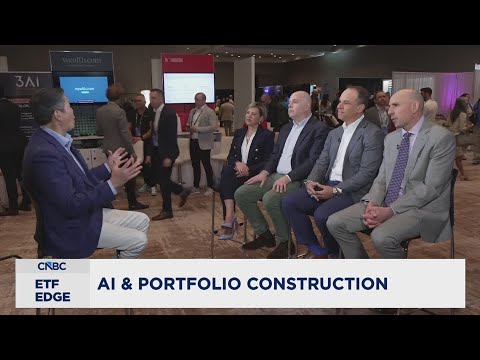
Biggest ideas at Exchange: Crypto, tokenization, AI and what’s likely to change in 2026
CNBC Television· 2026-03-17 16:54
More than 1000 RIAs, asset managers and portfolio managers gathered in Las Vegas this week to talk about the ETF industry’s hottest ideas. State Street Investment Management global head of ETFs Anna Paglia, Franklin Templeton head of ETF product and capital markets David Mann, SS&C Alps Advisors head of fund sales & strategy Paul Baiocchi and Osprey Funds CIO Bill Birmingham join CNBC’s Dominic Chu at Exchange, to discuss the latest trends in the ETF space, the outlook for year-end, new products to watch an ...
How AI and tokenization combined could disrupt disruption in the ETF space
CNBC Television· 2026-03-17 16:45
Asset managers, portfolio managers and ETF professionals from across the country gathered in Las Vegas this week to talk about the ETF industry’s hottest ideas. State Street Investment Management global head of ETFs Anna Paglia, Franklin Templeton head of ETF product and capital markets David Mann, SS&C Alps Advisors head of fund sales & strategy Paul Baiocchi and Osprey Funds CIO Bill Birmingham join CNBC’s Dominic Chu at Exchange 2026, to talk about the major role AI is playing in the space, and how token ...
ISCG vs. VBK: Which ETF Offers Lower Fees, More Liquidity, and Greater Returns?
Yahoo Finance· 2026-03-17 15:55
Vanguard Small-Cap Growth ETF (NYSEMKT:VBK) and iShares Morningstar Small-Cap Growth ETF (NYSEMKT:ISCG) both offer diversified exposure to U.S. small-cap growth stocks, but differ in portfolio breadth, assets under management (AUM), and trading liquidity. Both funds target the small-cap growth segment, with VBK tracking the CRSP U.S. Small Cap Growth Index and ISCG following a Morningstar methodology. This comparison looks at their respective costs, performance, risk, underlying holdings, and practical con ...
What Do You Need To Invest To Replace Your $95k Salary Just On Dividends Alone?
Yahoo Finance· 2026-03-17 12:45
With a current yield around 4.3% and a very low expense ratio of 0.15%, there's a lot to like about the total return investors can consider over a two to three-decade long time frame. For investors looking to generate $95,000 per year to offset their income, that would amount to roughly $2.1 million invested in a fund like TLT. That's not small potatoes, by any stretch, but there are certainly plenty of investors out there with liquid and illiquid capital (think, one's house or rental properties) that may b ...