HDFC Bank

Search documents
M-cap of eight of top-10 most valued firms jumps by Rs 1.94 lakh crore; TCS top gainer
The Economic Times· 2025-10-12 05:12
Core Insights - The combined market valuation of eight of the top-10 most valued firms increased by Rs 1,94,148.73 crore last week, driven by a positive trend in the stock market [7] - TCS emerged as the biggest gainer, adding Rs 45,678.35 crore to its market valuation, which reached Rs 10,95,701.62 crore [7] - The BSE benchmark index surged by 1,293.65 points or 1.59% during the same period [7] Company Valuations - HDFC Bank's market valuation surged by Rs 25,135.62 crore, reaching Rs 15,07,025.19 crore [7] - Infosys saw an increase of Rs 28,125.29 crore in its valuation, bringing it to Rs 6,29,080.22 crore [2][7] - Bharti Airtel's market valuation jumped by Rs 25,089.27 crore to Rs 11,05,980.35 crore [4][7] - Reliance Industries' market capitalisation climbed by Rs 25,035.08 crore to Rs 18,70,120.06 crore [5][7] - Bajaj Finance's market capitalisation rallied by Rs 21,187.56 crore to Rs 6,36,995.74 crore [7] - State Bank of India's valuation increased by Rs 12,645.94 crore to Rs 8,12,986.64 crore [7] - ICICI Bank's valuation rose by Rs 11,251.62 crore to Rs 9,86,367.47 crore [6][7] Declines in Valuation - The market capitalisation of LIC decreased by Rs 4,648.88 crore, resulting in a valuation of Rs 5,67,858.29 crore [6][7] - Hindustan Unilever's valuation declined by Rs 3,571.37 crore to Rs 5,94,235.13 crore [6][7]


Banks to remain closed on Dhanteras, Bihu, and other festivals from October 13–19? Check full schedule
MINT· 2025-10-12 02:29
Core Viewpoint - Banks in India will be closed for multiple days between October 13 and October 19, 2025, due to the festive season, including holidays for Diwali and other regional festivals [1][2]. Group 1: Bank Holidays Overview - In total, banks will close for up to 21 days in October 2025 due to official holidays such as Diwali, Maha Ashtami, Dussehra, Durga Puja, and Chhat Puja, along with weekly offs [2]. - The Reserve Bank of India (RBI) mandates bank holidays on the second and fourth Saturdays of each month, as well as all Sundays [2][7]. Group 2: Specific Holidays - On October 18, banks will be closed in Guwahati for Kati Bihu, and on October 19, they will be closed nationwide for the Sunday weekly off [5][6]. - Additional closures include: - October 20: Banks closed in multiple cities for Diwali and related festivals - October 21: Banks closed for Diwali Amavasya - October 22: Banks closed for various Diwali celebrations - October 23: Banks closed for Bhai Bij and other festivals - October 25 and 26: Nationwide closures for weekly offs [6]. Group 3: Banking Services During Holidays - Online and mobile banking services, including IMPS, NEFT, RTGS, and UPI, will remain operational during bank holidays [4][8]. - ATM services will also be available for cash withdrawals on bank holidays [4][8].
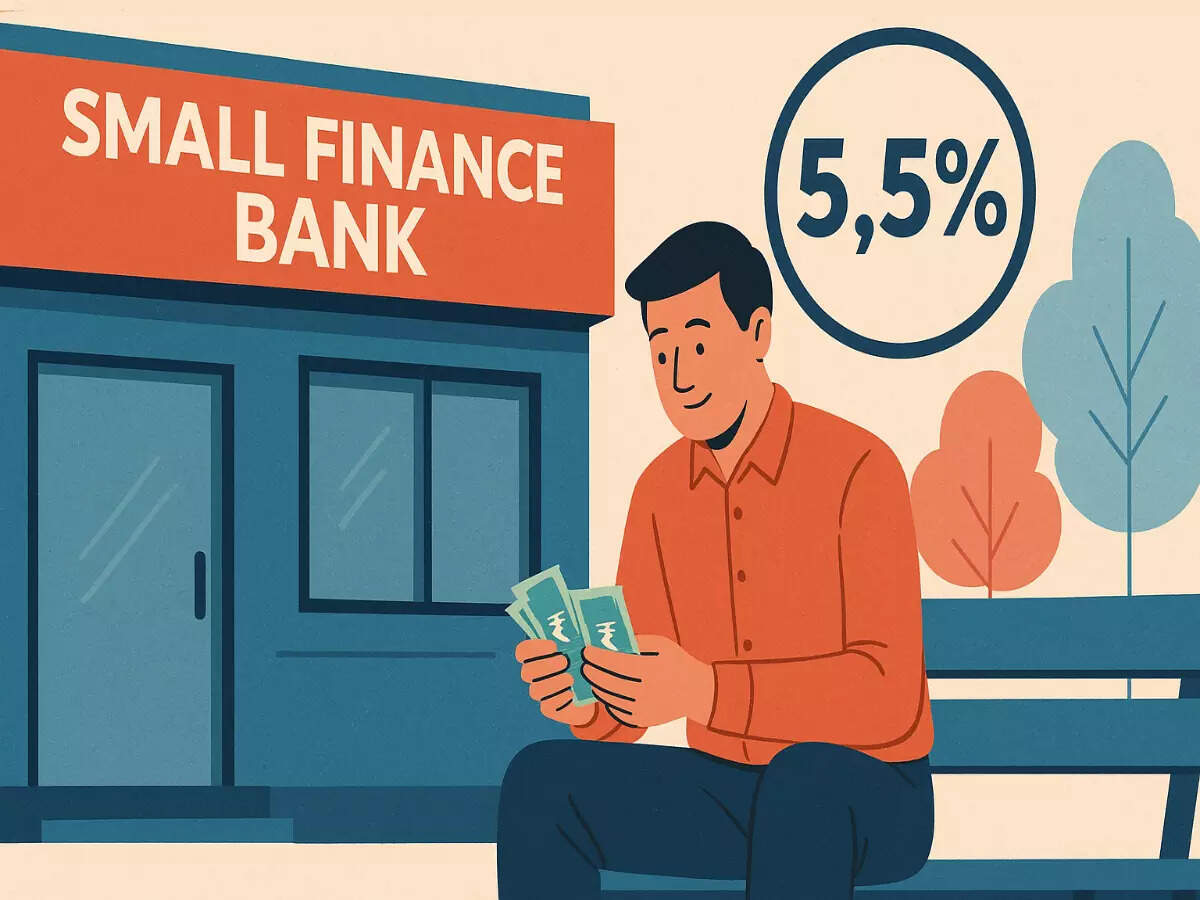
5.5% interest on savings account: Yes, this bank offers it without higher balance requirement
The Economic Times· 2025-10-10 11:56
Core Insights - Slice Small Finance Bank offers a competitive interest rate of 5.5% on savings accounts for deposits below ₹1 lakh, which is the highest among banks and small finance banks in India [1][11] - The Reserve Bank of India (RBI) repo rate is currently at 5.5%, and Slice Small Finance Bank claims to offer savings account interest rates at 100% off this rate [2][12] - The bank's ability to maintain this interest rate is attributed to its low operating costs through technology and efficient lending practices [4][12] Interest Rate Comparison - The interest rates offered by Slice Small Finance Bank (5.5%) significantly exceed those of other banks, which typically offer rates between 2.5% and 3% for deposits up to ₹1 lakh [11] - For balances above ₹1 lakh, other banks may offer interest rates up to 8%, indicating that Slice Small Finance Bank does not maintain the highest rates for larger deposits [5][12] Impact of RBI Repo Rate - The RBI repo rate influences overall interest rates on bank deposits; a reduction in the repo rate generally leads to lower interest rates on savings accounts due to competitive pressures among banks [8][12] - The current RBI repo rate has remained unchanged during the September-October Monetary Policy Committee meeting, which may stabilize interest rates in the near term [2][12] Digital Banking Features - Slice Small Finance Bank, previously known as North East Small Finance Bank, emphasizes a fully digital banking experience, allowing customers to open and manage savings accounts through a mobile app [9][10][12]
Sensex rises 329 pts on rally in pharma, banking shares
Rediff· 2025-10-10 11:04
Core Insights - Indian equities experienced a significant rise, primarily driven by strong performances in the banking and pharmaceutical sectors, alongside positive foreign fund inflows [5][6]. Market Performance - The BSE Sensex increased by 328.72 points or 0.40% to close at 82,500.82, reaching an intraday high of 82,654.11 with a maximum gain of 482.01 points or 0.58% [3]. - The NSE Nifty rose by 103.55 points or 0.41% to settle at 25,285.35, achieving an intraday high of 25,330.75 with a peak increase of 148.95 points or 0.59% [3]. Sector Performance - Major gainers among Sensex firms included State Bank of India, Maruti Suzuki India, Axis Bank, NTPC, BEL, Adani Ports, Sun Pharmaceuticals, and HDFC Bank [4]. - Conversely, laggards included Tata Steel, Tata Consultancy Services, Tech Mahindra, Titan, and Bajaj Finance [4]. Investor Sentiment - Investor sentiment improved following the Indian government's invitation for private sector professionals to lead the State Bank of India, which positively impacted banking stocks [5]. - The revival of the Biosecure Act in the US, aimed at reducing biotech ties with certain foreign firms, particularly from China, provided a boost to Indian Contract Development and Manufacturing Organizations (CDMOs) [5]. Foreign Investment - Foreign Institutional Investors (FIIs) purchased equities worth ₹1,308.16 crore on Thursday, indicating strong foreign interest in the Indian market [6]. Global Market Context - In the broader Asian market, indices such as Hong Kong's Hang Seng, Tokyo's Nikkei 225, and Shanghai's SSE Composite ended lower, while Seoul's Kospi closed positively [6]. - The global oil benchmark Brent crude saw a slight decline of 0.63% to $64.81 per barrel [7].
Gold loan interest rates: What different banks are offering? Check latest rate of SBI, HDFC, ICICI & others
The Times Of India· 2025-10-09 11:55
Core Insights - Gold loans provide a convenient solution for various financial needs, including education, business expansion, personal or medical costs, and home renovations, with minimal paperwork and quick access to cash [2][11] How Gold Loans Work - Gold loans involve pledging gold jewelry in exchange for funds, with the loan amount determined by the purity and weight of the jewelry [3][11] - Interest rates on gold loans vary based on the lender, borrower's profile, loan amount, tenure, and repayment option [3][11] Interest Rates - As of October 2025, interest rates for gold loans from various banks and financial institutions are as follows: - State Bank of India: 10.00% - Union Bank of India: 9.65% - Punjab National Bank: 8.35% - HDFC Bank: 9.30% - Muthoot Finance: 22.00% [4] Eligible Items for Pledge - Only specific gold items are accepted for loans, typically gold ornaments with a purity between 18 and 22 karats, and bank-minted coins of 24 karats weighing up to 50 grams [6][11] - Items such as hair pins, cufflinks, gold watches, and imitation jewelry are generally not accepted [6][11] Loan Amount Determination - The loan amount is based on the purity of gold (measured in karats) and net weight, with loans not offered against primary gold like 24-carat bars [9][11] Repayment Options - Various repayment options are available, including: - Paying interest as EMI and principal later - Making partial payments - Bullet repayment - Regular EMI option - Partial prepayment - Prepaying interest upfront [10][11] Market Considerations - Borrowers are advised to check the current market value of their gold and consider lenders offering low interest rates and flexible repayment options [9][11]

Adani sets out to raise ₹30,000 crore for Terminal 2 of Navi Mumbai Airport
MINT· 2025-10-08 11:50
NEW DELHI/MUMBAI : The Adani Group’s brand-new airport in Navi Mumbai is not even operational but the conglomerate is already going about raising funds for its second terminal, which is expected to start functioning four years from now. The group plans to raise ₹30,000 crore to build the second terminal and has initiated discussions with Indian and Japanese banks as well as the Singapore government’s investment company Temasek. Prime Minister Narendra Modi inaugurated the first terminal of Navi Mumbai Inter ...

New rules will bump up provisions, but SBI chair sees limited hit
MINT· 2025-10-08 09:07
Core Viewpoint - State Bank of India anticipates a limited impact from the transition to the expected credit loss (ECL) framework due to a long transition period that allows for increased provisioning against stressed loans [1][2]. Regulatory Changes - The Reserve Bank of India (RBI) has proposed a transition from the current "incurred loss" provisioning rule to an ECL framework, with a five-year glide path from April 1, 2027, to March 31, 2031 [3]. - The RBI has invited feedback on the draft circular by November 30 [3]. Classification of Financial Assets - Financial assets will be classified into three stages based on the increase in credit risk since initial recognition: Stage 1 (low risk), Stage 2 (rising risk), and Stage 3 (credit-impaired) [4]. Provisioning Requirements - Stage 1 requires a minimum provisioning rate of 0.40% for most standard loans, 0.25% for farm or MSME loans, and 1.0-1.25% for unsecured retail and project financing during construction [5]. - Stage 2 mandates a minimum 5% provisioning for the most deteriorated loans, 1.5% for secured retail loans, and 0.75-1.0% for operational project loans [6]. - Stage 3 has age-based provisioning floors ranging from 25-40% in the first year for secured or unsecured loans, increasing to 75-100% beyond 3-4 years, with unsecured retail loans requiring full provisioning after the first year [6]. Impact on Banks - Unsecured retail exposure to personal loans, credit cards, and microfinance may face a larger provisioning burden, while housing or gold loans may experience a lower incremental impact [8]. - The RBI estimates a one-time provisioning hit but expects the overall impact on minimum regulatory capital to be modest due to the transition path and existing capital buffers [8]. - Private banks are better positioned to manage the shift due to stronger capital buffers and advanced risk models, while public sector banks may face additional provisioning requirements [10]. Long-term Benefits - The ECL framework is expected to enhance earnings stability, transparency, and comparability, thereby strengthening the resilience of the banking system [11].
Lowest gold loan interest rates in 2025: Compare rates from SBI, PNB, HDFC Bank, ICICI Bank and others
The Economic Times· 2025-10-08 07:42
Core Insights - A gold loan is a financial product where individuals can borrow money against their gold jewelry, with the amount determined by the purity and weight of the gold [1][5] Interest Rates - As of October 2025, interest rates for gold loans vary across different banks and financial institutions in India, with public sector banks offering rates from 8.35% to 10.50%, while private sector banks range from 9.00% to 10.50% [1] Acceptable Gold Items - Only gold ornaments with a purity of 18 to 22 karats and bank-minted coins (24 karats) up to 50 grams per customer are acceptable for gold loans [2][5] - Items such as gold-plated jewelry, imitation jewelry, and gold bars are not accepted by reputable lenders [4][5] Loan Amount Determination - The loan amount is based on the purity of gold (measured in karats) and net weight, with loans not offered against primary gold (24-carat gold bars and biscuits) [5][4] Repayment Options - Various repayment options are available, including EMI-based repayment, bullet repayment for 3, 6, and 12 months, and an overdraft facility [6]
6 personal loan products with no foreclosure charges or conditional waiver options
MINT· 2025-10-08 06:58
Banks usually charge a foreclosure fee if an individual wants to close their personal loan before the scheduled tenure. However, in some cases, an individual can get a complete waiver or a conditional waiver of the foreclosure fee.In this article, we will discuss some banks/NBFCs that either don’t charge a foreclosure fee or provide a conditional waiver on the foreclosure fee on personal loans.What is the foreclosure fee?A personal loan tenure usually ranges from 3 months to 7 years. When an individual want ...


4 personal loan charges you should know before applying
MINT· 2025-10-07 11:01
Core Insights - Personal loans offer quick access to funds for various expenses but come with multiple charges and complexities that borrowers need to understand before applying [1][4] Interest Rates and Processing Charges - Current personal loan interest rates as of October 2025 range from 9.99% to 24% depending on the bank, with processing charges varying significantly [2][3] - HDFC Bank offers interest rates between 9.99% and 24% with processing charges of ₹6,500 plus GST, while ICICI Bank's rates range from 10.60% to 16.50% with processing charges up to 2% of the loan amount plus taxes [2] Types of Charges - Key charges associated with personal loans include loan processing fees, prepayment or foreclosure charges, and late payment penalties [4][5] - Processing fees typically range from 0.5% to 3.93% of the loan amount and are generally non-refundable [6] - Prepayment or foreclosure charges can range from 2% to 5% of the outstanding principal, with some lenders offering zero charges under specific conditions [6] Late Payment and Other Charges - Late payment penalties usually range from 1% to 2% of the overdue EMI amount, and consistent delays can negatively impact credit scores [6][7] - Additional charges may include statutory charges, stamp duty, and bounce charges for missed EMI payments, which can range from ₹500 to ₹1,200 [11] Importance of Understanding Charges - A clear understanding of these charges is crucial for borrowers to manage repayments effectively and avoid hidden costs, which can lead to defaults and affect credit profiles [9][10]