
Federal Reserve

Search documents
Consumer sentiment slides to near lowest level on record as government shutdown drags on
Fox Business· 2025-11-07 20:38
Core Insights - U.S. consumer sentiment has declined to its lowest level in over three years, with a preliminary reading of 50.3 for November, significantly below the expected 53.2 [1][2] - The decline in consumer sentiment is attributed to concerns over the economic impact of the ongoing government shutdown, with a notable 6% drop in sentiment this month [3] Consumer Sentiment Breakdown - The decline in sentiment was widespread across demographics, including age, income, and political affiliation, with the exception of consumers in the top tercile of stock holdings, who saw an 11% increase in sentiment [5] - Current personal finances saw a 17% drop, while expectations for business conditions a year ahead fell by 11% [3] Inflation Expectations - Consumers' expectations for inflation increased slightly from 4.6% to 4.7%, although this remains lower than earlier readings [5] - Longer-term inflation expectations decreased from 3.9% to 3.6%, now below the midpoint of previous year's readings and the peak in April 2025 [6] Economic Context - Recent inflation trends have been influenced by rising tariffs, with the September consumer price index showing inflation at 3%, exceeding the Federal Reserve's target of 2% [7] - The Federal Reserve is focused on maintaining longer-term inflation expectations near its target as it considers interest rate adjustments [10]


Dollar Slips on Economic Woes
Yahoo Finance· 2025-11-07 20:33
Group 1: Dollar Index and Economic Indicators - The dollar index (DXY00) fell to a 1-week low, finishing down by -0.15% due to pressure from rising US job cuts and declining consumer sentiment [1] - US job cuts in October surged by 175% year-on-year, marking the highest increase in 22 years, which supports the outlook for the Federal Reserve to continue cutting interest rates [1] - The University of Michigan's US November consumer sentiment index dropped to a nearly 3.5-year low of 50.3, falling more than expected from 53.0 [3] Group 2: Federal Reserve and Interest Rates - The ongoing US government shutdown is exerting additional pressure on the dollar, with potential negative impacts on the US economy and increased likelihood of Fed interest rate cuts [2] - Fed Vice Chair Philip Jefferson indicated that interest rates are still "somewhat restrictive" and suggested a cautious approach to further rate cuts as the Fed approaches the neutral rate [5] - Markets are pricing in a 67% chance that the FOMC will cut the fed funds target range by 25 basis points at the upcoming meeting on December 9-10 [5] Group 3: Inflation Expectations and Consumer Credit - Mixed news on inflation expectations, with the University of Michigan's 1-year inflation expectations unexpectedly rising to +4.7%, while the 5-10 year expectations eased to +3.6% [4] - US consumer credit in September increased by +$13.093 billion, surpassing expectations of +$10.230 billion [4] Group 4: Euro Performance - The euro (EUR/USD) rallied to a 1-week high, finishing up by +0.15% due to a weaker dollar and better-than-expected German trade data [6] - German September exports and imports rose more than anticipated, contributing to the euro's strength [6] - Central bank divergence is supporting the euro, as the ECB is perceived to be nearing the end of its rate-cut cycle, while the Fed is expected to implement several more rate cuts by the end of 2026 [6]
Fed's Miran: Stablecoin adoption could put downward pressure on interest rates
Reuters· 2025-11-07 20:00
Core Viewpoint - The widespread adoption of stablecoins may necessitate the Federal Reserve to maintain lower short-term interest rates than previously anticipated [1] Group 1 - Federal Reserve Governor Stephen Miran highlighted the potential impact of stablecoins on monetary policy [1]

X @Bloomberg
Bloomberg· 2025-11-07 11:12
Even if the US government reopens, questionable data will prolong a Fed debate about whether the labor market is weakening fast enough to warrant a December rate cut https://t.co/TTTGUQ5m4L ...
Fed's Williams Expects Central Bank to Return to Asset Purchases Soon
WSJ· 2025-11-07 08:07
Core Viewpoint - Recent volatility in repo markets indicates that the Federal Reserve will need to implement a modest level of bond purchases to maintain appropriate levels of overnight lending supply [1] Group 1 - The New York Fed President John Williams highlighted the necessity for Fed bond purchases due to recent repo market fluctuations [1]
Fed's Williams: Fed may soon need to expand balance sheet for liquidity needs
Yahoo Finance· 2025-11-07 08:00
Core Viewpoint - The Federal Reserve Bank of New York is considering expanding its balance sheet through bond purchases as it assesses the level of reserves in the financial system [1][2]. Group 1: Balance Sheet Strategy - The next step in the Federal Reserve's balance sheet strategy involves determining when reserves have reached an ample level, transitioning from the current state of "somewhat above ample" [2]. - The Federal Reserve has decided to halt the process of shrinking its bond holdings, which had been in place for three years, effective December 1 [4]. - The overall balance sheet is currently maintained at $6.6 trillion, following a significant increase from $9 trillion during the pandemic due to aggressive bond purchases [4][6]. Group 2: Market Indicators and Expectations - Recent pressures in the repo market and signs of reserves shifting from abundant to ample suggest that the Federal Reserve may soon reach the ample reserves threshold [3][6]. - Analysts anticipate that the Federal Reserve could begin expanding its holdings through bond purchases in the first quarter of the upcoming year [6]. - The Federal Reserve is closely monitoring various market indicators related to the fed funds market and repo market to assess reserve demand conditions [7]. Group 3: Nature of Purchases - The bond purchases aimed at managing reserves will not be considered a form of monetary stimulus but rather a necessary step in implementing the ample reserves strategy [8].
Fed Balance Sheet QT: -$14 Billion in October, -$2.39 Trillion from Peak, to $6.57 Trillion, Standing Repo Facility Back to Zero
Wolfstreet· 2025-11-07 03:45
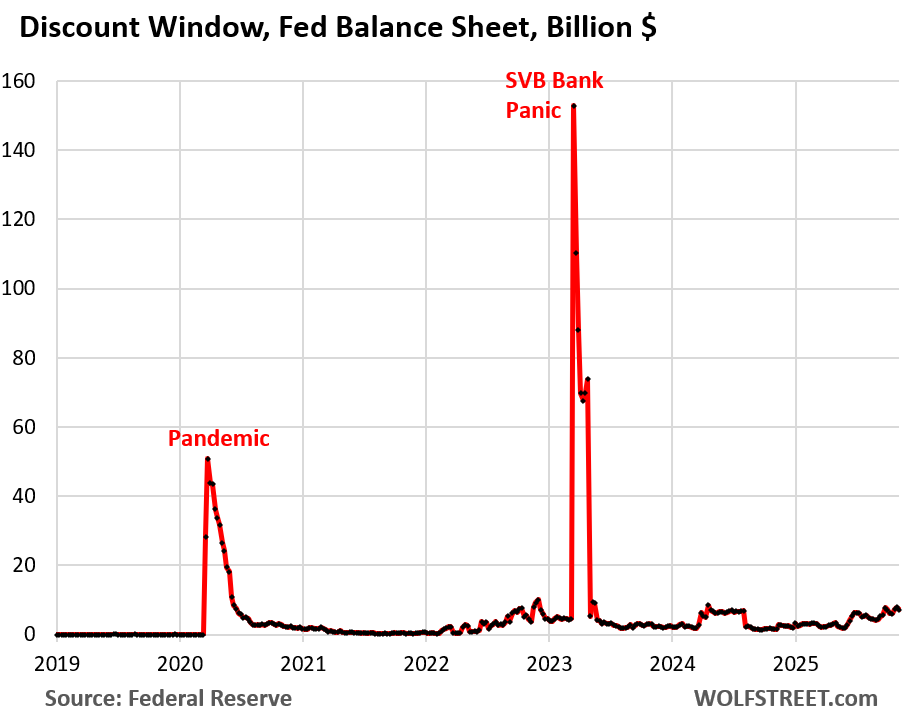
Core Insights - The turmoil in the month-end repo market has settled down, aided by the actions of the Standing Repo Facility (SRF) [1][15] - The Federal Reserve's quantitative tightening (QT) is set to end on December 1, with a total balance sheet decline of $14 billion in October, bringing the total to $6.57 trillion [3][28] - The Fed's QT has resulted in a reduction of $2.39 trillion, or 26.7%, from its peak in April 2022 [3] QT Assets - Mortgage-Backed Securities (MBS) decreased by $16 billion in October, totaling $2.07 trillion, a decline of $670 billion or 24% from its peak [5] - Treasury securities saw a reduction of $4 billion in September, totaling $4.19 trillion, down $1.59 trillion or 27.4% from the peak in June 2022 [10] Repo Market Dynamics - The SRF balance spiked to $50 billion during the repo market turmoil, but returned to zero as market rates fell below the SRF rate [14][15] - Banks utilized the SRF to manage liquidity pressures, borrowing and lending in the repo market to profit from the spread [12][13] Other Assets and Accounting Entries - "Other assets" rose by $8 billion due to accrued interest, reflecting a consistent quarterly fluctuation over the past five years [2][22] - Unamortized premiums decreased by $2 billion to $228 billion, representing the Fed's accounting for bond premiums [21] Balance Sheet and Economic Context - The Fed-assets-to-GDP ratio dropped to 21.6% in October, indicating a return to levels seen in Q3 2013 [28] - The Treasury General Account (TGA) at the Fed currently holds $943 billion, contributing to the permanent increase in the Fed's balance sheet size since the Financial Crisis [27]
Bank of England Diverges From Fed With Rate Hold
Yahoo Finance· 2025-11-06 13:23
Core Points - The Bank of England has maintained its key interest rate at 4%, breaking a pattern of quarterly rate cuts that began in August 2024 [2][3] - Inflation in the U.K. has increased to an annual rate of 3.8% for three consecutive months through September, up from 2.6% in March, primarily driven by government policy rather than consumer demand [5][6] - The decision to keep rates unchanged was made after a tight vote within the Monetary Policy Committee, reflecting differing views on inflation and the cooling jobs market [4][6] Economic Context - Other European central banks have also kept their key rates unchanged, but the Bank of England indicated that further cuts are likely in the coming months if inflation trends towards the 2% target [3] - The recent rise in inflation in the U.K. mirrors trends seen in the U.S., where inflation has also increased due to factors like higher tariffs [5][6] - The cooling jobs market in the U.K. suggests that inflation may ease by 2026, despite the current acceleration in prices [5]
X @The Wall Street Journal
The Wall Street Journal· 2025-11-03 20:48
Federal Reserve governor Lisa Cook said she supported last week’s decision to cut interest rates because she thought weaker-than-expected job-market conditions remained a greater risk than persistent inflation https://t.co/mAOnqtvehh ...
Fed president explains vote against interest rate cut
Fox Business· 2025-11-03 14:42
The Federal Reserve cut interest rates for the second time in 2025 last week, though one member of the central bank's monetary policy committee voted against cutting rates, citing concerns over inflation. Policymakers on the Federal Open Market Committee (FOMC), which guides the Fed's monetary policy, voted 10-2 in favor of lowering the benchmark federal funds rate by 25 basis points to a target range of 3.75% to 4%. One dissenter, Fed Governor Stephen Miran, called for a larger 50-basis-point cut.The other ...