
Reserve Bank of India

Search documents
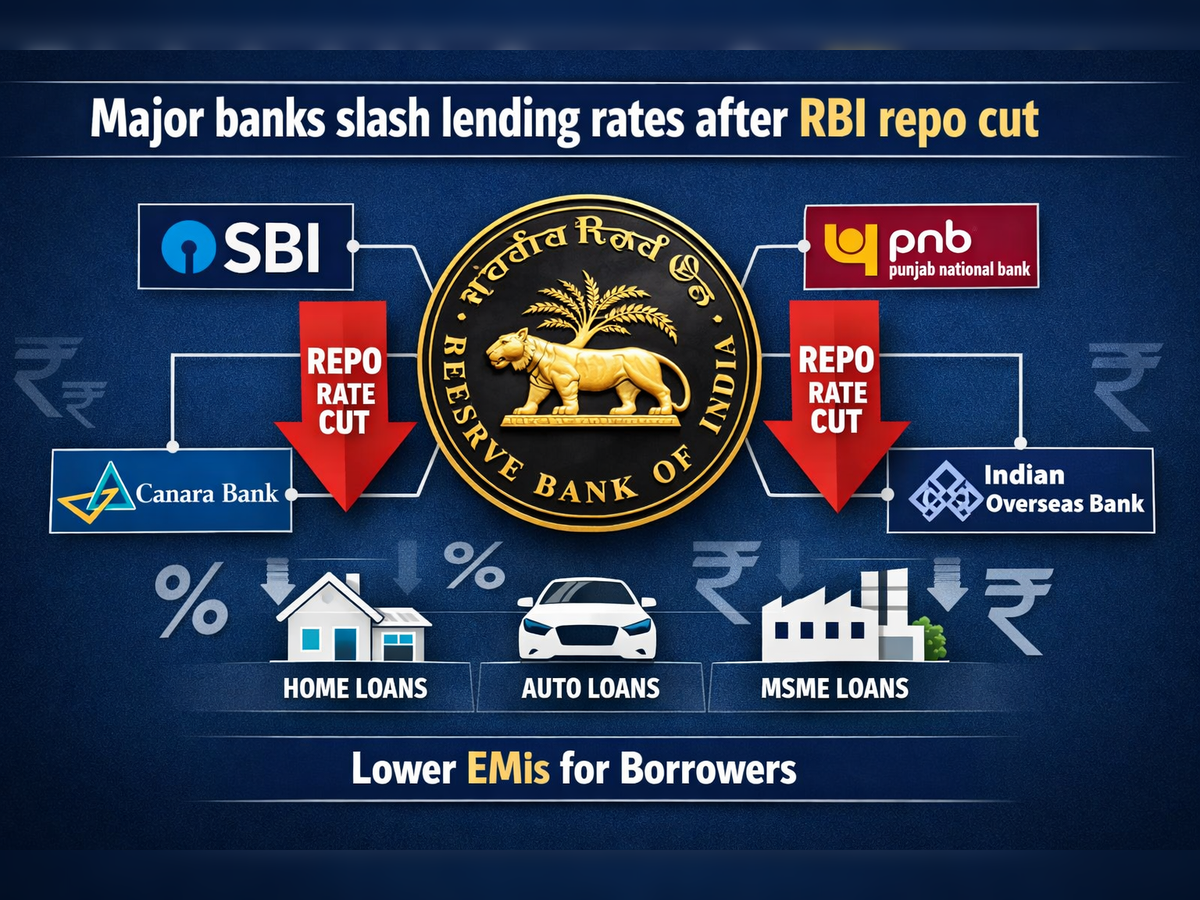
Major banks cut lending rates: After RBI trims repo rate, SBI, PNB, Canara Bank, and IOB lower borrowing costs
The Economic Times· 2025-12-17 11:58
Core Viewpoint - Several major banks in India have reduced their Repo Linked Lending Rates (RLLR) following a 25 basis point cut in the RBI's repo rate, leading to potential lower EMIs for borrowers [1][6]. Group 1: Canara Bank - Canara Bank has cut its RLLR by 25 basis points from 8.25% to 8%, effective December 12, 2025 [1]. - Existing borrowers will see a reduction in their EMIs or loan tenure based on their loan agreements [1]. Group 2: Punjab National Bank - Punjab National Bank has reduced its RLLR from 8.35% to 8.10%, effective December 6, 2025, including a bank spread of 10 basis points [1]. Group 3: Indian Overseas Bank - Indian Overseas Bank has revised its RLLR to 8.10%, effective December 15, 2025, with a one-year MCLR at 8.80% and a three-year MCLR at 8.85% [2]. Group 4: State Bank of India - State Bank of India has reduced its EBLR from 8.15% plus Credit Risk Premium (CRP) to 7.90% plus CRP, and its RLLR from 7.75% plus CRP to 7.50% plus CRP, effective December 15, 2025 [3]. - The final interest rate will depend on individual risk profiles and applicable spreads, but the cuts are expected to lower EMIs for eligible customers [3]. Group 5: Bank of Baroda - Bank of Baroda's effective BRLLR will decrease from 8.15% to 7.90%, effective December 6, 2025, providing slight relief to borrowers [4]. Group 6: Indian Bank - Indian Bank has reduced its RLLR from 8.20% to 7.95%, effective December 6, 2025 [5]. Group 7: Bank of India - Bank of India has cut its Repo Based Lending Rate (RBLR) from 8.35% to 8.10%, effective December 5, 2025, in response to the RBI's repo rate cut [6]. Group 8: Bank of Maharashtra - Bank of Maharashtra has reduced its home loan rates from 7.35% to 7.10% and car loan rates from 7.70% to 7.45%, waiving all processing fees on these loans [6].

X @Bloomberg
Bloomberg· 2025-12-17 03:02
China’s export of excess domestic capacity is adding to the disinflationary impulse in India, and may be helping RBI keep rates lower for longer. Read for free with your email on what could move markets today https://t.co/OBpKBeZM34 ...
RBI unlikely to play Santa again in February
The Economic Times· 2025-12-15 19:17
picked up to 0.71% YoY in November from 0.25% in October, driven by persistent food price deflation and weak core inflation. Most economists said headline inflation appears to have bottomed out in October on account of lower food prices and one-time GST cut adjustment and expect it to inch up but will be below RBI’s 4% medium-term target. RBI has cut the repo rate by 125 bps since the easing cycle began in February stating that it is to support growth as inflation remained benign.WHY A PAUSE NOW? , on the ...

India's inflation rises to 0.71% in November as decline in food, fuel prices loses steam
CNBC· 2025-12-12 10:48
Inflation Trends - India's consumer inflation rose to 0.71% in November, up from an all-time low of 0.25% in the previous month, aligning with estimates of a 0.70% increase in the consumer price index [1][2] - The increase in inflation was attributed to higher prices for vegetables, eggs, meat, fish, spices, and fuel, with fuel and light prices rising 2.32% in November compared to 1.98% in October [2] Monetary Policy - The Reserve Bank of India cut its policy rates by 25 basis points, aiming to support economic growth amid a low inflation environment [3] - The central bank projects consumer inflation at 2% for the fiscal year ending March 2026, a decrease from the previous forecast of 2.6% [3] - The RBI's monetary policy meeting indicated a continued focus on supporting growth, with Governor Sanjay Malhotra emphasizing a proactive approach to meet the economy's productive requirements [4] Economic Outlook - HSBC Research suggested that weaker growth, prolonged low inflation, and tight fiscal policy may necessitate supportive monetary policy in 2026 [5] - Exports to the U.S., which constitute about 2% of India's GDP, have seen a decline, with a significant drop of 8.5% in October, leading to concerns about job losses in labor-intensive sectors [6][7] - The Indian rupee has been trading at record lows against the dollar, falling below the 90-rupee-per-dollar mark, amid declining exports and lack of trade agreements with the U.S. [7]

Major banks pause digital onboarding as mule account scams surge: Report
The Economic Times· 2025-12-12 09:44
Core Viewpoint - Banks are reverting to physical verification processes for account openings to combat identity theft and mule accounts, marking a significant shift from their previous digital-first strategies [1][2][14]. Group 1: Industry Trends - Many banks are now requiring physical inspections and branch or home visits by relationship managers for clients wishing to open accounts online [1][14]. - This shift represents a U-turn for banks that had been digitizing services and streamlining procedures [2][14]. - The Reserve Bank of India (RBI) has imposed fines on banks for not adhering to strict KYC protocols, prompting tighter onboarding processes [9][12]. Group 2: Company Responses - ICICI Bank has halted its insta-account opening service, now only allowing salary accounts to be created digitally, while other accounts require an assisted process [3][15]. - HDFC Bank continues to onboard customers digitally but is investing in enhancing the security and robustness of its digital onboarding process [4][7][15]. - Banks are now instructed to open accounts only for customers within their locality, with provisions for those outside a specified radius [6][15]. Group 3: Fraud Prevention Measures - The increase in mule accounts has led to a tightening of online account onboarding services, with banks facing challenges in fully digitizing the process due to fraud risks [9][12][14]. - Instances of digital accounts being blocked due to high-volume transactions have been reported, necessitating customers to visit branches for resolution [10][11][15]. - Banks are increasingly requesting income documents from customers to verify they are not involved in fraudulent activities [11][15].




X @Bloomberg
Bloomberg· 2025-12-09 07:32
India’s longer interest-rate swaps have jumped since the central bank’s policy meeting last week https://t.co/Q7MhmM3ajZ ...
RBI may need to inject further '2 lakh crore to let rates transmit
The Economic Times· 2025-12-07 18:52
Core Viewpoint - The Reserve Bank of India (RBI) has announced liquidity measures amounting to ₹1.45 lakh crore, but this may not be sufficient due to concurrent advance tax payments estimated at ₹2-2.5 lakh crore, which could drain funds from the banking system [1][9]. Liquidity Measures - Economists and treasury officials suggest that the RBI may need to provide an additional ₹1.5-2 lakh crore of durable liquidity to ensure effective transmission of recent rate cuts, assuming no further foreign exchange intervention [9]. - The average system liquidity was reported at ₹1.68 lakh crore in November and ₹2.63 lakh crore in December so far, with liquidity being about 0.8% of Net Demand and Time Liabilities (NDTL) in November [9]. Deposit and Lending Rates - Fresh deposit rates have decreased by 92 basis points to 5.57% since February, while outstanding deposit rates have only fallen by 24 basis points to 6.78% [6]. - On the lending side, fresh loan rates have dropped by 76 basis points to 8.64%, whereas outstanding lending rates have increased by 56 basis points to 9.24% [6]. Market Reactions - Treasury heads from various banks are monitoring market reactions before making decisions on lowering deposit rates, indicating that the impact of liquidity on deposit rates will depend on market conditions in the last quarter of the year [5][9].
X @Bloomberg
Bloomberg· 2025-12-05 04:58
The Reserve Bank of India will buy bonds worth $11 billion this month to inject liquidity into the banking system https://t.co/8x2GOcxeL4 ...
Heartburn at lenders as loan rates fall but deposit rates don't
MINT· 2025-12-03 00:15
Core Viewpoint - State-owned banks in India are expressing concerns to the Reserve Bank of India (RBI) regarding the ineffective transmission of rate cuts to deposits, leading to a strain on their balance sheets as lending rates decrease more rapidly than deposit rates [1][4]. Group 1: Rate Transmission Issues - State-owned bank chiefs highlighted that external benchmark-linked loans allow for immediate repricing of assets with repo rate changes, while existing deposits are repriced at a slower pace [2][5]. - The disparity in repricing has resulted in a compression of net interest margins, with banks passing on 100 basis points of cuts on the asset side but only managing to reduce deposit rates by 30 basis points, creating a 70-basis point spread compression [4][8]. - Approximately 63% of floating-rate loans are linked to external benchmarks, while existing deposits only adjust when older, higher-cost deposits mature [5][7]. Group 2: Deposit Growth Challenges - Public sector banks have a higher proportion of floating loans linked to the marginal cost of funds-based lending rate (MCLR), while private sector banks have nearly 88% of their floating loans tied to external benchmarks, affecting their sensitivity to policy changes [6]. - Competition for household savings has intensified, with mutual funds now accounting for over one-third of bank deposits, compared to just 12.6% a decade ago, leading to a decline in deposit growth [8]. Group 3: Regulatory and Liquidity Factors - Regulatory factors, such as high runoff assumptions under the liquidity coverage ratio (LCR) framework, are exacerbating the issue by increasing liquidity buffers and funding costs [9][10]. - Economists suggest that RBI could enhance transmission by infusing liquidity into the banking system, which was in surplus of ₹2.58 trillion as of December 1 [11][12]. Group 4: Recommendations for Improvement - To improve deposit growth and transmission, a reduction in small savings interest rates is recommended, as these rates currently exceed bank term deposit rates [14][15]. - Suggestions include exploring floating-rate deposits and market-linked retail liabilities that could adjust in line with benchmark rates, facilitating faster transmission [16].

X @Bloomberg
Bloomberg· 2025-12-01 07:25
The Indian rupee hit a fresh all-time low against the dollar, as traders said the Reserve Bank of India had stepped away from defending the currency https://t.co/8UCPvps480 ...